What is Ticket Deflection? Your Guide to One of CX's Most Important Metrics
Ask any support leader what ticket deflection actually is, and the answer sounds simple at first. Answer the customer's question before they ever open a ticket.
The support leaders running it day to day know it gets messy fast. A high deflection number can hide unresolved issues, frustrated customers, and quiet churn.
A low number can mask great customer service that works behind the scenes. The metric is only useful when you measure it honestly and pair it with a few others.
This guide covers what ticket deflection actually means, how to calculate it, where teams go wrong, and how to improve it without hurting CX.
It is built for support leaders who care more about resolved issues than redirected ones.
What is Ticket Deflection?
Ticket deflection is the practice of resolving a customer's issue before it ever enters the support queue.
Self-service articles, in-product help, AI assistants, and proactive outreach catch the question first, so the customer gets an answer faster than a human ticket would arrive.
The goal is faster resolution, not avoidance.
That distinction matters. The whole point of deflection is to meet customers at the moment of friction with a real answer, faster than a human ticket would arrive.
Boil the ticket deflection meaning down to one sentence and it sticks: deflection resolves the issue without a ticket, and it does it faster than a person could.
The term started in IT service management, where help desks tracked how many issues never reached an engineer. CX teams adopted it as customer support volumes grew.
The modern version stretches across knowledge base articles that solve billing questions, in-product hints, and agentic AI assistants that resolve a refund inside Zendesk without a human ever touching the ticket.
One thing has not changed. A deflected ticket is still not the same as a resolved issue. We will come back to that several times.
How Ticket Deflection Works in a Modern Support Stack
Two quick ticket deflection examples make the pattern obvious. Picture a customer who hits a snag inside a SaaS dashboard. They cannot find a setting.
They click the help icon. An in-product hint surfaces a two-line walkthrough. They follow it, the setting is found, and they never open a ticket. That is one deflection.
Or picture a shopper who needs to update a delivery address. The order page suggests a self-service flow. They use it, save the change, and move on.
Same pattern, different industry.
Most modern teams stack four primary deflection layers:
- Knowledge base or help center articles that surface in search and on contact forms.
- In-product help, like contextual tips, tooltips, and embedded guides.
- AI chat or agentic AI assistants that pull from documentation, past tickets, and internal systems.
- Proactive outreach, including status pages, banner alerts, and account-aware nudges before a known issue.
Operationally, deflection lives inside a help desk like Zendesk, Intercom, Jira Service Management, or Freshdesk. The platform matters less than the logic.
A team running deflection well in Zendesk can run it well in Intercom. The deciding factor is how the deflection paths are configured, where the answers are sourced, and how each interaction is measured.
How to Calculate Ticket Deflection
The deflection rate formula, sometimes called the ticket deflection ratio, is straightforward.
Ticket Deflection Rate = (Deflected Interactions / Total Interactions) x 100
Run a clean example. A SaaS team logs 10,000 help center sessions in a month. Of those, 3,200 ended without a ticket and without a re-visit within 48 hours. Deflection rate equals 32%. Round numbers, easy to repeat in a leadership meeting.
The harder part is defining "deflected." Some teams count any help center visit that does not produce a ticket. Others count only interactions where the user clicked through an article or completed a self-service flow.
The number changes a lot depending on which definition you pick. Gartner's customer service research has flagged this attribution challenge for years. Teams routinely confuse "started a self-service path" with "resolved the issue through self-service."
The fix is documentation. Before you run the number, write down what counts and what does not. Get the operations team and the analytics team to sign off on the same definition.
A 32% deflection rate built on a clear definition is more useful than a 70% rate built on a fuzzy one.
Why Ticket Deflection Matters for Modern Support Teams
Cost is the most visible reason. Industry estimates put the average cost per support ticket between $6 and $12, with escalated tickets running significantly higher. Current help desk statistics reinforce these benchmarks across industries and company sizes.
Take a team handling 10,000 tickets a month at $9 per ticket. A 20-point lift in deflection saves roughly $216,000 a year.
Real money, especially for a support function that has historically been treated as a cost center.
Scale is the second reason. Ticket volume grows with users, but headcount cannot grow at the same rate without breaking the budget.
Repetitive low-complexity tickets are the fastest path to agent burnout, and burned-out agents handle the complex tickets worse.
Deflecting the easy stuff frees capacity for the work that genuinely needs a human and makes it possible to improve customer response time on the tickets that remain in queue.
Customer preference is the third reason, and the one most teams underweight. According to HubSpot's research on customer service, customers consistently say they prefer fast self-service for simple problems over waiting for an agent.
Password resets, status checks, basic how-to questions. Nobody wants to sit on hold for that. Customer service deflection done well aligns with what customers already want. Sorting which of those tickets can close in text and which still need a call is where chat vs. voice customer service stops being theory and becomes a routing decision.
The Deflection Trap: When High Numbers Hide Real Problems
This is where most articles on ticket deflection stop. They should not.
A team chasing the deflection number itself, without checking whether customers actually got their issue resolved, is heading for trouble.
That same Gartner research showed the gap between self-service attempts and self-service resolutions is wider than most leaders assume. A click on the help center is not a fix. A closed chat is not a fix.
The AI confidence problem makes it worse. Modern chatbots answer with conviction, even when they are wrong.
The customer takes the bad answer at face value, never opens a ticket, and the dashboard records a "successful deflection."
The cost surfaces later as a churned account, a public complaint, or a re-opened ticket two weeks down the line. None of which show up in the deflection rate. Published customer experience statistics consistently link these hidden failures to measurable drops in retention and lifetime value.
There is also the give-up problem. A customer closes the chat, gives up, and downgrades the plan. Their attempt is logged as a deflection. The dashboard looks healthy. The CFO sees a quiet revenue dip a quarter later and nobody connects the dots.
Without a re-contact check, a CSAT pulse on deflected interactions, or a downstream behavioral signal, you cannot tell a happy deflection from a silent loss. The number alone does not tell you which is which.
Ticket Deflection vs. Resolution: Why You Need Both Numbers
Deflection measures efficiency. Resolution measures effectiveness. Both have to live in the same dashboard.
Run the comparison on real numbers. Say 100 customer issues never reach an agent. That is 100 deflected tickets.
Now check what happened next. 72 of those customers got their problem solved and went on with their day. 28 either re-contacted within 48 hours, churned, or quietly stopped using the product. The honest success rate is 72%, not 100%.
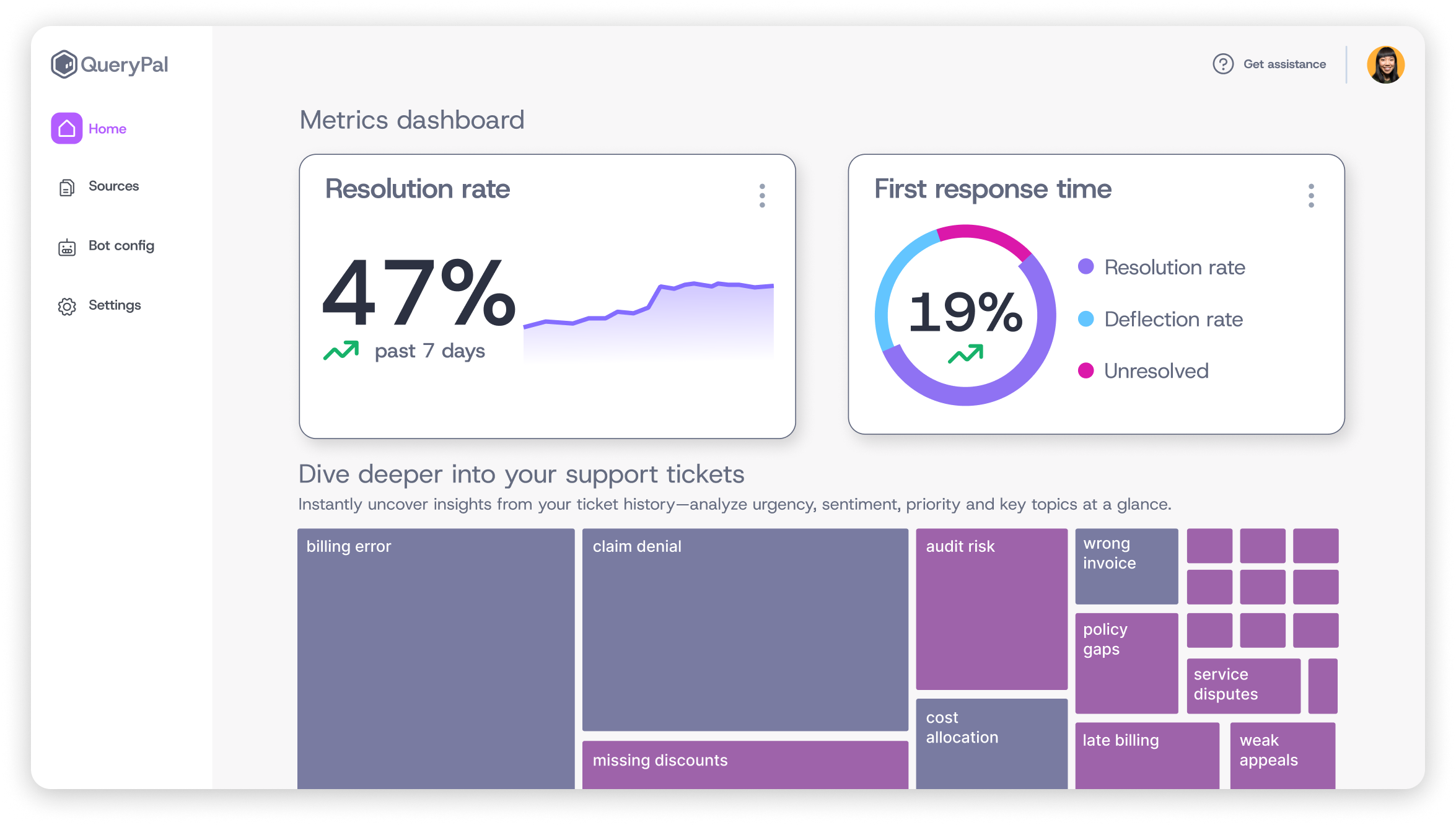
Track them side by side. Deflection rate to know how much volume stayed out of the queue. Resolution rate to know how much of that volume actually got fixed.
The story the two numbers tell together is more useful than either one alone, and understanding how self-service and case deflection differ as concepts sharpens which number you should be optimizing for in the first place.
For a deeper breakdown of how to define and measure deflection rate cleanly, see our guide on what deflection rate really means.
How to Improve Your Ticket Deflection Rate Without Hurting CX
A real ticket deflection strategy lifts the rate without hurting CX, and the fastest way there is to focus on the four layers that already produce most of it. Each one improves both numbers when you do it right.
Build a Knowledge Base Customers Will Actually Use
- Self-service deflection lives or dies on the help center. Audit the top 20 ticket categories in the help desk. For each, ask three questions:
- Does an article exist?
- Does the article actually solve the problem?
- Can a customer find it from the search query they would actually type?
Write articles in the customer's language, not internal product jargon. Match the words customers use in tickets and search bars. Format every article for scanning.
Short paragraphs, screenshots, clear next steps, and a final line that says what to do if the article did not solve it.
Set a monthly review cadence on the top 10 articles. Stale documentation is one of the most common reasons "self-service" deflection fails on the resolution side, even when the deflection rate looks fine.
Use AI That Resolves, Not Just Redirects
AI ticket deflection splits into two camps. There is a real gap between redirect-style chatbots and agentic AI assistants.
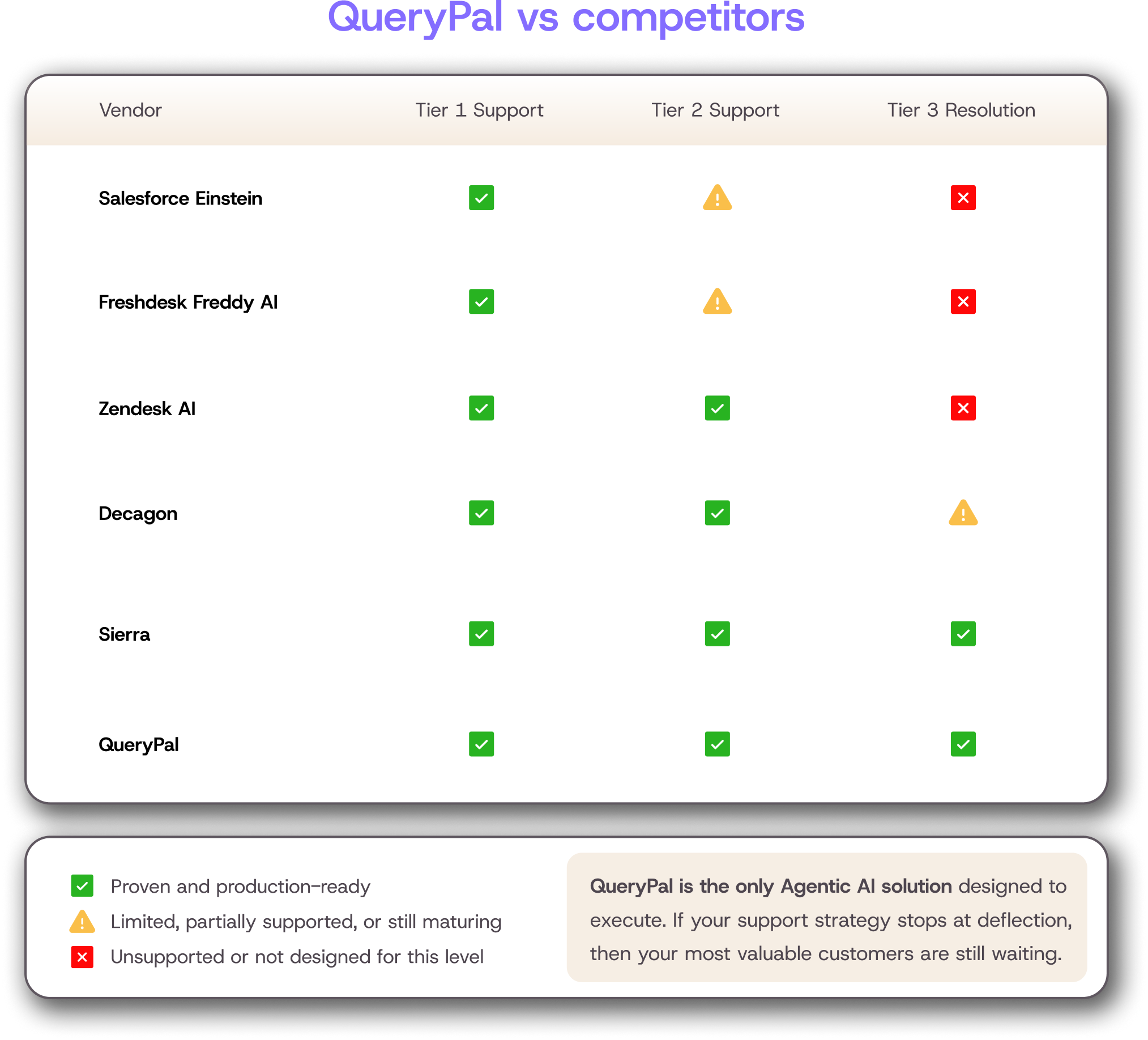
A redirect bot suggests articles or routes a ticket to a queue.
An agentic assistant pulls from documentation, past tickets, and internal systems to answer the question directly inside the support thread. The customer gets a real answer, not a link to one. That is helpdesk automation aimed at resolution instead of redirection.
QueryPal Intercept was built for that gap. It runs inside Zendesk, Jira, and Slack and resolves issues before they become tickets, drawing on the same systems your agents already use.
Internal data shows 90% approval ratings on responses and 70% faster time to resolution compared to traditional ticket handling.
Those numbers matter because of what they measure. Resolution, not a redirect that gets logged the same way.
If your team is already exploring zendesk ticket deflection or running similar workflows in Jira and Slack, that is exactly where this kind of assistant should sit.
When you evaluate any AI tool for deflection, ask one question. Does it measure resolution, or does it only measure redirection?
The honest answer separates AI that cuts cost without hurting CX from AI that quietly hides churn risk inside a vanity metric.
Deflect Earlier With Proactive Communication
Some of the cleanest deflection comes from the contact that never starts. Outage banners, account-aware status messages, in-product warnings before a known failure path, scheduled emails ahead of a billing change.
A customer who never had a problem in the first place is the highest-quality deflection on the dashboard.
Use ticket data to find the moments where proactive communication would have prevented the contact.
Most teams find at least three high-volume preventable categories within an afternoon of analysis. Pull the top contact reasons by week.
Look for spikes that line up with predictable events. Build a comms layer in front of those events.
This layer also tends to lift CSAT, since customers feel informed instead of stuck. That is the rare case where deflection and customer experience improve together with no tradeoff.
Match Automation to the Right Ticket Categories
Automated ticket deflection only earns its keep when you start with the right categories. Score the top 10 ticket categories on four dimensions. Volume, complexity, context required, and risk if the AI gets it wrong.
High-volume, low-complexity, low-risk categories are the right starting point. Password resets, order status, plan changes, basic configuration questions.
These categories produce a clean ROI without putting customer trust on the line.
Always measure resolution alongside deflection when you automate a new category.
If deflection rises but 48-hour re-contact spikes, the automation is creating new problems faster than it solves old ones. Pull it back, retrain it, and try again.
Resist the urge to automate sensitive categories first. Refunds, account access disputes, and billing escalations belong with humans for now.
Saving 30 seconds on a refund denial is not worth the brand damage of getting it wrong at scale.
Companion Metrics That Keep Ticket Deflection Honest
A single number cannot tell you if support is healthy on its own, and no deflection rate benchmark applies cleanly to every business. Pair deflection with these companion metrics, every time.
- CSAT on the deflection path. If the deflection rate is climbing and CSAT is dropping, the deflection is not working, no matter what the dashboard says.
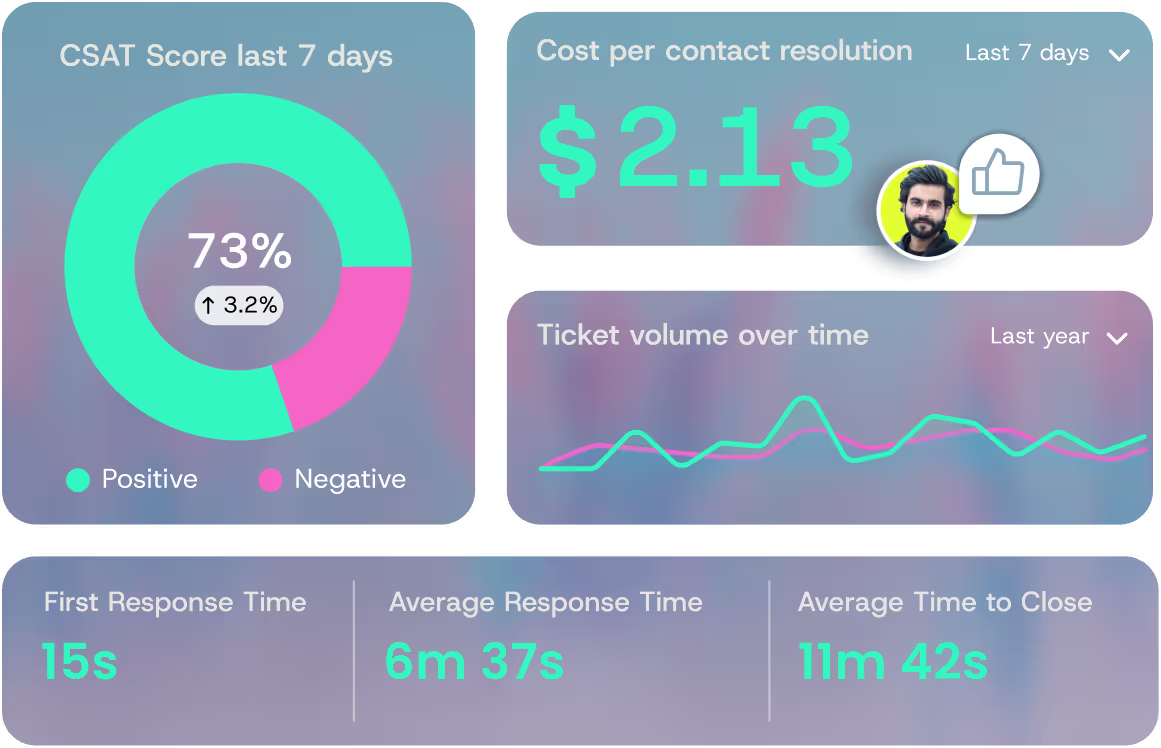
- First Response Time on tickets that did escalate. When the easy tickets get deflected, the remaining queue should get faster, not slower.
- Resolution Rate. The percentage of deflected interactions where the customer's issue was actually solved, not just rerouted. Some teams pair this with a self-service rate to track how much of the volume actually came through unassisted channels.
- 48-Hour Re-Contact Rate. The cleanest test for hidden deflection failures. A customer who re-contacts within two days was not really deflected.
- Cost Per Resolution. Cost Per Ticket only counts the tickets you handled. Cost Per Resolution counts every interaction, including the ones the AI handled, and tells you what each solved problem actually cost.
Each of these catches a warning sign that deflection alone misses. Together, they keep the headline number honest.
Making Ticket Deflection Work for Your Team
Once you understand what ticket deflection really is, the goal becomes obvious: more issues resolved with less friction for both the customer and the agent.
The deflection number is one signal of whether you are actually getting there. Define what counts as a deflection before you measure it.
Pair the number with the companion metrics that catch hidden failures. Choose tools that prove resolution, not just redirection.
If you lead a support team, you are probably looking at deflection through one of two lenses, either cost pressure or scaling pain. Either way, the path is the same.
Measure honestly, automate where the data says it is safe, and keep humans in the loop for the work that needs them. QueryPal Intercept was built for that exact playbook.
It sits inside the help desk your team already uses, Zendesk, Jira, or Slack, and resolves issues in-thread instead of routing customers somewhere else.
Support leaders use it to bring cost-per-resolution down without losing resolution rate or CSAT, with SOC 2 and GDPR compliance built in for the IT review. See QueryPal in action at querypal.com.

Activate your free
6 week trial
& white-glove integration support.
Cut support costs by 60%, slash response & resolution times, improve your customer experiences, & reduce agent burnout. Find some time with us to show you how.