Self-Service vs Case Deflection: What's the Difference?
Support teams use self-service and case deflection like they mean the same thing. They don't. Self-service is the customer choosing to help themselves.
Case deflection is the support team steering a customer toward self-help before a ticket gets created. The first is an activity. The second is a metric layered on top of it.
That distinction matters more in 2026 than it ever has. The old measurement of success, where every deflected ticket counts as a win, is starting to break under the weight of agentic AI that can resolve issues end to end, not just redirect them.
Here's how each term works, how to measure both, and why deflection alone is the wrong goal in a world where resolution is finally on the table.
Self-Service vs Case Deflection in One Sentence
Self-service is when a customer solves their own issue using your help content, search, or in-product tools. Case deflection is when the support team prevents a ticket by surfacing that self-service path before the customer can submit a request.
Same activity, different lens. Self-service is customer-initiated. Deflection is provider-measured.
The rest of this article unpacks how to measure each one, where the metrics break down, and what most teams get wrong about both.
How Customer Self-Service Works
Self-service covers everything a customer can do without contacting a rep. Knowledge base articles. Community forums. In-product help widgets.
Automated ai chatbots. And increasingly, AI-driven help surfaces that can close an issue from start to finish.
The preference is overwhelming.
Research from Harvard Business Review found that 81% of customers try to solve their problem on their own before reaching out to a support rep. That number holds steady across age groups, which kills the assumption that self-service is a generational habit. When self-service works, customer response time drops to near zero because the answer arrives before a ticket is ever created.
People want fast answers. They will dig through a knowledge base, a chatbot, and a community thread before they tap "contact support."
Here's the thing about self-service, though. It exists whether or not your team is tracking anything. It's customer-initiated.
You can invest in the content. You can design the search experience. You can't force customers to use any of it. Your job is to make the self-service path so clear and so useful that customers naturally take it.
How Case Deflection Works
Case deflection is the share of would-be tickets you prevented because the customer found the answer first. It's a metric layered on top of self-service. Self-service is the activity. Deflection is the accounting.
The reason deflection became a board-level metric is cost. Gartner research on contact economics shows that a deflected ticket can cost a fraction of what an agent-assisted contact costs once you factor in labor, tooling, escalation, and the QA work that comes with complex tickets. At scale, that math turns into real money saved.
Customers don't care what you call it as long as their problem gets solved. The label is for the support org, not the person typing into your help center.
The Key Differences Between Self-Service and Case Deflection
Both concepts touch the same moment in the support interaction. They diverge on who is measuring and what success looks like.
Who initiates it
- Self-service: Customer
- Case deflection: Support team
What’s measured
- Self-service: Activity and engagement with help content
- Case deflection: Tickets avoided
What success looks like
- Self-service: Customer finds and uses an answer without contacting support
- Case deflection: Reduced contact volume and lower cost per resolution
Primary risk
- Self-service: Poor content or hard-to-find answers still drive customers to support
- Case deflection: Customers get redirected without actually solving the issue
Tool examples
- Self-service: Knowledge bases, community forums, chatbots, AI help surfaces
- Case deflection: In-form article suggestions, AI deflection layers, smart triage
Self-service is the capability. Deflection is the outcome you measure on top of it. The trap is assuming one always produces the other.
You can absolutely have self-service that delivers terrible deflection numbers when customers can't find or use what you've built.
You can also have deflection numbers that look great while customers are bailing out frustrated and never coming back.
Explicit vs Implicit Deflection
Most analysts split deflection into two categories. Mixing them on a dashboard without labels is one of the fastest ways to overstate impact at a quarterly review.
Explicit deflection is the cleaner number. A customer starts a ticket form, sees a real-time article suggestion, finds the answer, and closes the form.
That's a countable event. Zendesk's article suggestions during ticket creation are the textbook example, and most modern helpdesks ship something similar out of the box.
Implicit deflection is the messier number. A customer hits the knowledge base from a Google result, finds what they need, and never opens a ticket form.
You can infer it from search exits and a drop in topic-related contact volume. You can't count it directly. Implicit deflection numbers are estimates dressed up as data. Treat them that way.
How to Measure Self-Service and Case Deflection
Each side of the equation has its own metrics. Use them together, not interchangeably.
On the self-service side, a few metrics pull their weight.
- Self-service success rate, the share of self-service sessions where the customer found a working answer
- Self-service abandonment rate, the share of sessions where the customer gave up partway through
- Content findability, whether users can reach the right answer in two clicks or fewer
- Self-help CSAT, collected separately from agent-assisted CSAT
On the deflection side, three numbers matter most. Understanding how to define and calculate your deflection rate cleanly is the foundation for all three.
- Deflection rate overall
- Cost per ticket avoided
- Deflection rate by topic, so you know where self-service is carrying the load
Industry benchmarks suggest a healthy deflection rate often lands between 20% and 40% for most support organizations. Top performers reach 80% to 90% on simple use cases.
B2B SaaS teams tend to fall in the 15% to 30% range because the questions are more complex. Variance is wide and these numbers are directional, not gospel.
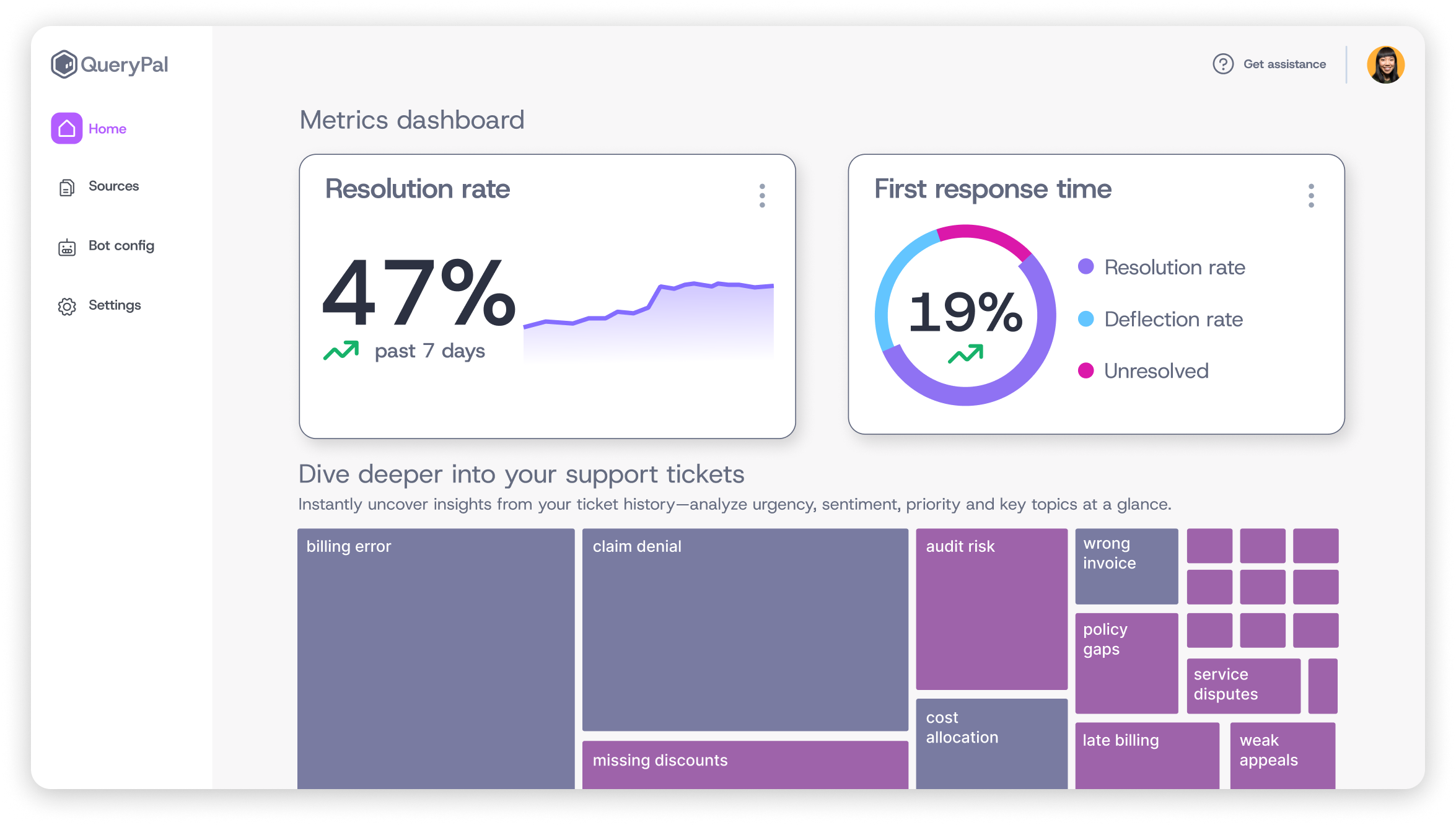
A re-contact rate over 10% to 15% within 48 hours is often a sign of false deflection, meaning the customer didn't get their issue resolved and circled back through a different channel.
High deflection plus low resolution means you're pushing customers into dead ends. Pair the numbers or you'll optimize for the wrong thing.
Why Deflection Alone Is the Wrong Goal in 2026
Here's where it gets uncomfortable for support orgs that have spent the last decade building deflection dashboards.
81% of customers try self-service first. Gartner research released in 2024 found that only about 14% of customer service issues are fully resolved in self-service, even when customers describe the issue as "very simple."
The rest of those people bounce out of the knowledge base, contact support anyway, or churn quietly. Deflection metrics often count the bounce as a win.
Deflection rate rewards throughput more than outcomes. A ticket that didn't get opened is not the same as a problem that got solved.
Pair deflection rate with resolution rate, re-contact rate, and CSAT and the picture gets honest fast.
Now layer on the technology shift.
The old deflection toolkit (search bars, decision trees, FAQ chatbots, knowledge base redirects) was built around the idea that the best ticket is the one that never gets opened. Agentic AI breaks that assumption.
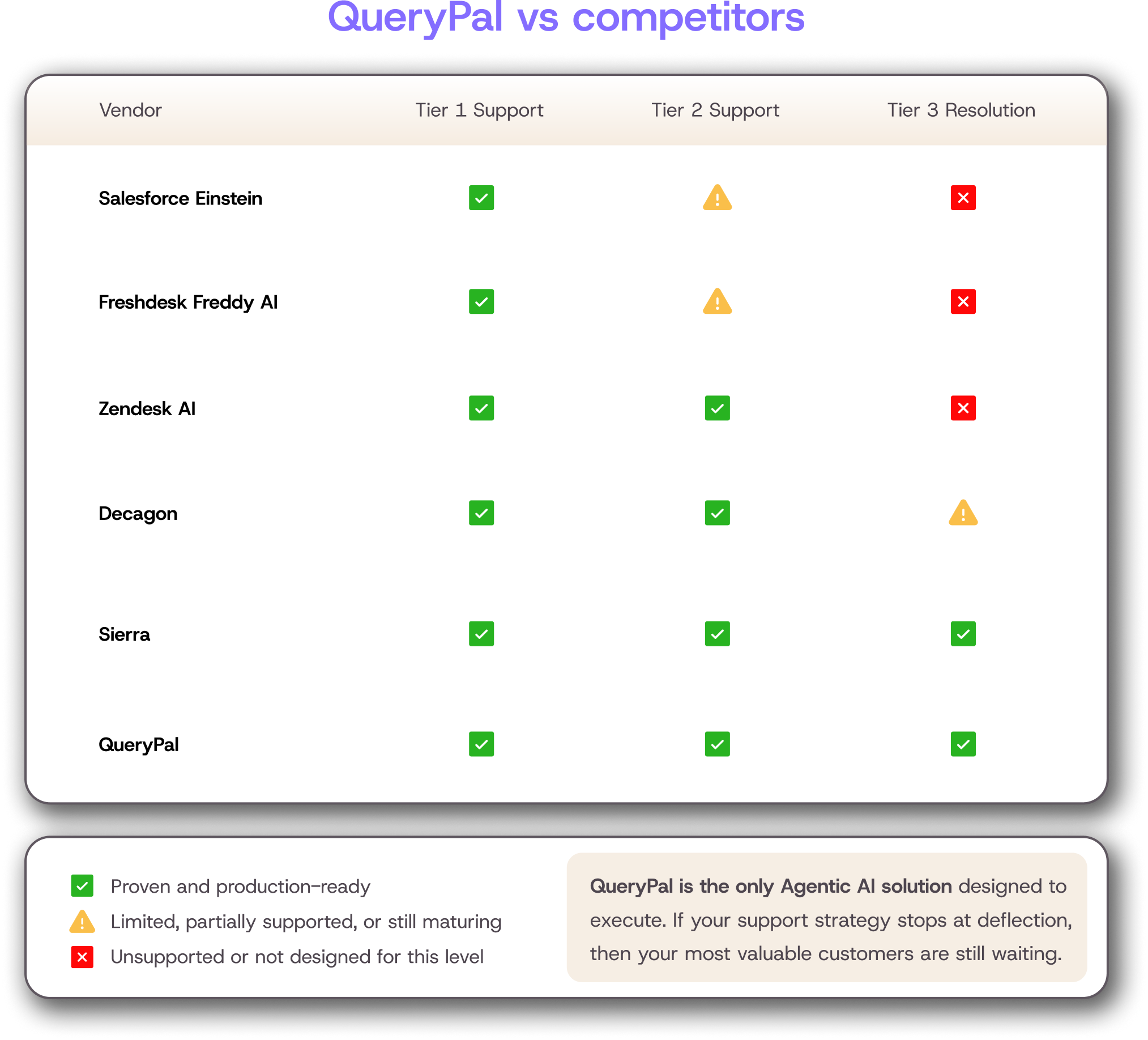
The right system can pull context from past tickets, walk a customer through multi-step troubleshooting, take action on the customer's account where permissions allow, and close out the issue on the first touch.
QueryPal was built on that distinction. The platform exists to resolve complex Tier 1 to Tier 3 issues, not redirect them.
Intelligent, autonomous AI that resolves complex issues instead of just deflecting them is the difference between a metric that protects your headcount and a metric that protects your customer.
How Self-Service and Case Deflection Work Together
Treating self-service and deflection as the same thing produces lazy strategy. Treating them as cooperating systems produces results.
Build the self-service foundation first. Audit your knowledge base against actual ticket data from the last quarter. Customers can't find what isn't there.
The fastest gains come from filling gaps in coverage, not from polishing articles that already perform.
Layer unified search and AI-powered answer surfacing on top so the right content reaches the right customer at the right moment. A knowledge base is a product, not a static archive.
Track which articles resolve issues and which get read but never resolve anything.
For enterprise teams, deployment matters as much as content.
QueryPal runs as a self-hosted platform with SOC 2 Type 2 and GDPR coverage, which keeps ticket data and customer context inside the customer's own environment.
That's the difference between bolting an AI vendor onto your stack and operating one that respects your security posture.
A short audit you can run on your own program.
- Is self-service content covering the top ticket drivers from last quarter?
- Are customers finding the right answer on the first search attempt?
- Are highest-deflection articles also highest-CSAT articles?
- What is the re-contact rate within 48 hours of a "deflected" session?
If any of those numbers are off, you have a self-service problem hiding inside a deflection number.
How AI Is Changing Self-Service and Case Deflection
The technology under "self-service" isn't the technology your team built five years ago. Static articles, keyword search, decision-tree chatbots, and FAQ widgets are the floor now, not the ceiling.
Agentic AI self-service uses semantic search, AI-generated answers grounded in real documentation and ticket history, and end-to-end resolution where the system completes tasks for the customer.
The metric of record shifts with it. Resolution rate captures whether the problem got solved. Deflection rate only captures whether the customer stopped trying.
QueryPal sits on the resolution side of that line. It's not a GPT wrapper. The platform is built by a team with 30-plus AI patents and a track record that includes Wavefront (acquired by VMware) and VMware's Project Magna.
It pulls context from existing documentation, past tickets, and active workflows to generate accurate, context-aware responses that move issues to closure on the first interaction, not into a deflection counter.
Move Beyond Deflection to Real Resolution
Self-service is the capability customers use to help themselves. Deflection is one outcome you can measure on top of that capability. Resolution is the metric that ties the picture together.
Track deflection rate alongside resolution rate, re-contact rate, and CSAT. The combination tells you whether your deflection numbers are real wins or hidden customer frustration.
If the picture isn't pretty, a better dashboard won't fix it. A system that closes the ticket on the first touch will.
QueryPal does that for support teams in technology, financial services, and healthcare, with outcomes measured in resolution rate, not deflection volume.
Book a walkthrough at querypal.com to see it run on your own ticket data.
References
Dixon, Matthew, et al. "Kick-Ass Customer Service." Harvard Business Review, Jan.-Feb. 2017, hbr.org/2017/01/kick-ass-customer-service.

Activate your free
6 week trial
& white-glove integration support.
Cut support costs by 60%, slash response & resolution times, improve your customer experiences, & reduce agent burnout. Find some time with us to show you how.