How to Deliver White-Glove Client Service at Scale in Wealth Management
Your clients demand the bespoke attention of a private concierge. Your board demands profitable growth and operational scale. These goals are not mutually exclusive. This creates a 360-degree view, enabling intuitive action on routine tasks.
Your relationship managers are then freed to focus on high-value, emotional engagement and complex financial planning. The hybrid model is the only viable path forward.
Keep reading to see how the mechanics of this model work in practice.
Can White-Glove Service Really Be Scaled Without Losing Personalization?
Yes. Premium, personalized attention can grow without losing the personal touch. The key is using a hybrid model, where people and smart technology work together. Organizations using AI customer service in financial services are already proving this model works at scale.
In this model, all customer information is kept in one place. This is called a 360-degree view. It helps relationship managers quickly understand each person's needs, goals, and history. Because of this, every conversation feels thoughtful and personal, catered to that individual client.
Simple tasks are handled by the Agentic User Interface. This includes scheduling, reminders, and updates.
Wealth managers then have more time to focus on what matters most: listening, planning, and building trust. This balance helps keep interactions warm and human, even as the business grows.
Here's How it Works:
- Hybrid Model: Agentic User Interface handles routine work, people handle important decisions
- 360-Degree View: All account details are easy to see and use
- Digital Empathy: Technology supports good timing and tone, while humans provide care and understanding
When this hybrid model is done right, premium attention does not lose quality as it grows. Instead, it becomes more consistent, personal, and meaningful.
Why is Traditional High-Touch Service Failing to Meet Modern White-Glove Service Demands?
Traditional high-touch approaches were built for a slower, more predictable world. They rely heavily on manual processes, personal availability, and one-to-one attention.
While this once defined premium offerings, it is now struggling to keep up with modern expectations, especially among high-net-worth individuals (HNWIs).
Today's customers expect real-time answers, digital access, and full transparency.
Unfortunately, manual models make this difficult to deliver at scale. Every new account adds more workload, more cost, and more pressure on relationship managers, without a matching increase in efficiency. Firms looking for proven strategies to reduce customer costs are increasingly turning to intelligent automation to break this cycle.
The result is an ever increasing gap between what clients expect and what wealth management organizations can realistically provide.
Key Pain Points Include:
- Rising costs: High-touch models require more staff as portfolios grow, pushing operating expenses higher
- Poor scalability: Manager time is finite, creating bottlenecks as organizations expand
- Delayed responsiveness: Manual workflows slow down updates, reporting, and communication
- Limited transparency: Disconnected platforms make it harder for people to see real-time progress or information
- Advisor burnout: Constant availability expectations reduce focus on strategic, high-value work
This strain is easy to see in the numbers. In 2022, smaller wealth managers with under $150B in assets under management saw cost-income ratios rise above 82%, signaling a model under pressure (1).
As tech-enabled competitors offer faster, clearer, and more flexible experiences, people are increasingly willing to switch. Without modernization, traditional high-touch approaches become not a strength, but a liability.
Building Emotional Intelligence into Every Touchpoint
The solution is not to remove the human touch. It is to enhance it with digital empathy. This concept means using technology to recognize and respond to the unique financial personality of each individual client.
It ensures every interaction, even automated ones, feels deeply personal and contextually relevant. For a deeper look at how this works across the industry, see our complete guide to AI in customer service.
Digital empathy starts with moving beyond basic demographics. You must define personas based on behavior, values, and goals. Think about the ESG-focused entrepreneur versus the legacy-focused inheritor. The hands-on trader versus the delegation-minded executive.
Technology can identify these personas from interaction patterns and portfolio activity. Once you understand the persona, you can tailor the experience.
For the hands-on individual, provide deep educational resources and model-building capabilities. For the delegator, focus on clear, concise performance summaries and proactive check-ins. This is a segment-of-one approach.
The platform must also communicate with empathy. This means using the right channel, tone, and timing. A market alert might be a push notification.
A complex estate planning question should trigger a secure video call invitation. The technology orchestrates this flow, ensuring the right level of human support appears exactly when needed, and Querypal can assist it.
What Are the Core Components of a Scalable Tech Stack?
Building this requires a deliberate architecture. You need infrastructure designed for integration and action, not just information. Think of it as building an intelligent central nervous system for your organization.
An Open Wealth Platform as the Foundation
Your core should be an open platform, not a monolithic solution. This platform acts as middleware, seamlessly connecting your existing best-of-breed tools: your CRM, your custodial information, your financial planning software. Its primary job is unification, creating that essential 360-degree view.
Smart Workflows for Frictionless Operations
On this unified layer, you build smart workflows. These are automated processes for high-friction, repetitive tasks.
- Account Onboarding: Automate document collection, identity verification, and funding.
- Prospecting: Use AI to analyze network information and trigger personalized outreach.
- Cashflow Forecasting: Automatically update forecasts with new transaction information.
- Portfolio Rebalancing: Execute model-driven trades and generate communications.
An Intelligence Layer for Proactive Engagement
This is the engine of digital empathy. It uses AI not just to report, but to recommend.
- It analyzes the unified information for patterns.
- It surfaces "next-best-action" insights.
- It can power personalized dashboards that show performance against personal goals, not just benchmarks.
Client Portals as a Service Channel
The portal is the customer's window into this intelligent infrastructure. It should be a premium experience. Choosing the right customer service ticketing software ensures that every request routed through the portal is tracked, prioritized, and resolved efficiently.
- It offers holistic net-worth views, pulling from all integrated accounts.
- It enables secure document sharing and e-signature.
- It facilitates direct, context-rich communication with the advisory team.
How Do Firms Transition to an End-to-End Platform Model?
Organizations don't move to an end-to-end platform overnight. The transition is a structured shift that simplifies operations while sharpening focus on what truly differentiates the business: relationships and advice. Below is a practical, step-by-step approach of many leading wealth organizations.
Begin by mapping all front-, middle-, and back-office functions. This helps identify which activities create real competitive value and which are purely operational. Middle-office processes, such as reporting, reconciliation, and compliance workflows, are often the most complex and least differentiating.
Non-core operational functions are candidates for outsourcing. By migrating these to third-party platforms, organizations reduce proprietary infrastructure that is costly to maintain and hard to scale.
Transitioning in stages lowers risk. Start with operational information and legacy processes, ensuring continuity while gradually retiring internal infrastructure.
As operational burden decreases, internal teams shift toward acquisition, management, and specialized advisory work. Talent is redeployed, not removed.
Moving to an end-to-end platform can deliver operating cost savings of up to 30% compared to traditional models (2). Leading organizations reinvest these savings into digital experiences, tools, and personalized engagement.
Done well, this transition replaces complexity with clarity, creating a leaner, more scalable organization built for modern wealth management demands.
Three Client Requests Your System Should Resolve Automatically
A true premium platform does more than answer questions. It takes action. Here are three common requests that could and should be fully resolved without human intervention.
1. "What is my total cash position across all accounts?"
This seems simple. But with assets held at multiple custodians, it often requires manual work.
- How it gets resolved: Your unified platform pulls real-time balances from every linked account. The person asks this question in the portal chat, powered by a solution like Querypal. The infrastructure reads the intent, queries the live core, and returns a precise, formatted total in seconds.
- The benefit: The individual gets an instant, accurate answer. Your team avoids a 15-minute hunt.
2. "I need to move $50,000 from my brokerage to my checking account."
This is a routine transaction, but it involves checks and approvals.
- How it gets resolved: The person makes a request via a secure message. The platform verifies available funds and identity. It then executes the transfer within your custodial infrastructure. It sends a confirmation with a tracking number.
- The benefit: The transaction completes in minutes, not hours. It demonstrates powerful, convenient support.
3. "Send me the performance report for my ESG portfolio from last quarter."
Generating custom reports is a major time sink. This can be an easy fix.
- How it gets resolved: An intelligent assistant like Querypal understands "ESG portfolio" and "last quarter." It accesses the performance information, formats it into the branded report template, and emails a PDF.
- The benefit: Your relationship manager saves an hour of work. The individual receives a professional document immediately.
Implementing the Shift: A Phased Platform Transition
Moving to this model is a strategic transition, not an overnight rip-and-replace. The goal is to migrate non-differentiating, commodity functions to a more efficient model, freeing your team to focus on what truly differentiates you: bespoke advice.
Map your entire lifecycle. Identify every touchpoint and the infrastructure behind it. Pinpoint the high-effort, low-value tasks that consume time, things like scheduling, entry, and report generation.
Calculate their true cost. Simultaneously, define what "premium attention" means for your organization. Is it speed? Depth of insight? Proactivity? Get specific. It's different for every organization, and that's what makes you stand out. This is where your personalization can come into play on the internal side of things.
Build a Unified Data Core Before Automating Anything
This is the most critical technical step. Begin integrating your key platforms. Start with your CRM and your core portfolio accounting solution. The objective is to establish a single, reliable profile.
This project may involve partnering with a specialist to build secure APIs and pipelines. Do not skip this step. Everything else depends on clean, unified information.
With a core in place, start automating. Choose one or two high-impact workflows. Account onboarding is a prime candidate.
Design a seamless digital process that guides the person, populates your infrastructure, and notifies the team. Measure the time saved and the improvement in satisfaction. Use this success to build momentum for the next automation project.
Now introduce AI-driven insights. Start with a next-best-action capability.
Activate Intelligence and Surface It to Clients
Feed it your unified information and let it suggest timely touches, planning opportunities, or portfolio adjustments.
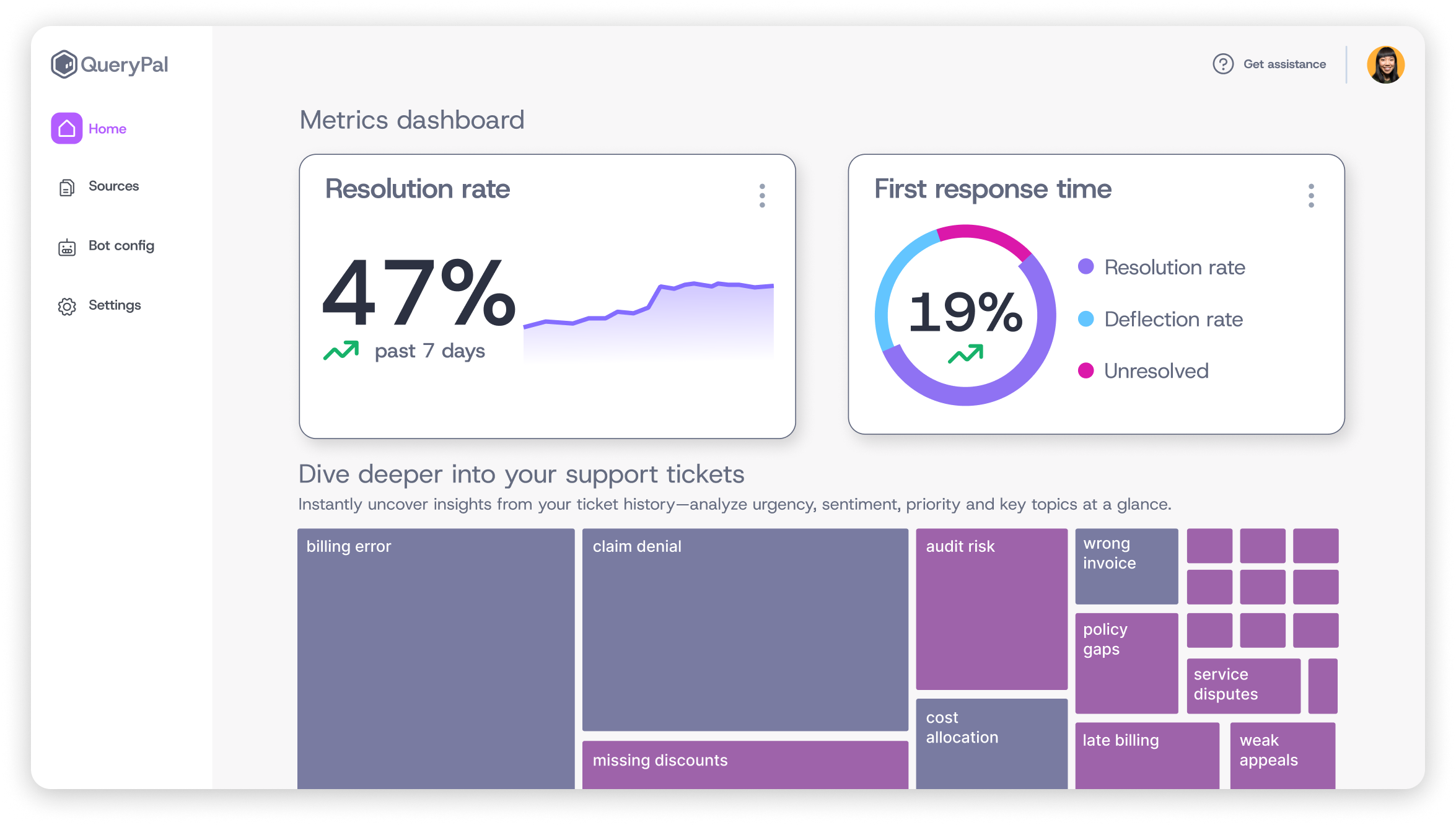
Then, expose a layer of this intelligence to customers through a modernized portal powered by tools like Querypal. Provide them with personalized dashboards and proactive alerts.
Technology change requires people to change. Train them to act on insights, not just compile information. Redefine roles.
Junior team members might manage the automated workflows and initial screening. Senior professionals focus on strategic planning. Continuously measure the new cost-income ratio and retention metrics.
Key Metrics to Start Tracking Your Scaling Success
You cannot manage what you do not measure. As you build your scalable model, watch these numbers closely. They will tell you if your strategy is working. For a comprehensive breakdown of which indicators matter most, explore these essential customer service metrics every team should track.
Efficiency Metrics
These show you are reducing cost and effort.
- Cost-Income Ratio (CIR): The primary financial health indicator.
- Average Resolution Time: The time to fully answer a question or complete a request. This should drop sharply.
- Advisor Capacity: The number of households or assets each professional can manage well. This number should rise.
Client Experience Metrics
These show you are improving engagement and loyalty.
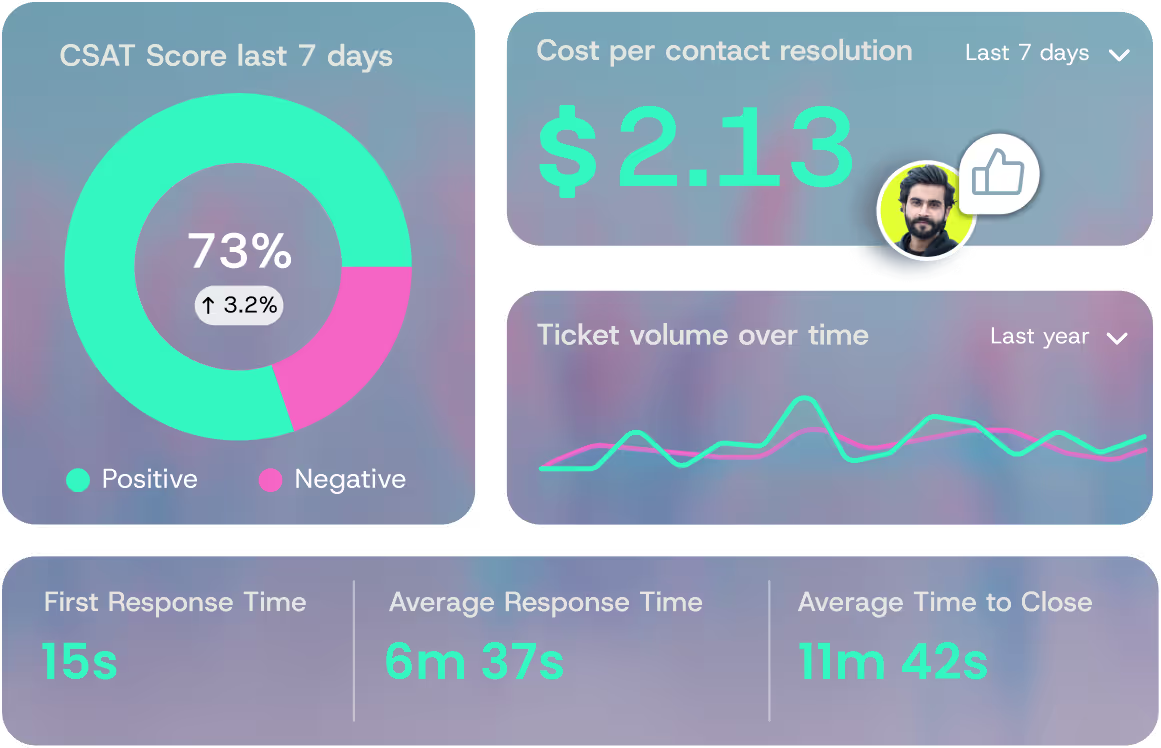
- Customer Satisfaction Score (CSAT): Measured after key interactions. It should increase.
- Net Promoter Score (NPS): Measures loyalty and referral likelihood. A high NPS is a competitive moat.
- Asset Retention Rate: The percentage of assets you keep year-over-year. This is the ultimate test.
Business Growth Metrics
These show you are becoming more competitive.
- New Asset Growth: The rate of net new money coming in. Efficient operations free up time for business development.
- Win Rate on New Prospects: Your success rate with ideal prospects. A streamlined onboarding process improves this.
- Employee Retention: Employee and staff turnover. A modern toolset makes jobs more rewarding.
What Is The Business Impact of Hyper-Personalization on Retention?
Hyper-personalization has a clear and lasting impact on retention in wealth management. By tailoring communication, advice, and digital experiences to each individual, organizations create relationships that feel personal rather than transactional. This relevance builds trust and strengthens loyalty, even as expectations continue to rise.
First, you regain control over profitability. Automating middle and back-office functions can reduce operating costs. This directly improves your cost-income ratio, moving you from the pressured 82%+ range toward the more sustainable benchmark of larger players. You scale attention without scaling headcount proportionally.
Second, you secure loyalty during the great wealth transfer. An estimated $83 trillion will pass to younger generations in the next 25 years (3). These heirs are digital natives. An organization that can deliver both high-tech efficiency and high-touch empathy will retain these assets. Hyper-personalization is your retention engine, directly addressing the churn risk.
Finally, you empower your team. Managers spend less time on administrative work and more time doing what they do best: building trust and providing sophisticated advice. This leads to higher job satisfaction, lower turnover, and a stronger culture. It also increases the number of accounts each professional can handle effectively, improving your ratio.
Key retention and ROI benefits include:
- Higher retention rates driven by more relevant and timely experiences
- Reduced asset attrition during generational wealth transfers
- Higher lifetime value as people consolidate assets.
Over time, these gains compound. Hyper-personalization lowers churn, stabilizes revenue, and turns retention into a competitive advantage rather than a constant risk.
The Path to Scalable White-Glove Service Starts with a Single Step
This journey begins with a decision to move beyond fragmented tools and manual processes. It starts with unifying your information to truly see your customers and their needs. From that foundation, you can build intelligent workflows and empathetic engagement capabilities.
The result is an organization that feels boutique to every individual yet operates with the efficiency and insight of a large institution.
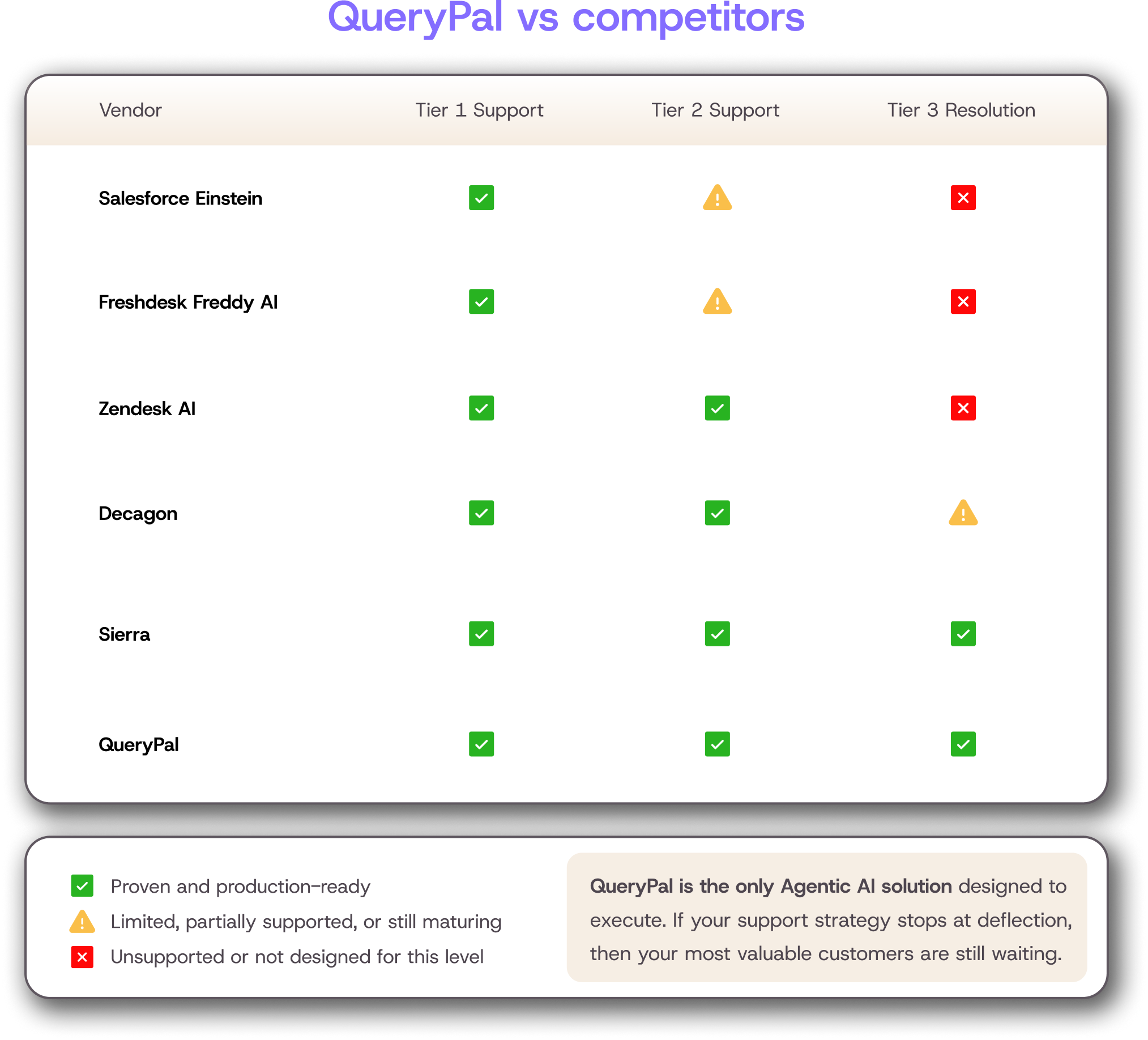
You do not need to build this future alone. The key is selecting partners whose philosophy aligns with yours: focused on deep integration and resolution, not superficial deflection.
Ready to see how an intelligence layer can transform your model? See Querypal in action.
References
- https://files.consumerfinance.gov/f/documents/cfpb_consumer-credit-card-market-report_2023.pdf
- https://www.researchgate.net/publication/380721976_The_impact_of_digital_platforms_on_traditional_market_structures
- https://finance.yahoo.com/news/millennials-gen-x-inherit-83-140300918.html

Activate your free
6 week trial
& white-glove integration support.
Cut support costs by 60%, slash response & resolution times, improve your customer experiences, & reduce agent burnout. Find some time with us to show you how.