9 Helpdesk Best Practices Every Support Team Should Follow
Support leaders are stuck between two pressures right now. Ticket volume keeps climbing. Headcount and budget stay flat. Customers expect faster answers than ever, and your team is burning out trying to deliver them.
The 9 help desk best practices below are the ones that actually move the numbers. Think lower cost-per-ticket, fewer escalations, less agent attrition, and a helpdesk that earns budget instead of begging for it.
Each one works for customer-facing and internal IT helpdesks, with examples drawn from teams operating at scale today.
Why Helpdesk Best Practices Matter More in 2026 Than They Used To
A helpdesk is the system, processes, and people that handle inbound questions from customers or employees. Whether it serves end customers or internal users, the same fundamentals apply. Respond fast, resolve correctly, and learn from every ticket.
The stakes are higher in 2026 than they were two years ago. Customer expectations keep climbing. Support budgets keep tightening.
Agents who used to keep up with the queue are now buried. Every executive in your company is asking the same question. Where is the ROI on this team?
That question has a clear answer when you apply the right practices. Lower cost-per-ticket, faster resolution, less agent burnout, and a measurable shift from cost center to growth driver.
None of these come from working harder. They come from running the helpdesk like a strategic operation instead of a reactive one.
1. Define Clear SLAs and Actually Hold the Helpdesk Accountable to Them
A service level agreement is the promise your helpdesk makes about how fast it will respond and resolve issues. Most teams set them in three tiers, covering first response time, full resolution time, and a customer satisfaction floor.
Most SLAs fail for predictable reasons. The definitions are vague, nobody enforces them, and once the dashboard goes live in week one, nobody opens it again.
Here is the pattern that works. Tier every ticket by priority on intake (urgent, high, normal, low). Set realistic response and resolution windows per tier.
Then review SLA performance every week with the entire team, not just the leads. Call out the wins, diagnose the misses, and surface the patterns before they spread across more queues.
SLAs become the foundation for every other metric on this list. Without them, your team has no shared definition of good. With them, every other improvement compounds.
2. Build a Single Source of Truth Knowledge Base
Your knowledge base is the most undervalued asset in your support stack, and the data backs that up.
Gartner research shows that 74% of customer service and support leaders prioritize improving content and knowledge delivery to customers and employees, putting it ahead of nearly every other CX investment.
The mature teams maintain two KBs in parallel. One is an internal version for agents that holds troubleshooting playbooks, escalation paths, and edge cases.
The other is a customer-facing help center that handles common questions in plain language. Each serves a different reader and demands different writing.
A handful of hygiene rules separate a useful KB from a graveyard of stale articles. Every resolved ticket should either create a new article or update an existing one.
Every article needs an owner and a review date. Stale content should auto-flag for review so nothing rots silently.
Get this right and your agents move faster. Get it really right and your knowledge base becomes the foundation for everything AI can do for your help desk later in this list.
3. Automate Tier 1 Tickets, but Choose AI That Resolves Instead of Just Deflects
Helpdesk automation best practices live or die on one distinction. This is where most teams waste their AI budget.
Deflection means pushing the customer away from a human agent. Resolution means actually solving their problem. Almost every AI helpdesk tool on the market does the first. Very few do the second.
The industry is moving in the resolution direction fast. Gartner predicts that by 2029, agentic AI will autonomously resolve 80% of common customer service issues without human intervention, cutting operational costs by 30%.
At that scale, the AI is taking the action, closing the loop, and only escalating tickets that genuinely need a person.
Good AI reads your KB and past ticket history, generates a contextual answer, takes the action (issues the refund, updates the account, resets the password, runs the diagnostic), and escalates with full context only when the situation needs human judgment.
QueryPal is one example of this agentic resolution model, designed to handle complex Tier 1 through Tier 3 issues rather than just route them away.
For regulated industries, your AI vendor needs to clear the security bar before any of this matters.
SOC 2 Type 2 compliance, self-hosted deployment options, and GDPR support are baseline requirements if you operate in fintech, healthcare, or anywhere data residency matters.
4. Use Role-Based Specialization and Smart Ticket Routing
The every-agent-handles-everything model breaks at scale. Quality drops because no one builds deep expertise.
raining takes longer when every new hire has to learn everything, and your senior agents end up burning out to cover for juniors on issues they should not be touching yet.
A simple three-tier specialization model fixes most of this. Tier 1 handles routine issues, password resets, account questions, basic troubleshooting.
Tier 2 handles technical issues that require product knowledge. Tier 3 handles engineering escalations, edge cases, and anything that touches the underlying system. Each tier gets its own queue, its own SLAs, and its own training path.
Routing is the other half of the equation. Modern helpdesks route by issue type, customer tier, language, agent skill, and current workload, not by who happens to be next up in a round-robin.
Every handoff is a CSAT risk. The fewer handoffs per ticket, the better the customer experience.
5. Track the Metrics That Actually Drive Outcomes (and Ignore Vanity Numbers)
Raw ticket count tells you nothing. Hours logged tell you nothing. These are vanity metrics that look productive on a dashboard and hide the real story underneath.
The metrics that matter are smaller in number and harder to game. Track these six.
- First contact resolution (FCR): the percentage of tickets closed on the first interaction.
- Average handle time: how long an agent spends per ticket.
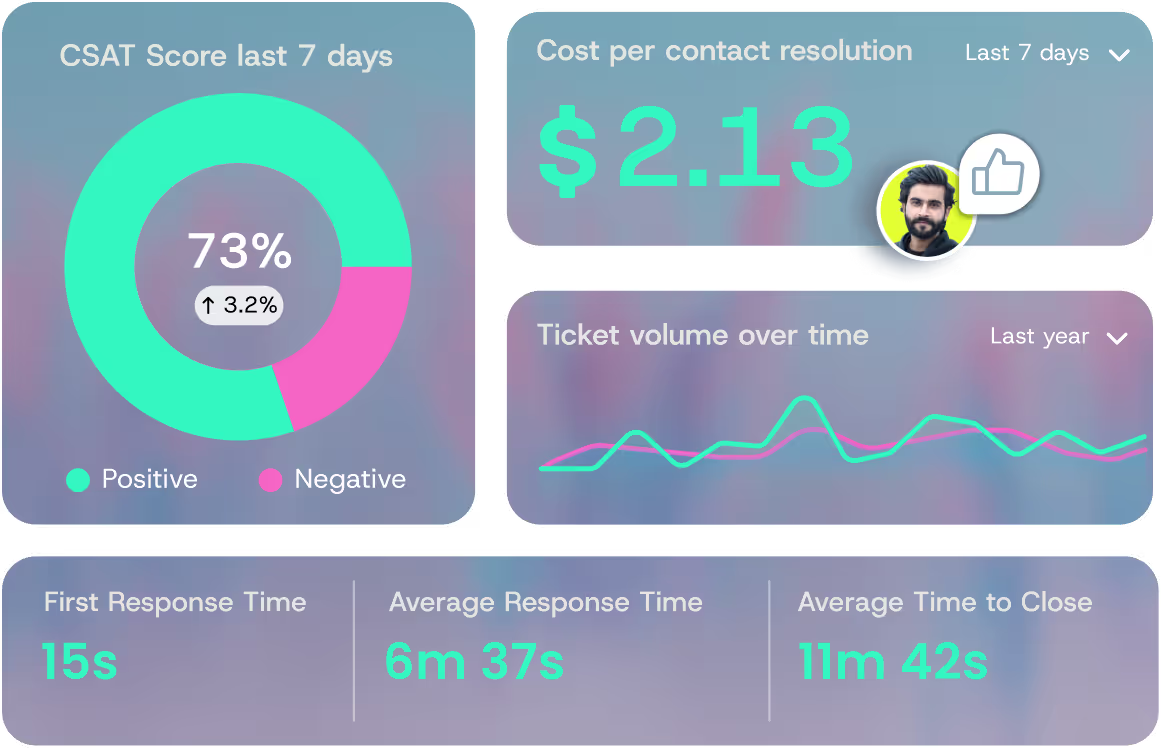
- CSAT: the customer's rating of a closed ticket.
- Deflection rate: how many inbound questions get resolved before they reach a human.
- Cost-per-ticket: total support spend divided by ticket volume.
- Backlog age: the median age of unresolved tickets in your queue.
Each of these connects to a business outcome that an executive actually cares about. Lower cost-per-ticket is real margin. Higher FCR drives retention, because nobody enjoys explaining their problem twice.
And a faster backlog keeps angry escalations out of product and engineering's queues.
That translation matters when budget conversations happen, and it gets sharper when you pair the metrics with purpose-built support analytics that surface the underlying trends.
6. Invest in Continuous Agent Training, Not One-Time Onboarding
The standard training playbook is broken. A heavy bootcamp in week one, a handbook nobody opens again, and then silence for six months. Agents stagnate. KB knowledge decays.
Service quality drifts in ways no one notices until CSAT drops.
Replace the bootcamp model with a continuous loop built around three habits.
- Weekly micro-training tied directly to the metrics from the previous section.
- Ticket reviews used as teaching moments, not punishments.
- Cross-tier shadowing so Tier 1 agents see what Tier 2 and Tier 3 do.
AI does not replace the need for training. It changes what your agents need to learn.
When automation handles the routine work, your team's value lives in the edge cases, the empathy moments, and the judgment calls.
rain hard for those. The agents who stay sharp on complex Tier 1 through Tier 3 work keep their seats as the helpdesk evolves.
7. Make Self-Service the First Stop, Not the Last Resort
Many customers reach for self-service before they pick up the phone. Yet most self-service portals fail to deliver, with industry research routinely pegging successful self-service resolution at around 14%. The intent is there. The execution is not.
Self-service portals fail for predictable reasons. Articles go stale. Search is bad. There is no feedback loop on what worked and what did not. And the escalation path to a human is buried so deep that frustrated customers give up and call anyway, often angrier than they would have been on the first contact.
What works is a self-service experience that feels complete, not punitive. AI-powered search across your full KB and past ticket history. A clear, one-click escalation to a human agent when self-service does not resolve the issue.
Analytics that surface which articles solve problems on the first read and which generate more support tickets than they prevent. Treat self-service as a product, not a deflection tactic.
8. Standardize Processes With ITIL or a Lightweight Framework You Will Actually Use
Without a shared process, helpdesk performance varies wildly by agent, by shift, and by week. Reporting becomes guesswork. Customer experience becomes a lottery.
New hires take twice as long to get productive because every senior agent does things slightly differently.
ITIL help desk best practices give you a practical vocabulary for this work, starting with four buckets that cover most of what a helpdesk handles. Incidents are when something is broken.
Problems are the root causes behind recurring incidents. Changes are planned updates, and requests cover standard asks like a password reset or a new account.
You do not need to deploy the full ITIL framework to benefit from those four categories. For smaller customer support teams, a lightweight equivalent works fine, as long as the entire team follows it.
Help desk documentation best practices form the connective tissue that holds standardization together.
Research from the HDI Practices & Salary Report consistently shows that the highest-performing support organizations also have the most mature process documentation and the clearest definitions for what counts as a resolved ticket.
Write your processes down. Train against them. Audit against them. Update them when the team finds a better way.
9. Treat Support as a Strategic Function With a Seat at the Table
Treat support as the revenue and retention engine it actually is, even if it happens to show up on the wrong line of the P&L.
Every ticket is a signal about your product, your onboarding, your billing, your documentation, and your customers' real day-to-day experience. Treated right, that signal is gold.
Make the connection points formal.
- Weekly handoffs between support and product where the top customer pain points get reviewed and prioritized.
- Monthly readouts to leadership covering trending issues, root causes, and what support sees that nobody else does.
- Shared OKRs with CX, product, and engineering so the helpdesk is not pulling alone.
Every best practice on this list ladders up to this one.
Clear SLAs, a strong KB, AI that resolves instead of deflects, smart routing, the right metrics, continuous training, self-service that actually works, and standardized processes all add up to a helpdesk that improves the rest of the business by surfacing what customers actually need.
That is the difference between support that defends its budget and support that drives the strategy.
Helpdesk Best Practices FAQ
What makes a good helpdesk in 2026?
A good helpdesk in 2026 has four traits. It runs on clear SLAs the whole team is accountable to, a knowledge base that stays current and serves both agents and customers, AI that resolves complex issues instead of just deflecting them, and a direct, measurable link between support metrics and business outcomes like retention, margin, and revenue. Get those right and the rest follows.
Is AI replacing the IT helpdesk?
AI is replacing the most repetitive Tier 1 work, not the helpdesk itself. The helpdesk role is shifting toward complex problems, judgment calls, and customer relationships, which is where humans still beat AI by a wide margin.
The teams winning right now use AI to remove drudgery and reinvest that human time in higher-value work, including agentic AI that can resolve complex Tier 1 through Tier 3 issues end to end.
What are the most important helpdesk metrics to track?
First contact resolution, cost-per-ticket, CSAT, deflection rate, and backlog age. FCR tells you whether your team is actually solving problems or just kicking them down the queue.
Cost-per-ticket translates support performance into dollars an executive understands. CSAT measures the customer experience.
Deflection rate shows whether automation and self-service are pulling their weight. Backlog age is your early warning that something is breaking before it shows up in churn.
How do I get leadership buy-in for investing in our helpdesk?
Translate operational metrics into financial outcomes. Multiply your average cost-per-ticket by your monthly volume and show the savings from a 20% deflection improvement.
Pair that with the retention impact of a higher CSAT score and the revenue impact of faster resolution on enterprise accounts.
Leadership signs off on investments that connect to revenue and margin, not on tickets resolved. Frame the helpdesk as a value driver and the budget conversation gets easier.
Platforms built for resolution, like QueryPal, give you the concrete lever for that story. When AI handles complex Tier 1 through Tier 3 tickets end to end, the savings show up as a number the executive team can sign off on.
Turn These Helpdesk Best Practices Into Real Results
The through-line across all nine practices is simple. The best help desks treat support as a strategic operation with clear standards, the right tools, the right metrics, and a continuous improvement loop. Every practice on this list compounds the others.
You will not implement all nine at once, and you should not try. Start with SLAs to give your team a shared definition of success. Layer metrics on top so you know what is working. Build the KB so your agents and your AI have something accurate to pull from. Then bring in automation that resolves instead of deflects. The rest follows from there.
If you are putting these help desk best practices to work and evaluating AI for your help desk, the test that matters is whether the platform actually closes tickets or just routes them.
QueryPal scans your documentation, past tickets, and workflows to handle complex Tier 1 through Tier 3 issues end to end, not just kick them to a human or to a wall of FAQs. See what agentic resolution looks like in practice and explore QueryPal.

Activate your free
6 week trial
& white-glove integration support.
Cut support costs by 60%, slash response & resolution times, improve your customer experiences, & reduce agent burnout. Find some time with us to show you how.