Are High-Touch Services Scalable? The Customer Support Reality
Yes, you can grow your high-touch customer service. But you cannot just hire more people. There is a limit. Your best people can only talk to so many customers.
The real way to grow is to use smart technology. These systems handle the routine tasks, freeing up your team so they can focus on the important conversations that define what your clients remember most. Keep reading to learn how to make this work for your company.
Why is Scaling High-Touch Service a Growth Paradox?
Scaling high-touch service is a growth paradox because the personalized, human-led interactions that build trust and win clients don't scale efficiently.
Think of this kind of high-touch advising as building a bridge of trust, beam by beam, with each personalized interaction.
In wealth management, where firms manage significant client assets and complex financial plans, personalized advisor relationships are the bedrock of long-term trust. Yet, it creates a fundamental growth paradox.
The very thing that wins business — deep, personal advisor attention — becomes the bottleneck that limits it. Human-led support does not scale linearly with customer volume.
Adding more customers means either diluting the quality of attention for each one or facing an unsustainable explosion in operational costs and headcount. This is the ceiling many firms hit.
Let's Rethink How the "Personal Touch" Is Delivered
The path forward requires a fundamental rethinking of how that "touch" is delivered. It means using AI and integrated CRM data not to replace the human, but to amplify their impact.
Understanding what high-touch services actually means is the first step: it's about preserving the quality of relationships, not just the volume of contacts.
The goal is to automate workflows and surface critical insights, allowing a single advisor to manage more relationships without sacrificing the connection that defines premium client service.
To see how this applies specifically in wealth management, read our guide on delivering white-glove client services at scale.
In wealth management, especially, customers expect proactive guidance, fast responses, and a sense that their advisor truly understands their goals, history, and concerns.
That level of care is built through repeated, thoughtful interactions, not shortcuts.
Why Are The Models Hitting a Growth Ceiling?
As rosters grow, agent teams are forced to make trade-offs: respond faster but less thoughtfully, delegate sensitive moments, or stretch themselves thin.
This is true whether you're building high touch SaaS model or managing complex portfolios in finance.
Why does this growth ceiling happen in practice:
- Each new account increases cognitive load, follow-ups, compliance tasks, and communication demands
- Relationship manager time scales one-to-one, while expectations scale faster
- Hiring more staff raises costs without guaranteeing consistent quality
- Manual data entry and fragmented systems steal time from relationship-building
- Lack of real-time insights makes proactive service harder as portfolios grow
The challenge, then, is not whether personal attention matters — it clearly does — but how to preserve its quality while removing the manual friction that caps growth.
This is where AI-driven automation and intelligent CRM integration can quietly carry the load behind the scenes. You can explore specific AI use cases in financial services to see how firms are already making this shift.
Which Workflows Should You Automate First to Increase Capacity?
Your engagement model must match the complexity and value of the relationship. A one-size-fits-all approach wastes resources and frustrates customers. In finance, the choice between high touch vs low touch is stark, dictated by the stakes involved.
High-touch is for your most important accounts. They have significant assets with you. Their plans are complex. They get their own relationship manager, communicate frequently, and receive personalized advice.
Low-touch is for many others. Their needs are simpler. They are comfortable using self-service platforms to check their balance online or read answers in a help section.
The direct answer for a growing firm is segmentation. When deciding where to allocate advisor time, reserve it for high-value, complex relationships where the lifetime value justifies the cost.
For the broader base, leverage low-touch efficiency for routine matters. This hybrid allocation balances resource expenditure across segments, ensuring premium attention where it counts and scalable efficiency everywhere else.
How Intelligent Tools Can Amplify Human Expertise
Technology is not a replacement for the human touch in high-stakes situations. It is the engine that allows genuine connection to scale.
For investment firms and accounting practices, the right platforms act as a force multiplier, streamlining administrative burdens and providing superhuman context.
Technology-assisted engagement plays a powerful supporting role here, not by replacing the advisor, but by handling the routine so your team can focus on the conversation.
A unified CRM integration provides a complete 360-degree view instantly. No more tab-switching or asking people to repeat their history. The agent has the full context before the conversation even begins, making every interaction more informed and personal.
Intelligent systems also move you from reactive to proactive — enabling anticipatory outreach that prevents problems and strengthens trust.
AI copilots can summarize lengthy histories, draft complex communications, and automate follow-up tasks, empowering financial agents to operate significantly faster.
This is a core benefit of smart customer support automation that firms of all sizes can deploy today.
Here is what good technology can do:
- Show all information in one place. The agent sees the complete history instantly. No searching. This makes every conversation more meaningful.
- Spot problems early. The system can detect when someone is confused or unhappy and alert the agent to reach out proactively before it becomes a bigger problem.
- Handle the routine tasks. Automation can write simple emails, schedule meetings, and pull reports, saving agents many hours each week.
When technology handles the routine, your people can focus on what matters: complex planning, understanding emotions, and building trust. This is what keeps customers for life.
5 Easy Tasks You Can Handover to Automation First
To move from theory to practice, you must identify the specific low-value activities that drain your staff's time and dilute experience.
These are repetitive, rule-based tasks that offer no strategic value when performed manually. Automating them delivers immediate capacity gains. Start with these five high-impact areas.
- Collecting Documents. Customers often need to send forms, IDs, or tax papers. Automation can request them through a secure portal, verify correctness, and file them in the proper location.
- Setting Up Meetings. Stop sending emails back and forth to find a time. Smart scheduling can check both calendars, find suitable times, and send reminders and summaries before meetings.
- Answering Simple Questions. People often ask, "What's my balance?" or "How did my investments do last month?" Self-service platforms can answer these questions anytime, day or night, through chat or web portals.
- Recording Compliance. Finance has many regulations. Systems can automatically save copies of all emails and calls, tag them, and file them properly — helping significantly with audits.
- Welcoming New Accounts. When someone new joins, there are many steps. Onboarding automation can guide them through each stage, grant access, and set up their first meeting, making a great first impression.
Delegating these tasks to automation doesn't remove the staff member from the process. It removes the friction. Team members remain the conductors, but the system handles the orchestration.
This is how you create bandwidth without adding bodies.
What Steps Are Required to Build a Scalable System?
Transitioning from a strained, manual model to a scalable, hybrid one requires a deliberate framework. It is about systematically injecting intelligence into your workflow to preserve human empathy for the moments that truly matter.
The goal is to ensure every person feels uniquely valued, regardless of your firm's growth rate. This is not about cost-cutting. It is about impact amplification.
Follow these steps to build a system that grows but still feels personal.
- Step 1: Segment Your Accounts. Not all relationships are the same. Decide who gets high-touch attention and who gets low-touch support. Your biggest, most complex accounts get the most dedicated time. This ensures your best resources go where they matter most.
- Step 2: Automate Simple Inquiries. Use self-service platforms to handle common questions. Inquiries like "How do I reset my password?" or "Where is my form?" can be answered instantly — resolving most requests without any human intervention.
- Step 3: Equip Your Staff Well. Give them software that displays all information on one screen and suggests next steps. This transforms them from data-searchers into problem-solvers.
- Step 4: Monitor Satisfaction. Growing is counterproductive if people become unhappy. Use surveys to gauge sentiment. Watch these scores closely. If scores decline, identify and fix the problem.
This plan lets you use technology for efficiency and people for empathy. It is the best of both worlds.
How to Make Sure Your New System is Working Properly and Efficiently
You cannot manage what you do not measure. Moving to a scalable hybrid model requires shifting your key performance indicators from pure activity metrics to outcome-oriented health metrics.
Tracking the right customer service metrics is what separates firms that grow sustainably from those that scale blindly.
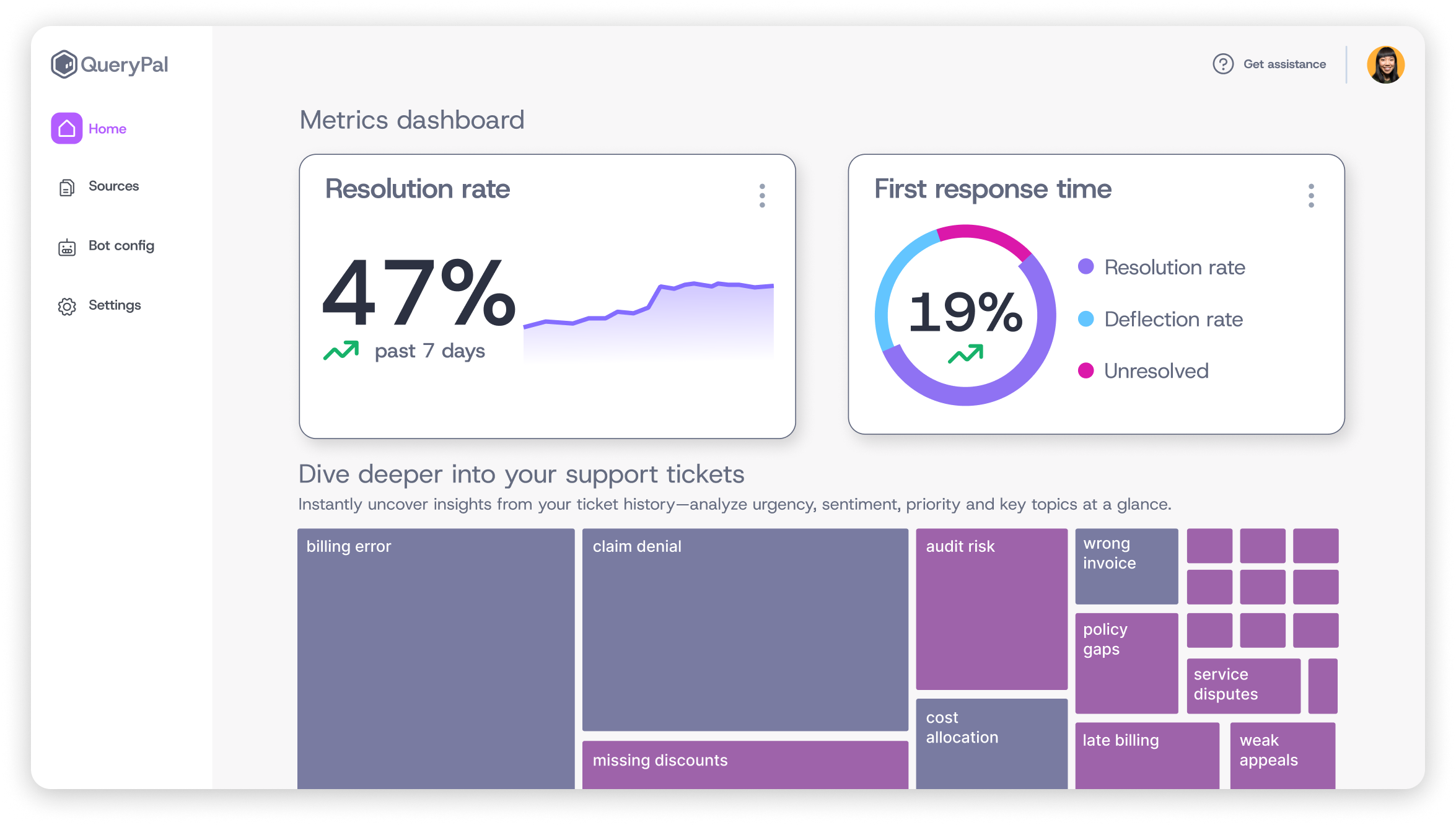
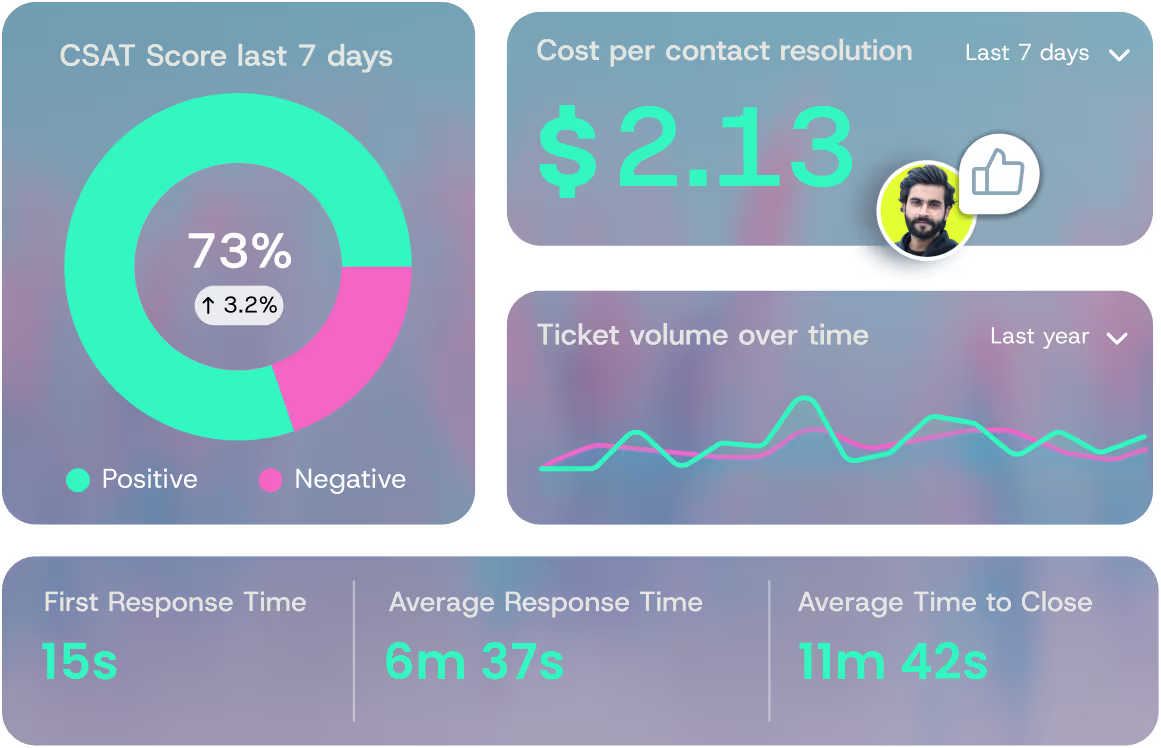
These numbers will tell you if your automation is effective and if relationships are thriving, not just surviving. Track these five categories closely.
- Success Rate — What percent of questions did automation solve independently? A good goal is 70–90% for appropriate inquiries.
- Time Saved — How much less time do your people spend on each interaction? It should decrease because they have better information.
- Customer Satisfaction Score (CSAT) — This comes from a quick survey after an interaction. The score should stay high or improve.
- Net Promoter Score (NPS) — This asks if someone would tell a friend about you. This crucial score should remain strong.
- Accounts per Advisor & Retention Rate — How many important relationships can one advisor handle well? And are you keeping your most important accounts? Both numbers must trend in the right direction.
Watching these numbers helps you see the truth. You can prove that your new approach is delivering results. For a deeper look at measuring the ROI of your support investments, see how to reduce call center cost without sacrificing service quality.
How Can QueryPal Help You Scale Your High-Touch Model?
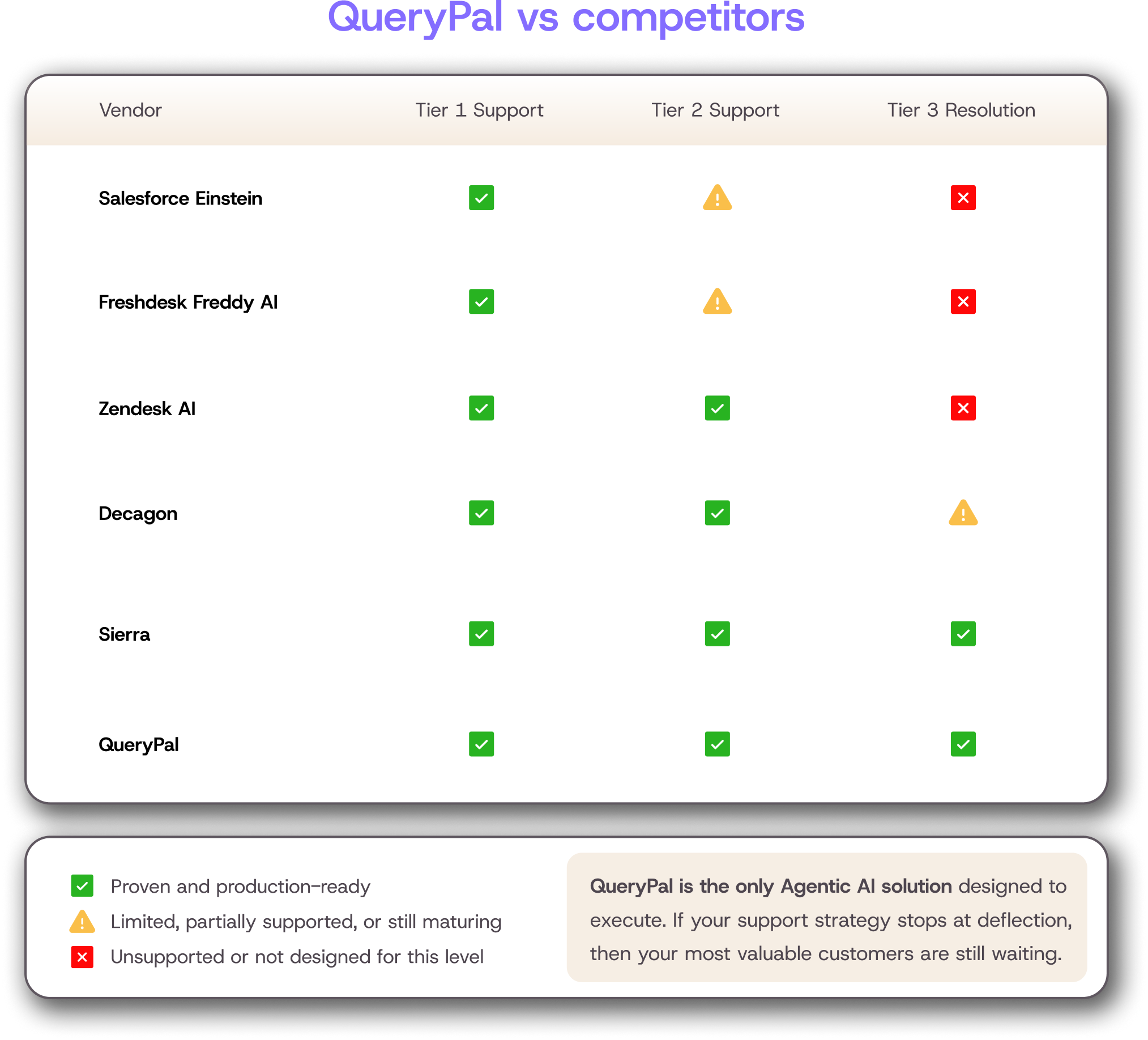
The market is flooded with platforms that promise scalability through deflection. They route tickets, suggest knowledge base articles, and log interactions.
This is a dead-end for the wealth management industry. Deflection might manage volume, but it erodes the trust you've built.
At QueryPal, we engineer for a different outcome: resolution. Our core philosophy is built on the principle of intelligent action. We provide an Agentic User Interface (AUI) — an intelligence layer that operates alongside your staff.
It doesn't just answer questions. It takes intuitive action within your existing systems to solve problems. This is what resolving problems, not just routing them looks like: not just faster responses, but smarter, more complete ones.
For a wealth manager, this means the AUI can autonomously generate a portfolio performance report from the CRM, check for missing documentation, and schedule a review call, all within a single, natural request.
- Find the account in the system.
- Create the performance report.
- Show it right away.
It does real work and makes things happen. This is called "resolution."
The technical foundation is built for the enterprise. We offer friction-free deployment that integrates deeply with your core systems, like CRM and portfolio management software.
For firms where data sovereignty is non-negotiable, our self-hosted deployment option ensures everything remains within your controlled environment, meeting the strictest SOC 2 and GDPR compliance standards.
What Mistakes You Should Avoid From the Get-Go
Adopting a new model is fraught with execution risks. Awareness of these common pitfalls can save your firm significant time, money, and goodwill. The goal is not just to implement technology, but to successfully change your operational culture.
- Mistake 1: Automating a Bad Process. If your current workflow is messy, automation will just create messes faster. Fix the process first, then add the technology.
- Mistake 2: Ignoring the System After Setup. Smart platforms need tuning. You must check reports, see what questions are missed, and refine performance over time.
- Mistake 3: Scaring Your Staff. Your people might worry that automation will replace them. Tell them the truth: the platform is there to help. It will handle boring tasks so they can do more interesting, valuable work. Let them help choose the solution.
- Mistake 4: Confusing Your Customers. If people are used to calling, a new chat platform might confuse them. Explain the change. Tell them it will give them faster answers and free up their advisor for bigger conversations.
- Mistake 5: Removing the Human Touch. Never use automation for delivering bad news or handling very sensitive conversations. Some discussions must always be between people. Use the system to flag these moments for a human to step in.
What Comes After Automation: Your Next Step
Growing your personal service is possible. You do not have to choose between getting bigger and staying personal.
The secret is to use smart technology as a force multiplier for your staff. These platforms handle the simple, repetitive tasks, giving your best people more time to build stronger relationships with your most important accounts.
Ready to see how it works? Book a Demo with QueryPal.
References
- Brown, Elizabeth L. "High-Touch or High-Tech: Industry Pros Love AI Concierges, but Hotel Guests Crave a Human Connection, USF Study Finds." Muma College of Business News, University of South Florida, 9 Feb. 2026, www.usf.edu/business/news/2026/02-09-usf-studys-ai-concierges-adoption-finds-guests-crave-human-connection.aspx.
- "High-Touch Service." Marketing Dictionary, Monash Business School, Monash University, www.monash.edu/business/marketing/marketing-dictionary/h/high-touch-service.f

Activate your free
6 week trial
& white-glove integration support.
Cut support costs by 60%, slash response & resolution times, improve your customer experiences, & reduce agent burnout. Find some time with us to show you how.