QueryPal vs. Decagon: Comparison Guide for 2026
Customer experience departments are leaning harder than ever on autonomous tech. Not because it's trendy, but because support queues keep stretching past what their human bandwidth can handle. AI has shifted from "nice-to-have" to "strategic necessity."
Leaders want instruments that trim manual effort without sacrificing clarity, accuracy, or oversight. That's the crossroads where QueryPal and Decagon sit.
Both of these support solutions aim to reduce repetitive labor and streamline service, yet they approach the challenge through differing and distinct philosophies.
The headache for most buyers isn't choosing between vendors. It's figuring out how to scale without drowning staff in assignments or drowning the business in endless configuration.
Machine-driven assistance helps only when the setup doesn't consume the same time it's supposed to save. That's the real tension: speed versus governance, autonomy versus rigidity, adaptability versus predictability.
This guide breaks down what matters most when it comes to these support solutions: how each platform's AI works, where their approaches diverge across self-driving software depth, setup, integrations, analytics, pricing, and information governance, plus practical scenarios where one fits better than the other.
This is a direct comparison, no filler, no rankings, straight to the point so you can make the best informed decision for your company.
What Is QueryPal?
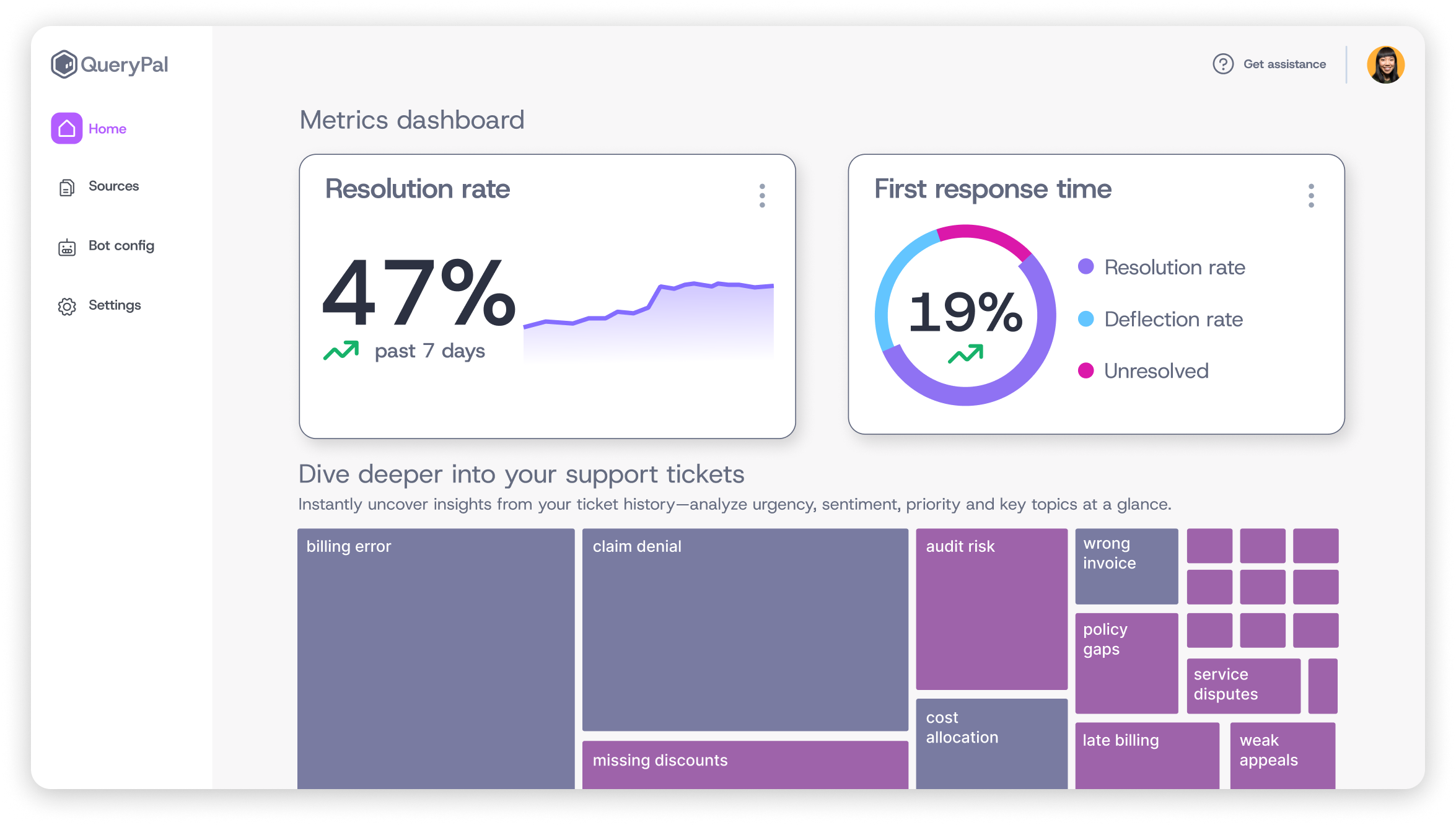
QueryPal is built around agentic execution [1]. Instead of simply drafting responses, it carries out multi-step procedures across your internal infrastructure.
It identifies incoming requests, gathers context, and executes the duties, updates, lookups, resets, adjustments, or administrative functions, without waiting for manual intervention.
Its core architecture revolves around three main components:
- Intercept: The automated capability that handles real-ticket resolution. It takes in requests, determines the required steps, and completes them directly.
- Prism: A visibility layer offering insight into decisions, moves, and performance trends.
- Concierge: A conversational front end that lets customers and employees interact with internal functions naturally.
A noticeable trait during deployment is how quickly QueryPal becomes active. Connect the help desk. Link your knowledge base. It starts absorbing patterns from historical cases and real-world procedures.
No tedious branching. No ritual of mapping every possible edge case. The software learns from lived behavior, not theoretical flow charts.
It also meets staff where activity happens. Slack and Teams turn into command centers, giving the workforce a central spot for approvals, escalations, insights, and change confirmations.
And because some industries have strict information boundaries, QueryPal can run entirely within a company's private AWS cloud.
Who Is QueryPal Best For?
Some enterprises need tight governance. Others simply need the burden to disappear so they can breathe again. QueryPal fits departments that want strong efficiency without spending weeks building flows or managing complex rules.
It's built for ecosystems where speed matters, requests stack up fast, and daily output relies on clear resolutions rather than long reviews.
Ideal matches include:
- Fast-Growth Companies: When volume spikes, manual steps start falling apart. QueryPal cuts down the backlog without forcing managers to hire ahead of demand.
- Technical Resolution Units: These squads deal with system checks, resets, and detailed fixes. QueryPal handles those multi-step assignments like a teammate who already knows the routine.
- Security-Focused Enterprises: Some industries require private cloud hosting. QueryPal's deployment options can make that happen.
- Chat-Centric Organizations: If most activity happens in Slack or Teams, QueryPal keeps everything moving inside those channels.
What Is Decagon?
Decagon approaches customer care differently. It centers on deflection, regimented guidance, and assisted replies. Instead of performing system changes directly, the engine focuses on interpreting messages, routing them correctly, and helping representatives craft responses that match tone and policy expectations.
Its strongest features revolve around language parsing and rule-driven sequences [2]. Admins can outline conversational routes through a visual builder, establishing predictable paths for incoming queries.
The AI then guides operators along those paths, ensuring consistency.
Its main components include:
- Visual Builder: A drag-and-drop setting for creating conversational flows and deflection routes.
- Agent Copilot: Suggests messages inside the help desk and fills in formatted data.
- Smart Routing: Automatically labels and forwards cases to the appropriate unit or queue.
Decagon's design works well for groups that want high oversight. It sits within the ticketing system, not the collaboration layer, and requires a defined setup. This provides predictability but demands more configuration time.
Who Decagon Is Best For
Many support departments value predictability over speed. Decagon fits companies that prefer clear rules, steady supervision, and strong command from start to finish. It's designed for teams that want to keep people in the driver's seat while using AI mainly as a guide.
This route is best for:
- Rule-Driven Environments: These units follow strict procedures, and every step matters. Decagon reinforces that framework by keeping conversations on a set path and preventing unwanted surprises.
- Approval-Centric Groups: Some businesses need a person to approve replies before they're sent. Decagon strengthens that habit by offering suggestions while still letting reps make the final call.
- Ticket-Centric Setups: If your staff spends most of its time in Zendesk, Salesforce Service Cloud, or similar applications, Decagon fits smoothly. Everything stays inside the software, keeping the process organized and familiar.
Comparing the Main Features: QueryPal vs. Decagon
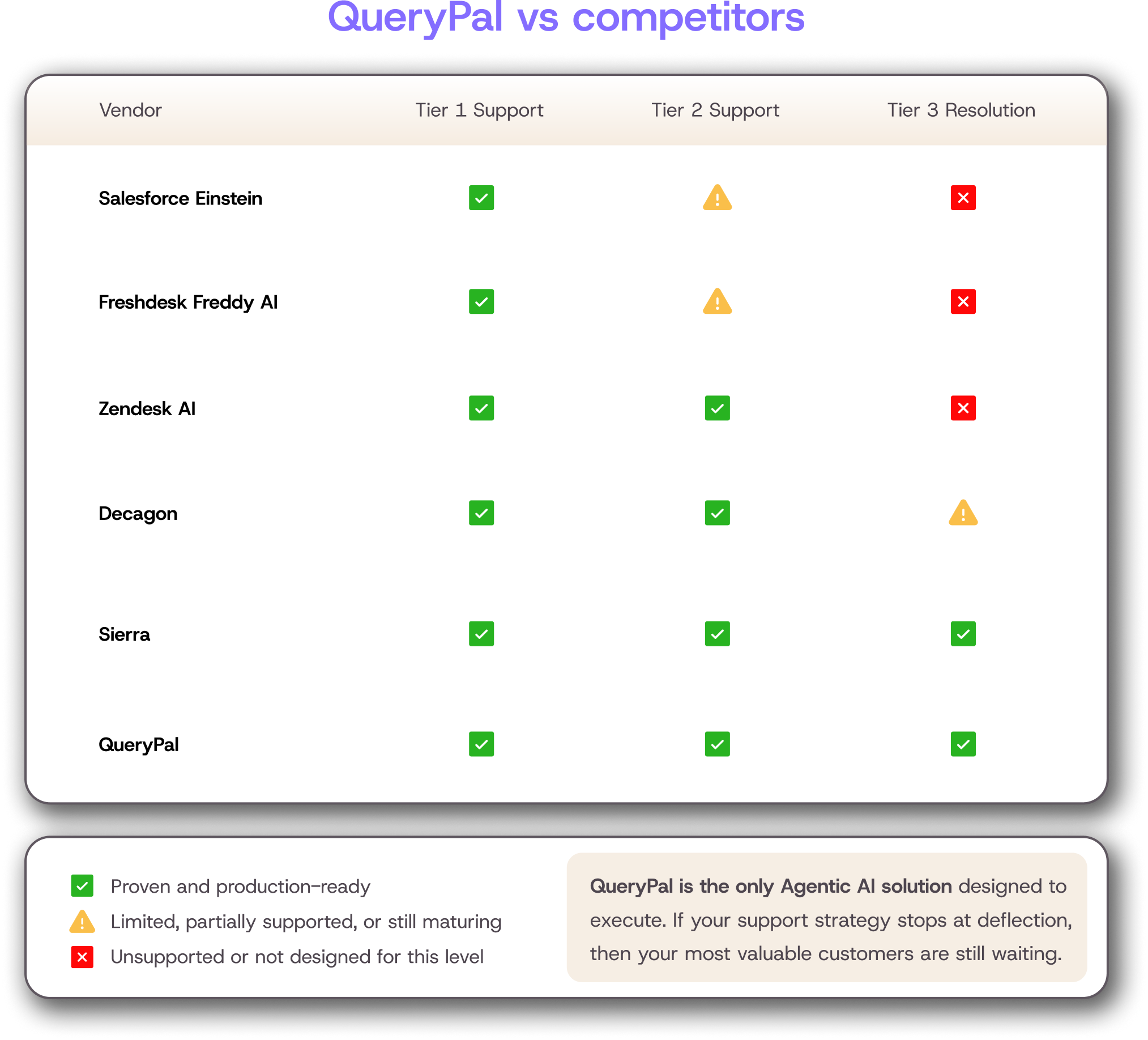
The differences become obvious when you examine how each product fits into a real business context. The real world is where operation and execution matters.
You'll need to know what your company specific needs are in order to choose the best support solution.
AI & Execution Capabilities
QueryPal uses agentic reasoning to execute duties. It reads a request, determines the required steps, and performs them across linked applications. That might include modifying an account, pulling internal intelligence, updating fields, or initiating internal measures without additional prompts.
Decagon focuses on understanding messages, deflecting simple requests, drafting responses, routing, and guiding conversations. It does not perform system-level modifications unless explicitly tied to a rule you create.
Consider this contrast: With QueryPal, a billing adjustment can be completed end-to-end. With Decagon, the software may classify the request, propose phrasing, and point the rep to standard instructions.
Both reduce strain, but in different ways. One clears the queue entirely. The other assists the staff in getting through items faster.
What's the Setup Time & How Easy is Implementation?
QueryPal keeps setup simple. Once your help desk and internal utilities are connected, it starts learning from past logs, your knowledge base, and common support patterns. There's no need to build long decision trees or map out every scenario, because it adapts on its own.
Businesses see real impact early, even during the first weeks. This makes it easy for fast-moving squads that don't have time to design complicated pipelines.
Decagon takes a more hands-on path. Admins must create mapped flows, define branches, and set rules that guide each conversation. This gives leaders strong authority, but it also means more effort up front.
As processes change, those flows must be updated to stay accurate, which adds ongoing maintenance.
Time-to-value ends up looking quite different:
- QueryPal: Quick lift with minimal effort.
- Decagon: Slower start but high oversight.
Both approaches work, depending on the company's comfort with automated reasoning.
Integrations & Workflow Compatibility
Departments operate across multiple channels. How each solution fits into that rhythm matters.
QueryPal integrates heavily with Slack and Teams. Activity doesn't leave those channels. Approvals, explanations, and confirmations show up exactly where staff communicate.
It also integrates with common ticketing software, but the collaboration layer becomes the execution hub.
Decagon stays closer to traditional support stacks. It integrates with major case management platforms but lives within those landscapes rather than the chat layer.
This suits organizations that treat the help desk as the main workspace.
Two distinct styles emerge:
- Chat-First Models: QueryPal blends directly into daily conversations.
- Ticket-Based Models: Decagon reinforces organized service processes.
Neither is inherently better. Fit depends on how your workforce naturally functions.
What's the Price Look Like & the Total Cost of Ownership?
Pricing philosophy matters as much as features.
QueryPal ties value to completed jobs, aligning cost with resolved outcomes. Instead of billing by seats, it reflects how much throughput is actually achieved.
Leaders trying to cut cost-per-ticket often find this appealing because the expense scales with productivity, not personnel count. When evaluating QueryPal pricing, organizations appreciate how costs connect directly to measurable support efficiency.
Decagon follows a more traditional SaaS framework. Costs depend on seats, tiers, and access to specific capabilities. This approach is familiar and predictable, especially for companies accustomed to per-user licensing.
Decagon pricing structures reflect industry-standard seat-based models.
The financial contrast reflects their core philosophies: QueryPal reduces manual labor directly while Decagon improves human efficiency while keeping personnel central.
Why Does Security, Information Governance & Compliance Matter in 2026?
Data privacy is no longer a back-office issue. It's a procurement prerequisite. Companies want transparency, hosting flexibility, audit trails, and strict boundaries for proprietary records, especially in regulated sectors.
QueryPal offers modern compliance frameworks like SOC 2 and GDPR, along with private cloud hosting within an organization's AWS infrastructure. For industries dealing with financial records, PHI, or sensitive internal databases, this deployment option is often mandatory.
It ensures that sensitive information never leaves the company perimeter.
Decagon uses a SaaS-only deployment model. While secure, it doesn't offer the isolated hosting some enterprises require. For most firms, this is acceptable.
For others, particularly those in finance, healthcare, or security-sensitive fields, it becomes a decisive factor.
Real-World Use Cases: When to Choose QueryPal vs. When to Choose Decagon
Different units prioritize different outcomes. Here's where each platform naturally fits.
When Choosing QueryPal Makes Sense
QueryPal is ideal for groups that want real burden reduction, not just a faster way to respond. It handles the kinds of requests that normally send staff jumping between tabs, applications, and internal dashboards.
When a service queue is packed with multi-step items, the solution fills the gap by taking ownership of the entire sequence. That means fewer handoffs, fewer checks, and fewer moments where reps stop to verify information before executing.
Strong fits include:
- Units needing AI to complete jobs end-to-end: It doesn't stop at routing or drafting. It finishes the work.
- Businesses that rely heavily on Slack/Teams: Approvals, explanations, and updates stay inside the chat apps people already use.
- Enterprises requiring private hosting: Some industries need strict information sovereignty. QueryPal supports that requirement.
- Departments trying to control headcount growth: Automating becomes a practical alternative to constant hiring.
Because it removes manual load instead of adding more apps to manage, high-volume squads feel the impact quickly. It keeps velocity high even when demand spikes. Organizations exploring how AI ticketing systems transform operations often find QueryPal's approach delivers faster returns.
When Choosing Decagon Makes Sense
Decagon fits enterprises that care more about uniformity and message precision than speed. It's designed for firms that rely on predictable steps and need every interaction to follow a clear pattern.
Instead of executing duties, it guides representatives through established routes, helping them respond with accuracy and consistency.
Best suited for:
- Groups that prefer rule-based or predictable processes: Procedures stay clean, organized, and easy to review.
- Companies wanting AI assistance rather than autonomy: Staff still make the final decision.
- Units with strong, documented knowledge bases: Clear SOPs make its guidance effective.
- Operations that rely exclusively on traditional help desks: Everything stays in the main ticketing system.
This setup works well when supervision is central, and leaders want every reply to meet a defined standard.
Which AI Support Solution is Right For You?
Choosing between these options comes down to the philosophy your workforce trusts.
QueryPal focuses on agentic execution, acting like a capable teammate that resolves items, moves across infrastructure, and operates autonomously with surprisingly low setup. It blends into collaboration tools and supports private cloud deployments.
For businesses chasing meaningful efficiency gains, it delivers leverage fast.
Decagon prioritizes guided logic. It gives groups predictable flows, consistent phrasing, and strong routing. It's ideal when human review stays central, and configuration provides comfort.
The software fits cleanly into case-centric environments where oversight matters more than autonomous intervention.
If your goal is real self-driving intuitive action with minimal configuration, QueryPal typically proves the better fit. If your department wants AI assistance layered onto an existing process with clear rules, Decagon aligns naturally.
When comparing Decagon competitors and QueryPal competitors, the distinction becomes clear: QueryPal emphasizes autonomous resolution while Decagon emphasizes guided assistance. Teams exploring customer support automation strategies or investigating alternatives to traditional approaches should weigh these philosophical differences carefully.
For teams evaluating their self-driving intuitive action strategy for 2026 and beyond, a hands-on trial of QueryPal can reveal how agentic support behaves under real-world pressure. Explore additional resources on AI in customer service or learn how enterprise companies address complex support challenges to make the most informed decision for your organization.
References
[1] Association for Computing Machinery. "Agentic AI Systems: Autonomous Decision-Making in Complex Environments." ACM Digital Library, 2024, dl.acm.org/agentic-ai-systems.
[2] Institute of Electrical and Electronics Engineers. "Natural Language Processing in Enterprise Customer Support Applications." IEEE Xplore, 2024, ieeexplore.ieee.org/nlp-customer-support.

Activate your free
6 week trial
& white-glove integration support.
Cut support costs by 60%, slash response & resolution times, improve your customer experiences, & reduce agent burnout. Find some time with us to show you how.