The Future of Customer Service: AI with a Human Touch
The support teams keeping your customers happy are running out of runway, and the future of customer service depends on what comes next.
Ticket volumes keep climbing and the problems landing in the queue are more complex than they were even a year ago. Hiring more agents to keep pace stopped being a viable growth strategy a long time ago.
AI is already reshaping customer service from the ground up. But the real shift goes well beyond chatbots deflecting FAQ-level questions.
Next generation customer service tools can resolve complex support issues while taking repetitive work off your agents' plates, giving support organizations a path to scale that doesn't depend on growing headcount quarter after quarter.
Support Teams Are Already at a Breaking Point
The future of customer service only makes sense when you understand where things stand right now. Recent customer support trends show the picture isn't great.
Salesforce's 2025 State of Service report, which surveyed 6,500 service professionals, found that 56% of agents experience burnout. These findings align with broader help desk statistics showing sustained pressure on frontline teams. The context makes it worse.
Seventy-seven percent of reps say both their workload and the complexity of incoming issues increased over the past year.
The queue isn't full of simple password resets anymore. Agents spend their days untangling multi-step technical problems that require pulling information from four or five different internal systems before they can even begin troubleshooting.
These Tier 3 support problems consume the most time, budget, and agent energy.
The downstream effects follow a predictable pattern. Overwhelmed agents quit.
New hires take months to ramp up. The remaining team absorbs the extra load, burns out faster, and the cycle picks up speed.
Customers feel it through longer response times and inconsistent answers depending on who picks up the ticket.
Most companies respond the way they always have, throwing headcount at the problem. But every new agent brings salary, benefits, onboarding costs, and months of ramp-up before they're fully productive.
When ticket volume grows faster than your budget allows, that model breaks down. Those same scalability and ownership questions shape whether a team should build or buy AI for customer support.
Why Most AI Customer Service Tools Still Fall Short
AI in customer service isn't new. Chatbots have been fielding support questions for years. If you've ever rage-typed "SPEAK TO A HUMAN" into a chat widget, you already know the problem with most of them.
The first generation of AI support tools was designed to deflect tickets, not resolve them.
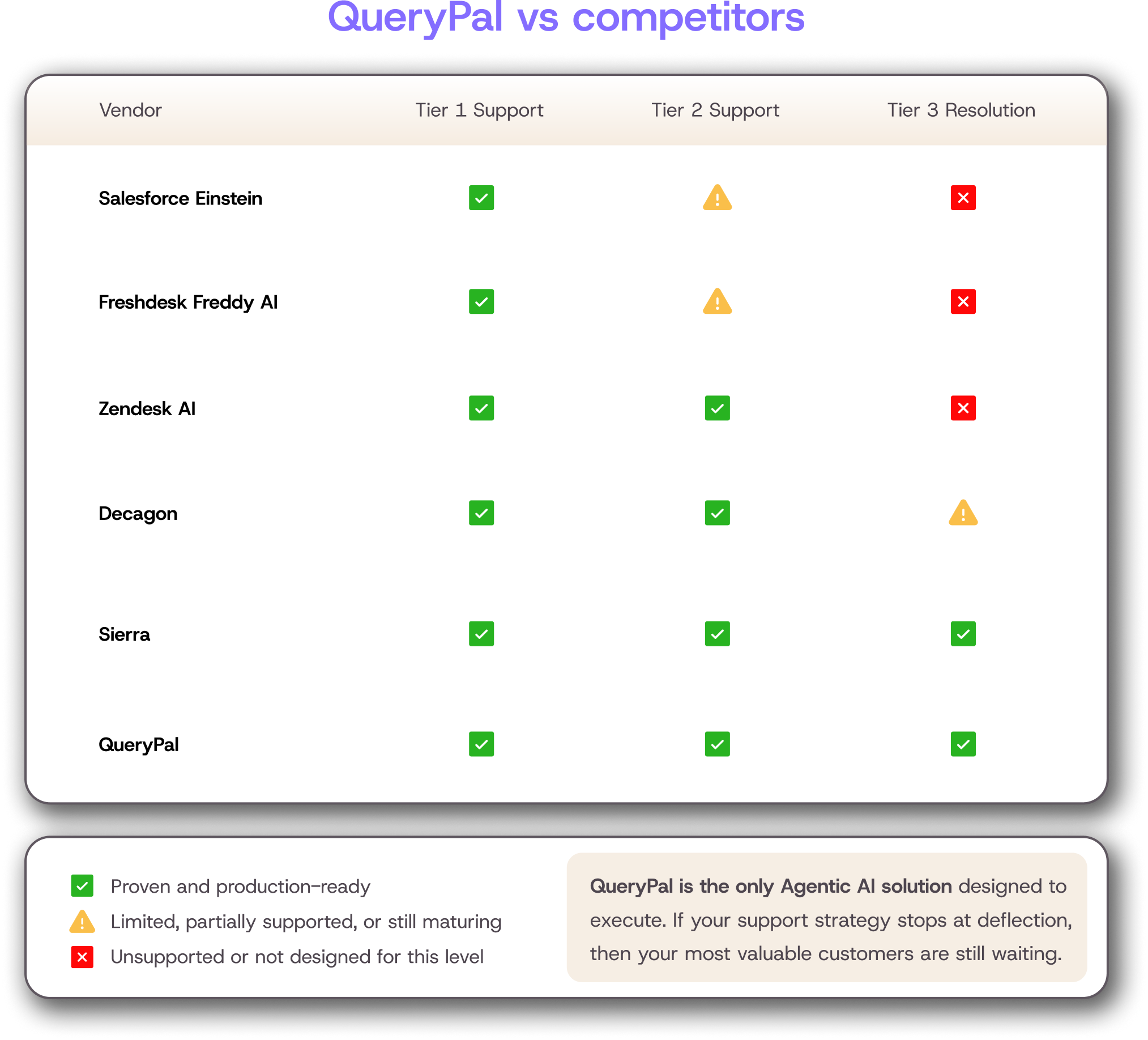
They handled "where's my order" and "what are your business hours" fine.
Anything beyond that and they'd cycle through the same canned responses before dumping you into a human queue, often without passing along any context.
The customer would start over from scratch while the agent scrambled for background, and the "AI" would quietly log it as a handled interaction.
That experience, repeated millions of times across industries, taught customers to distrust AI support. Gartner's 2024 customer experience survey found that 64% of customers would prefer companies that didn't use AI for customer service at all.
That number comes from years of poor implementations, not a fundamental flaw in the technology.
The technology itself has moved far past those early tools. But customer perception hasn't caught up.
It won't until companies deploy AI-driven customer service that genuinely solves problems instead of routing people in circles.
What Agentic AI Actually Changes
The term "agentic AI" is everywhere right now, so let's pin down what it actually means for support.
Traditional chatbots follow decision trees. They pattern-match keywords against pre-written answers and hope for the best. Agentic AI systems reason through problems.
They connect to your existing tools and data sources, evaluate the full context of a customer's situation, and take action to resolve issues end-to-end.
What makes this possible is how these systems are built. Agentic AI connects to your knowledge base, CRM, ticket history, and internal documentation simultaneously, then executes multi-step workflows by understanding how different pieces of information relate to each other.
A system triaging a billing dispute can pull payment history, check recent plan changes, cross-reference the support policy, and apply the right resolution without a human ever touching the ticket.
The practical difference for customers is stark. Instead of an AI that says "here are some help articles that might be relevant," you get a system that identifies the root cause and takes corrective action in a single interaction, reducing customer response time from hours to seconds.
A customer with an API error gets their authentication token regenerated and the new key delivered to their dashboard, not a link to a generic troubleshooting guide.
Gartner predicts that by 2029, agentic AI will autonomously resolve 80% of common customer service issues without human intervention, leading to a 30% reduction in operational costs.
That prediction captures the future of AI in customer service: a fundamental restructuring of how support teams operate and how companies budget for service delivery.
This generation of AI exists to handle the volume of work that doesn't require human judgment, so your best agents can focus on interactions that genuinely need a person.
The enterprise client with a tangled integration problem. The frustrated customer whose issue requires empathy and creative thinking.
Those are the conversations where humans are irreplaceable, and agents can only get to them when AI is handling the rest.
The Trust Gap and How to Close It
The 64% of customers who'd rather companies skip AI aren't rejecting the technology. They're reacting to years of bad experiences with it. Recent customer experience statistics confirm this trust gap is narrowing as resolution-first AI tools replace older chatbot models. They want faster, better support. They just don't believe AI can deliver it yet.
Customer experience in the age of AI hinges on whether companies prove them wrong.
Companies building trust with AI-powered support tend to do two things well.
They're transparent about when a customer is interacting with AI, and they make escalation to a human agent fast and context-aware so the customer never has to repeat themselves.
When the AI can't fully resolve an issue, it hands off to a person who already has the full picture.
When a system genuinely fixes your problem in under three minutes without asking you to re-explain your situation, the technology powering it becomes irrelevant. You got your answer. You moved on with your day.
That experience, delivered consistently, is how AI will change customer service for the better, reversing the trust deficit built by years of bad chatbots. When that happens at scale, it redefines the future of customer experience.
Data security adds another trust layer at the enterprise level. Support conversations carry sensitive information.
For companies in financial services or healthcare, routing customer data through a third-party AI provider creates compliance risks that can stall a deployment entirely.
Self-hosted AI platforms that process everything within your own infrastructure remove that blocker at the architecture level and give both compliance teams and customers fewer reasons to hesitate.
QueryPal takes this approach. All support data stays within the customer's own environment, protected by SOC 2 Type 2 certification and GDPR compliance.
Regulated teams can deploy agentic AI without adding a new third-party data processor to their vendor list.
What the Hybrid Model Actually Looks Like
The public narrative about AI in customer service keeps framing it as replacement. AI takes the tickets, agents lose their jobs, full stop. The reality at organizations running capable AI is more encouraging than that narrative suggests.
In practice, the hybrid model plays out like this. AI absorbs the high-volume, repetitive work. The troubleshooting walkthroughs and status checks that come in dozens of times per day.
Human agents get those hours back and redirect them toward complex edge cases and the kind of high-stakes interactions where empathy and creative judgment make a real difference.
The impact on agents is measurable. Salesforce's 2025 data shows that reps using AI tools spend 20% less time on routine cases, freeing roughly four hours per week.
Four hours that used to go toward copying and pasting the same answer again and again now go toward work that keeps agents engaged and customers coming back. That shift defines the future of contact centers: fewer repetitive tasks, more meaningful human work.
Agent burnout rarely stems from hard work alone. It comes from monotonous, low-value tasks that make skilled people feel like human ticket routers. When AI handles that work, agents get to do what they were hired for.
Help real people solve real problems.
This shift changes what it means to work in customer support, a customer service transformation that runs deeper than technology. As AI takes on more of the routine volume, the support agent role evolves from ticket processor to problem solver.
The skills that matter shift toward empathy and creative thinking in situations the AI flagged for human review. For support leaders, that means rethinking how they hire, train, and measure agent performance.
Prepare Your Support Team for the Future of Customer Service
The trajectory is clear. AI will handle a growing share of customer interactions, and the complexity of what it can resolve will keep expanding.
For support leaders, the question isn't whether AI belongs in their operation but how quickly they can deploy something that works and that customers trust.
The companies that get this right will have a few things in common.
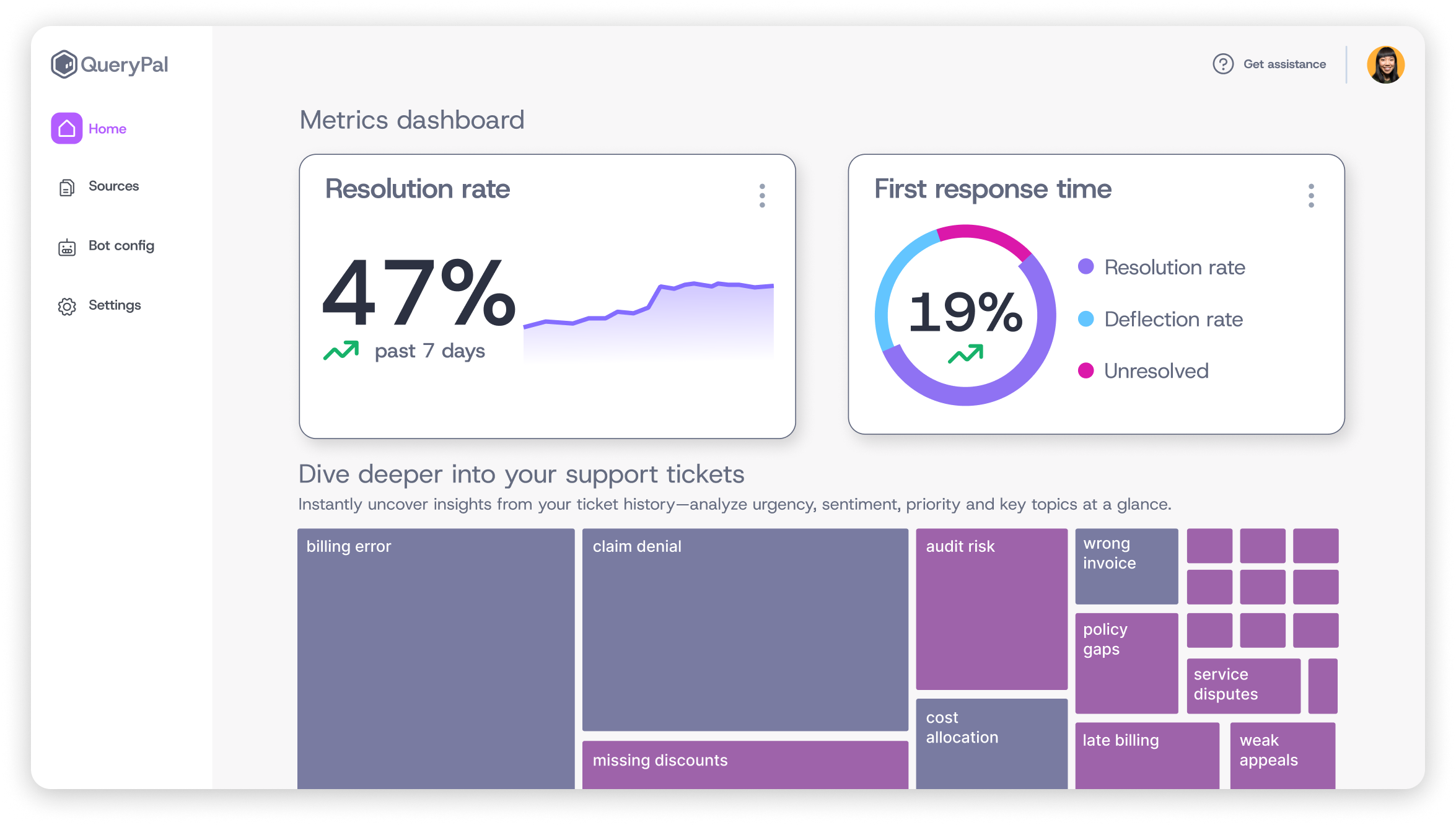
- They'll measure resolution, not deflection. If your AI dashboard tracks "tickets avoided" instead of "issues fully resolved," you're optimizing for the wrong number. The two terms are not interchangeable: self-service and case deflection describe distinct outcomes, and treating them the same is exactly what causes teams to chase a vanity metric while resolution quality erodes. Customers know when they've been deflected, and the customer service metrics that matter will show it.
- They'll obsess over AI accuracy. A system that handles high ticket volume but gets a meaningful percentage of answers wrong does more harm than good. The strongest deployments monitor resolution quality closely and feed mistakes back into the system so it improves continuously.
- They'll treat agent experience as inseparable from customer experience. Burned-out agents deliver burned-out service. The best customer support automation implementations free agents from drudgery and give them headspace to do meaningful work, which shows up in every customer interaction.
- They'll be honest about what's AI and what's human. Companies that disguise AI as a person or bury the option to reach a real agent will keep feeding the distrust cycle. The ones that are transparent and make handoffs smooth will build loyalty their competitors can't match.
The future of customer service belongs to organizations that treat AI as a force multiplier for their support teams.
That means deploying AI capable of genuine resolution and keeping humans where they add the most value, while earning customer trust through consistent results instead of promises.
The future of support operations depends on getting this balance right.
If your team is overwhelmed and your customers are feeling it, the technology to fix that exists right now.
QueryPal's agentic AI resolves the complex, multi-step support issues that first-generation tools can't touch, from billing disputes to technical troubleshooting that spans multiple internal systems.
Built by a team with 30+ AI patents, the platform deploys inside your own infrastructure, so your compliance team signs off faster and your data never leaves your environment.
See how it works with your current helpdesk, or request a demo to see resolution quality in action.

Activate your free
6 week trial
& white-glove integration support.
Cut support costs by 60%, slash response & resolution times, improve your customer experiences, & reduce agent burnout. Find some time with us to show you how.