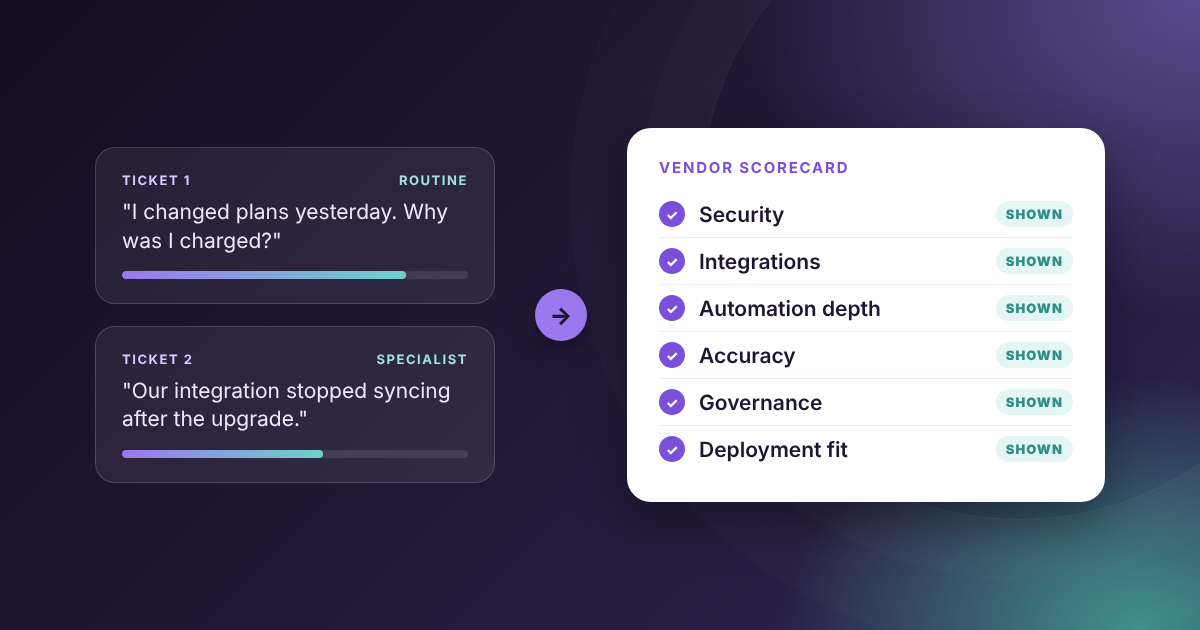
- Run the two-ticket test: give every vendor the same routine request that takes judgment and the same difficult case that usually goes to a specialist.
- Score security, integrations, automation depth, accuracy, governance, and deployment fit, and give full credit only for what is demonstrated on your tickets.
- Compare vendors on verified resolution and cost per verified resolution, including human review time.
To evaluate agentic AI customer support platforms, run every vendor through the same two de-identified tickets from your queue and score six criteria: security, integrations, automation depth, accuracy, governance, and deployment fit. Give full credit only for what the vendor demonstrates on your tickets, not for what it documents or promises.
We call this the two-ticket test: a vendor evaluation that gives every platform the same everyday request that takes judgment and the same difficult case that usually goes to a specialist.
Consider two fictional examples. A customer changed plans yesterday, sees an unexpected charge, and wants a refund. Another customer’s integration stopped syncing after an upgrade. Can the platform help a rep explain the charge and apply the right policy? Can it help a specialist verify that syncing resumed?
This guide is for choosing a vendor. To test a platform you have already shortlisted, see how to evaluate an AI support agent before deployment.
How should we shortlist agentic AI customer support platforms?
Shortlist only platforms that pass your mandatory conditions on your own tickets, then compare those platforms on the six criteria below. An agentic platform can choose a next step and use tools within the permissions you grant it. Before the demos, have Support and IT agree on which steps the agent may take independently and which conditions every vendor must satisfy. Give each vendor the same two de-identified tickets, sandbox records, and success criteria.
Mark each criterion unverified, documented, or demonstrated on our case. Record a failed mandatory condition separately so a high score elsewhere cannot conceal it.
What should we send vendors before a demo?
For a billing ticket, give vendors the plan history, the invoice, and the refund policy in force on the date of the charge. For a technical ticket, supply the installed version, relevant procedures, and a sandbox where a new source record can be traced to its destination. Tell vendors which actions need approval. Save one variation for the live session: move the plan change across a billing cutoff, for example, and see whether the explanation changes for the right reason.
Have a frontline rep and a technical specialist work comparable cases with their usual tools. Record active minutes spent finding evidence, correcting an answer, or briefing a colleague. Capture time waiting for approval separately. Those baselines let each team judge whether a faster draft actually saves work.
How do we test which customer records the agent can access?
Test record access by giving the agent a restricted test identity and confirming that another customer’s records appear in neither its sources nor its reply. Use a sandbox with two customers who changed plans on the same day. Give the test rep access to one account. Ask the AI to explain the invoice and show which account events and policy passages support its answer. Include identifiable dummy invoice numbers so the reviewer can spot a record from the wrong account. Check the retrieved sources as well as the customer-facing reply.
Revoke the permitted access and repeat after the vendor’s documented propagation interval. Ask your security reviewer to record which records were accessible in each run. For the permission model behind this test, see least privilege for AI agents.
Request a data-flow diagram for the exact deployment being quoted. Follow one attachment from the helpdesk through retrieval, the model endpoint, and the audit log. Who can see each copy, how long is it kept, and what happens when the ticket is deleted? Have the vendor identify any settings your administrators must enable for the proposed boundaries to hold.
How do we verify that a backend action actually completed?
Verify a backend action by reading the target system again after the agent reports success. For example, if a customer’s integration stops syncing after an upgrade, ask the agent to read the installed version, request an approved restart, and check the job’s state in the backend. Have a support engineer follow the case ID and job ID from the helpdesk to the underlying record.
Now simulate a timeout after the backend accepts the request. The agent has lost the acknowledgment. Does it check the existing job before trying again? A second restart could interrupt recovery already in progress. Record whether the integration handles this case today, what custom work it requires, and who will maintain it.
Can the platform use our existing knowledge base or RAG system?
If you already use retrieval-augmented generation (RAG), ask each vendor to demonstrate how it would query your existing retrieval service or index approved sources separately. Give it two procedures with the same symptom and different supported versions. Ask which passage it used, how source permissions traveled with the request, and when a correction to the procedure becomes available to agents. Record who would own reindexing and troubleshooting if stale instructions reached a customer.
When should an AI agent hand a case to a person?
An AI agent should hand a case to a person when the request exceeds its authority, when it cannot verify that a fix worked, or when policy requires approval. For a fuller set of triggers, see QueryPal’s guide to AI support agent handoffs.
Take a customer who sees an unexpected charge after changing plans. Let the AI trace the charge to the plan change and draft an explanation. Then have the customer ask for a courtesy refund that requires supervisor approval. Check whether the rep can route the request without promising a refund before someone has approved it.
Open the case as the receiving supervisor. Can they see the disputed amount, the effective policy, the customer’s request, and the decision they need to make? A handoff that makes the customer repeat the story adds effort even if the first response arrived in seconds.
Specify the handoff for technical cases too. If a sync job restarts and no new records arrive, the specialist needs the version, the job ID, and the failed verification. Score what each team receives. A summary can be enough to approve a small billing exception while leaving an engineer short of the evidence needed to diagnose a sync failure.
Which accuracy metric tells us whether the fix worked?
Verified resolution is the accuracy metric that shows whether the fix worked. Verified resolution means the requested outcome was completed correctly and confirmed in the system of record or by a reviewer, rather than inferred from a closed conversation. Report it at closure and again after an agreed follow-up period, because some tickets reopen.
Measure verified resolution across all eligible tickets. For an approved refund, look for the matching credit on the account. For a charge explained correctly under the policy, have a reviewer check the explanation against the invoice. Track repeat contacts about the same charge, including contacts that open a new ticket. For a sync failure, look for a new record at its destination.
Ask each vendor how it verifies a resolution. Zendesk, for example, says an LLM evaluates the text of the conversation to confirm that the request was satisfactorily resolved. Conversation text alone cannot show that a credit posted or that a sync resumed, so pair any vendor’s resolution count with a check of the target system.
Suppose 100 tickets qualify, 70 close automatically, and 60 have a verified fix. Five of those 60 reopen for the same issue within seven days. Automatic closure is 70%. Verified resolution at closure is 60%. The share verified and still resolved at day seven is 55%. Compare vendors on the same mix of routine cases and difficult escalations, and record human review time alongside those rates.
How much time does AI save a customer service rep?
Compare active handling time on similar tickets with and without assistance. Include source checks, corrections, and any specialist time needed after handoff. If a draft arrives instantly but takes four minutes to correct, those four minutes belong in the comparison. Break out billing questions and technical escalations so the result reflects the work each team does.
Who can approve, investigate, and stop an action?
A named person should approve each sensitive action, a reviewer should be able to reconstruct it, and an authorized operator should be able to stop automation without the vendor. Give a support lead the audit record for a billing exception. Can they identify who approved it, which policy was in force, which tool ran, and what the backend reported? Let them reconstruct the sequence without a vendor walkthrough. That is the evidence they would have during an incident.
Ask the authorized operator to pause automated credits. Open another eligible case and check that it routes to a person. Document who can restore automation. For a fuller list of fields, see QueryPal’s guide to support AI audit trails.
Also ask what happens when someone edits the approved procedure a week later. Can an investigator recover the version that governed the original case? Have the reviewer trace one case from before the edit and one from after it. This is a practical way to find out whether the records will still explain a customer complaint next month.
Which deployment can our team operate and afford?
Choose the deployment whose data flow, on-call ownership, and cost per verified resolution your team can accept. For each proposed configuration, identify where ticket data goes, which model endpoint receives it, and who owns credentials, upgrades, connector failures, and on-call support. Ask a mid-market team who would take the call overnight. At a larger enterprise, ask Support, IT, and the vendor to name the owner of each handoff.
Compare cost per verified resolution over the same period:
Cost per verified resolution = (platform fees + model usage + integration and operating labor + human review and rework) ÷ verified resolutions
Count bundled charges once and spread setup costs over the same period for every vendor. Request figures for an ordinary month and a volume spike. Pricing units differ by vendor, so see per-resolution vs. per-conversation pricing before comparing quotes.
What does cost per verified resolution look like in practice?
Consider two illustrative monthly quotes for the same 1,000 eligible tickets. With fees and labor included, platform A costs $6,000 and delivers 500 verified resolutions, or $12 each. Platform B costs $5,000 and delivers 350, or about $14.29 each. Use that comparison alongside coverage and quality: check which customers still needed help and whether your team can handle the remaining queue. Ask Finance to recalculate both quotes using your own traffic and observed review time.
When should a support team shortlist QueryPal?
Consider QueryPal when your customer service reps regularly consult policies and previous cases before answering, or your technical specialists need product documentation to resolve an escalation. QueryPal’s agent assist brings relevant information into a source-backed draft inside the helpdesk for an agent to review. JetBrains reports a 90% agent upvote rate. That measures how agents rated the output. To estimate the benefit for your queue, time the review and check what happened to the customer’s issue afterward.
Ask QueryPal to prepare a draft for each team. Can the frontline rep explain the charge, cite the applicable policy internally, and send a clear answer in their own voice? Can the specialist distinguish two procedures for different software versions? Let each reviewer identify what they would change and time the edits.
Deployment can also determine whether QueryPal belongs on the shortlist. QueryPal describes fully hosted, managed hosting, and self-hosted options. Ask for a diagram and a price for the option you would actually buy. In particular, establish who operates the model endpoint and whether source documents, diagnostic logs, or support personnel cross your environment’s boundary. Bring the answers to your security reviewer while there is still time to change the proposed configuration.
Which vendor earns the pilot?
Give the pilot to the vendor that meets every mandatory condition and shows the strongest evidence on your tickets. Suppose one vendor drafts the clearest answer but retrieves a restricted customer record. A second respects permissions and verifies the restart but needs a custom connector. If customer isolation is mandatory, eliminate the first configuration. For the second, get the connector price, delivery date, and maintenance owner in writing before committing a pilot slot.
Write down what the pilot must settle. For example, the support lead might own the resolution measure, IT might own connector reliability, and Finance might own the cost calculation. Agree on the decision date and who can accept each result before the pilot starts.
What should the buying team take away from the demo?
Write one decision sentence for each vendor and attach the evidence behind it. For example: “Advance vendor B for agent-assisted tickets on versions we support, subject to a fixed connector quote and a successful replay of the interrupted restart.” That gives procurement a specific commitment to negotiate and the pilot team a clear first test. It also preserves the distinction between a capability the buyer observed and one the vendor expects to deliver later.
Frequently asked questions
What is the difference between agentic AI and a chatbot in customer support?
A basic chatbot mainly answers questions. An agentic AI platform can also choose a next step and use tools, within the permissions you grant, to act on the request. The practical test is whether it can complete an approved action in another system and confirm the result.
How long should an AI support platform evaluation take?
An evaluation should run long enough to complete both tickets, repeat the access and timeout tests, and observe the full follow-up period you chose for reopened tickets. If that period is seven days, results from the day of the demo cannot show whether a fix held.
How many tickets do you need to evaluate an AI support vendor?
Two well-chosen tickets can expose disqualifying gaps and help narrow a shortlist. They cannot estimate a resolution rate. For a pilot, include enough cases in every important ticket type and risk level to compare results with your own baseline.
What is the difference between deflection rate and verified resolution rate?
Deflection rate measures how much work automation keeps away from human agents. Verified resolution rate measures the share of eligible tickets whose requested outcome was completed and confirmed. A customer who gives up can count as deflected without being helped. See what deflection rate measures for more.
What are the red flags in an AI support demo?
Be cautious when a vendor will not use your tickets, cannot show the sources behind an answer, reports an action as complete without reading the target system again, cannot show who approved an action, or counts closed conversations as resolutions.
Run the two-ticket test on your own queue
Bring your scorecard and a representative ticket from each queue to a QueryPal walkthrough. Once you have a shortlist, use the predeployment evaluation guide to design a pilot against your own support baseline.