What Is Deflection Rate? Optimizing One of CX's Most Important Metrics
Your ticket queue keeps growing. Agents are spending half their day answering the same password reset and shipping status questions.
Every new hire seems to pile on more complexity without draining the backlog. This is where deflection rate becomes the number your leadership team wants to see.
But deflection rate is more complicated than most dashboards make it look. A high number can mean your self-service is working beautifully, or it can mean customers are giving up and churning quietly.
This guide breaks down what deflection rate measures, how to calculate it accurately, and how to improve it without pushing frustrated customers into the void.
What Is Deflection Rate in Customer Service?
Deflection rate is the percentage of incoming support requests that get resolved through self-service channels, like knowledge bases, chatbots, FAQ pages, or automated workflows, rather than reaching a human agent.
It measures how effectively your support infrastructure handles requests before they become tickets.
The metric originated in IT service management, where teams tracked how many help desk requests could be handled without a technician.
Today, it has expanded across every customer-facing support function and has become one of the primary metrics CX leaders use to justify AI and automation investments.
The catch is that "deflected" does not automatically mean "resolved." A customer who reads a help article and leaves without submitting a ticket counts as deflected.
But did they get their answer, or did they give up? That distinction is everything.
How to Calculate Your Deflection Rate
The core formula is straightforward.
Deflection Rate = (Deflected Requests / Total Incoming Requests) x 100
If your support org receives 10,000 requests in a month and 3,500 are handled through self-service channels without agent involvement, your deflection rate is 35%.
The hard part is defining what counts as a "deflected request." Some teams count any self-service interaction. Others only count cases where a customer explicitly confirmed their issue was resolved.
As DB Kay & Associates has pointed out, most organizations struggle with this measurement because they cannot reliably track the interactions that never became tickets.
Define your criteria before you start measuring. Document what channels count (knowledge base visits, chatbot completions, in-app guides) and what threshold constitutes a successful deflection.
Without clear definitions, you'll end up comparing numbers that mean different things across quarters.
What's a Good Deflection Rate? Benchmarks Worth Tracking
Benchmarks vary widely by industry, company size, and what you count as deflection. That said, here are practical ranges based on industry data.
- 20-40% is typical for teams with basic self-service (a knowledge base and a simple chatbot).
- 50%+ is common for mature support operations with well-maintained knowledge bases and AI-powered automation.
- 80%+ is achievable for products with repetitive, well-documented support scenarios, but only if resolution quality stays high.
The right target depends on your product complexity and customer base. A B2B software company with technical enterprise clients will naturally have a lower deflection rate than a consumer app with simple account questions.
Compare against your own baseline, not generic industry numbers.
Why Deflection Rate Matters for Your Support Team
Every ticket that reaches a human agent costs money. Industry estimates put the average cost per ticket between $6 and $12, and complex tickets that require escalation can cost far more. The latest help desk statistics show these costs continuing to rise as ticket complexity increases. When your deflection rate improves, those costs drop directly.
When your deflection rate improves, those costs drop directly.
Gartner projects that by 2029, 80% of customer service organizations will apply generative AI in some form, with early adopters reporting up to 30% reductions in support costs. Deflection is the primary mechanism behind those savings.
But cost is only part of the picture. High-volume repetitive tickets burn out your best agents. Nobody went into customer support to answer "reset my password" tickets eighty times a day.
Effective deflection frees agents to focus on complex, high-value conversations where human judgment matters.
Scale matters too. Hiring another support agent typically costs tens of thousands of dollars annually when you factor in training, benefits, and tooling.
If your ticket volume is growing 20% year over year, you cannot hire your way out of it. Improving deflection is how support teams scale without linearly increasing headcount.
Customers benefit too. Most people prefer solving simple issues themselves rather than waiting in a queue. When self-service works, resolution happens in seconds instead of hours.
The Deflection Trap: When a High Rate Hurts More Than It Helps
This is where most companies get deflection wrong. They optimize for the number itself and lose sight of what it's supposed to represent.
Gartner research found only 14% of customer service issues are fully resolved through self-service alone. That means much of what most teams count as "deflected" amounts to "delayed" or "abandoned."
The customer could not find their answer, gave up on the chatbot, and either tried again later or just lived with the problem. Broad customer experience statistics reinforce this pattern, showing that failed self-service attempts directly increase churn risk.
The danger comes when AI tools provide a confident answer that happens to be wrong. A customer who gets incorrect instructions from a chatbot and follows them does not show up as a failed deflection.
They show up as a successful one, because they never submitted a ticket. The damage shows up later in churn data, not in your deflection dashboard.
A better approach is to measure your 48-hour re-contact rate. If a customer was "deflected" but comes back with the same issue within two days, that deflection failed.
Track this number alongside your deflection rate and you'll get a more honest picture of performance.
The mindset shift that matters here is moving from "how many tickets did we avoid" to "how many issues did we resolve without human help."
That single reframe changes everything about how you evaluate your automation tools and self-service content.
Deflection Rate vs. Resolution Rate
These two metrics get conflated constantly, but they measure fundamentally different things. Deflection rate measures efficiency. Resolution rate measures effectiveness.
You can have a 70% deflection rate and a terrible customer resolution experience if most of those deflections are customers who could not find help and gave up.
A 30% deflection rate with near-perfect resolution might be exactly what your customer base needs.
Think of it this way. If your chatbot deflects 100 tickets in a week but only 72 of those customers got their problem fixed, your real success rate is 72%, not 100%. The other 28 customers either come back later (increasing your real ticket volume) or leave quietly.
The best support teams track both metrics together. Deflection rate tells you how much work your automation is handling. Resolution rate tells you how well it is handling it.
How to Improve Your Deflection Rate Without Sacrificing Quality
Build a Knowledge Base Worth Reading
Most knowledge bases fail because they were written for internal teams, not customers. Start by auditing your top 20 ticket categories. For each one, check whether a corresponding help article exists, whether it answers the question, and whether a customer can find it.
Rewrite internal documentation in customer-facing language. Skip the technical jargon. Use the exact words your customers use in their tickets. If they call it "my account is locked," don't title the article "Account Authentication Error Resolution."
Format matters too. Short paragraphs, step-by-step instructions with screenshots, and clear headings make the difference between an article that deflects tickets and one that generates them.
Review and update your top articles monthly. Stale documentation is often worse than no documentation.
Use AI That Resolves, Not Just Redirects
Traditional chatbots deflect by redirecting customers to articles or FAQ pages.
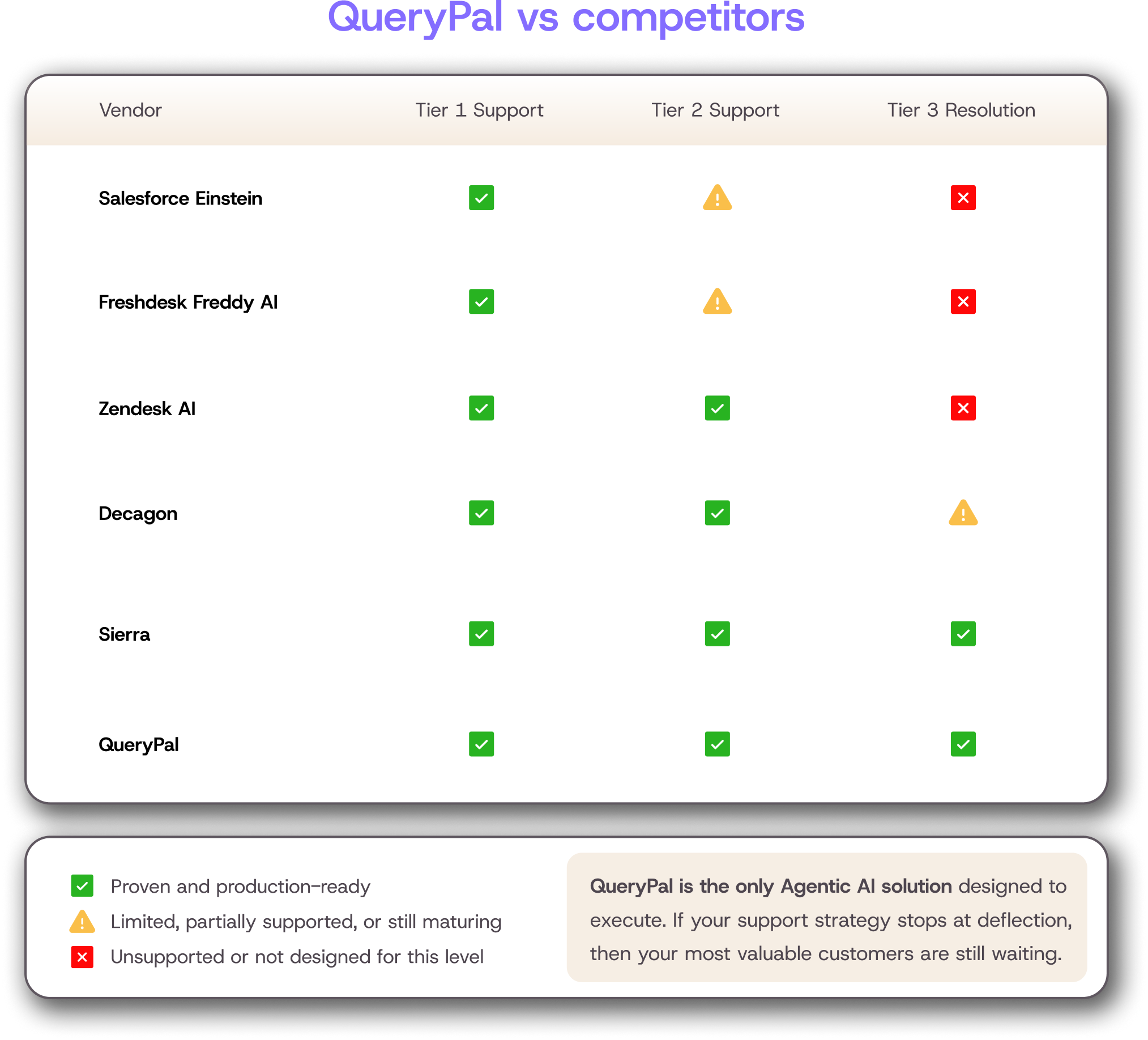
Agentic AI takes a different approach.
Instead of pointing customers toward answers, it pulls from your documentation, past tickets, and internal systems to deliver direct, contextual answers.
QueryPal Intercept, for example, sits inside ticketing systems like Zendesk and Jira and resolves issues before they become tickets. Its internal data shows 90% approval ratings and 70% faster time-to-resolution.
The key difference is that these tools measure whether the customer's issue was solved, not whether a ticket was avoided.
When evaluating AI tools for deflection, ask one question first. Does this tool measure resolution, or does it just measure redirection? The answer tells you whether you're buying a real improvement or a better-looking dashboard.
Analyze Ticket Patterns to Find Automation Opportunities
Not every ticket type is a good candidate for deflection. Pull your top 10 most repetitive ticket categories and evaluate each one.
How complex is the resolution? How much context does the agent need to resolve it? How much risk is involved if the automated answer is wrong?
Start with high-volume, low-complexity issues like password resets, order status checks, and basic how-to questions.
These have clear, repeatable answers and low risk if the automation gets something slightly off. Leave complex issues like billing disputes, technical escalations, and safety-related concerns to human agents until your AI can prove it handles them accurately.
Always measure resolution alongside deflection when you automate a new category. If your deflection rate goes up but your re-contact rate spikes, the automation is creating problems, not solving them.
Make Self-Service Easy to Find and Use
The best knowledge base in the world does not help if customers cannot find it. Embed self-service options directly where customers are already looking for help.
- In-app help widgets that surface relevant articles based on what page the customer is on
- Contextual suggestions in the ticket submission form that show related articles before the customer hits "submit"
- Proactive prompts that appear when a customer appears stuck on a specific workflow
- Search functionality that understands natural language, not just exact keyword matches
Every extra click between the customer's problem and the answer reduces the chance of successful deflection. Meet them where they are.
Metrics That Work Alongside Deflection Rate
Deflection rate tells part of the story. To get the full picture, pair it with these metrics.
- CSAT (Customer Satisfaction): Are deflected customers happy with the outcome? Survey them after self-service interactions to find out.
- First Response Time: Effective deflection should reduce queue volume, which should improve response times for the tickets that do reach agents.
- Resolution Rate: What percentage of deflected interactions resulted in a resolved issue? This is the single most important companion metric.
- Re-contact Rate: If deflected customers come back within 48 hours with the same issue, your deflection is not working.
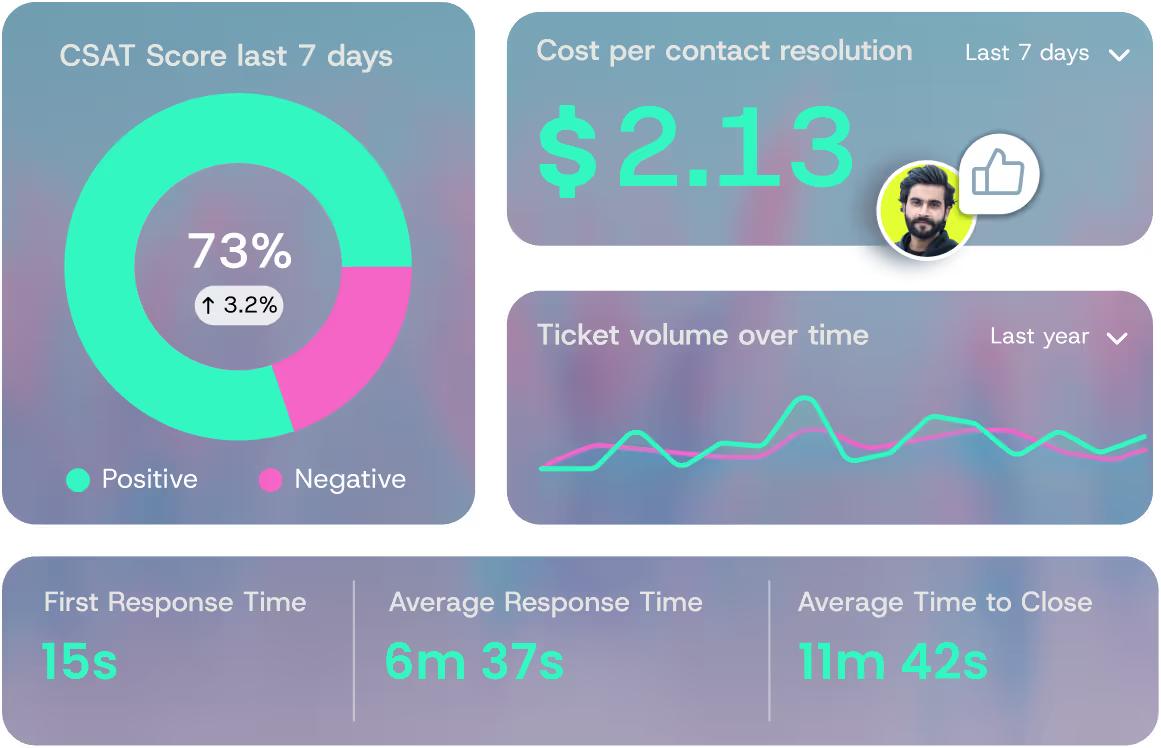
- Cost Per Resolution: Compare the cost of resolving an issue through self-service vs. human agents. This quantifies the ROI of your deflection investments.
No single number tells you whether your support operation is healthy.
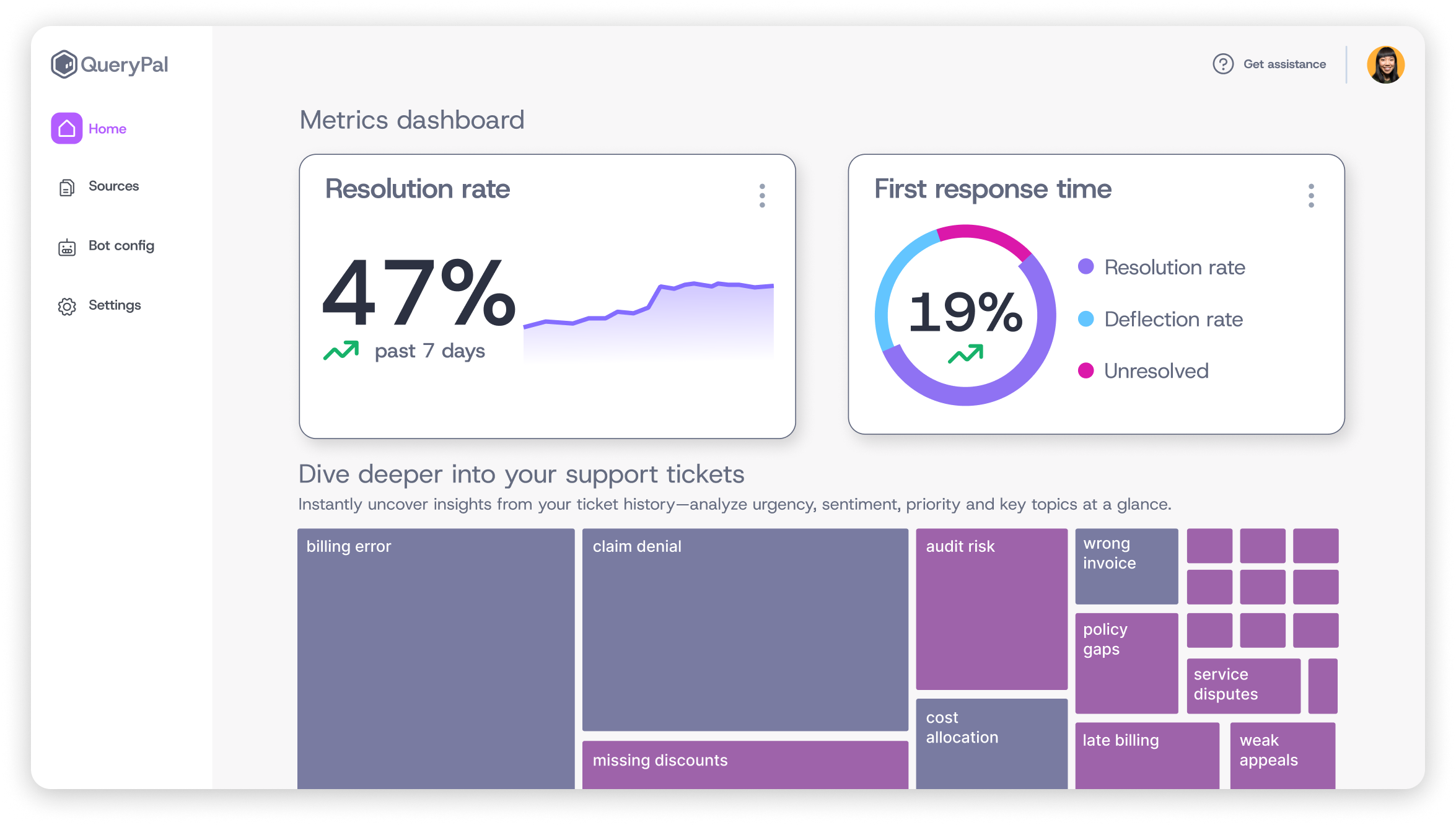
These metrics together give you the context that deflection rate alone cannot provide.
Making Deflection Work for Your Team
Deflection rate is a powerful metric when you use it honestly. Measure it alongside resolution quality. Define your criteria clearly. And never optimize for the number at the expense of the customer experience.
The teams that get this right aren't chasing the highest deflection rate they can reach. They're building support systems that resolve issues fast, whether that happens through a help article, an AI agent, or a human.
QueryPal Intercept was built for that second category. It handles the repetitive Tier 1-3 questions burning out your team and only escalates the cases that genuinely need a human touch.
The platform is self-hosted, SOC 2 Type 2 compliant, and built on technology from a team with 30+ AI patents, with internal data showing 90% approval and 70% faster time-to-resolution inside the ticketing systems your agents already use.
If you're ready to cut your backlog without trading away customer satisfaction, explore what QueryPal can do for your support operation.

Activate your free
6 week trial
& white-glove integration support.
Cut support costs by 60%, slash response & resolution times, improve your customer experiences, & reduce agent burnout. Find some time with us to show you how.