Help Desk Statistics & Data to Know in 2026
The help desk has become the place where AI strategy meets daily reality.
Tickets keep climbing, customers expect first-contact resolution, and the economics of automated support are shifting fast.
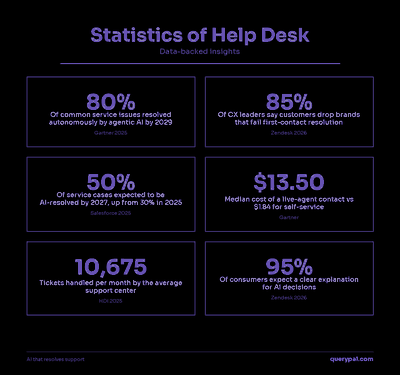
Gartner projects that agentic AI will autonomously resolve 80% of common customer service issues by 2029, with a 30% cut in operational costs.
At the same time, Zendesk reports that 85% of customer experience leaders say customers will drop a brand that cannot resolve an issue on first contact.
The support teams that win in 2026 read both numbers as the same instruction, resolve more, resolve faster, and let people handle what only people can.
Key Help Desk Statistics at a Glance
- 80% of common customer service issues will be resolved autonomously by agentic AI by 2029, cutting operational costs 30% (Gartner, 2025).
- 85% of CX leaders say customers will drop a brand that cannot resolve an issue on first contact (Zendesk, 2026).
- 50% of service cases are expected to be resolved by AI by 2027, up from 30% in 2025 (Salesforce, 2025).
- 20% less time on routine cases for reps using AI, about four hours back per week (Salesforce, 2025).
- $13.50 median cost of a live-agent contact, against roughly $1.84 for self-service (Gartner).
- 10,675 tickets handled per month by the average support center (HDI, 2025).
- 51% of customers would let a generative AI assistant handle a service interaction on their behalf (Gartner, 2025).
- 95% of consumers expect a clear explanation for decisions an AI makes (Zendesk, 2026).
The Cost of a Help Desk Ticket
Cost per ticket is the number that drives most support budgets, and the gap between channels is wide.
Gartner benchmarks put the median cost of an assisted contact, anything that involves a live agent across phone, chat, or email, at about $13.50, against roughly $1.84 for self-service.
That spread is why deflection has moved from a nice-to-have to a core metric. Every ticket a customer resolves on their own, or that an AI agent handles end to end, is a contact that never reaches the $13.50 tier. Inside the human queue the economics steepen again, with tier 1, tier 2, and tier 3 help desk support running from about $22 per ticket at the front line to $85 or more for expert escalations.
The freshest twist for 2026 is that AI economics are no longer a one-way slide toward zero.
Gartner now predicts that by 2030 the cost per resolution for generative AI will exceed $3, higher than many B2C offshore human agents, as data-center costs rise and vendors pivot from subsidized growth to profitability.
The same forecast expects 10% of Fortune 500 companies to double their service spending by 2030 to fund hyperpersonalized support.
The lesson for help desk leaders is that automation pays off when it is aimed at the right tickets, not sprayed across all of them, a discipline that sits at the core of modern helpdesk best practices.
Tools like QueryPal's Intercept ticket and email deflection earn their keep by resolving the high-volume, low-complexity tickets where the math works best.
Ticket Volume and Help Desk Workload
The volume picture explains the urgency. The HDI State of Tech Support 2025 report found that the average support center now processes 10,675 tickets a month, and 34% of leaders say their volumes are still rising.
Each user contacts the help desk about 1.25 times a month, so volume scales with headcount whether or not the support team grows with it.
Training is the quiet bottleneck behind that load. HDI found that only around 40% of support organizations give staff more than ten days of ongoing training a year, and hiring has cooled to 82% of teams filling roles, down from the 92% peak in 2022.
Rising volume against thin training and slower hiring is the structural problem every help desk faces in 2026, and hiring alone cannot close it.
The practical move is to take repetitive, well-understood tickets off the human queue entirely so agents can spend their hours on the cases that actually need judgment.
AI Resolution and Ticket Deflection
This is where the 2026 data gets genuinely new.
The Freshworks Customer Service Benchmark Report 2025 analyzed more than 187 million tickets across 10,551 organizations in 118 countries and found that AI agents now deflect over 45% of incoming queries, with early adopters of agentic workflows averaging 65% deflection and some reaching 80%.
AI-powered support also pulled average first response time down from over six hours to under four minutes.
Salesforce puts the trajectory in plain terms.
In its 2025 State of Service research, half of all service cases are expected to be resolved by AI by 2027, up from 30% in 2025.
Reps already using AI spend 20% less time on routine cases, about four hours back each week, and 88% of service professionals say conversational AI accelerates resolution times.
Data quality decides whether that payoff shows up. Salesforce found that companies which unify their service channel data are 1.4 times more likely to report a very successful AI rollout.
QueryPal's Concierge agentic AI chatbot is built for exactly this split, resolving the routine front line so human agents inherit a cleaner, more complex queue.
Customer Expectations and First Contact Resolution
Customers have set the bar, and the help desk has to clear it.
The Zendesk CX Trends 2026 report, built on responses from more than 11,000 consumers and CX leaders across 22 countries, found that 85% of CX leaders say customers will drop a brand that cannot resolve their problem on first contact.
Context is the new expectation. 81% of consumers want a representative to pick up exactly where they left off rather than starting over.
Trust in AI now hinges on transparency. The same Zendesk research found that 95% of consumers expect a clear explanation for decisions an AI makes, yet 80% of CX leaders admit transparency will soon be required for customer-facing AI while only 37% currently offer any reasoning behind an AI decision.
A help desk that resolves fast but cannot explain itself loses the goodwill it just earned. Surfacing the right context to both the customer and the agent is the difference, and that is the case for pairing automation with analytics through a layer like QueryPal's Prism enterprise analytics.
The Shift Toward Autonomous Support
The headline prediction for the rest of the decade is autonomy. Gartner forecasts that agentic AI will autonomously resolve 80% of common customer service issues by 2029, driving a 30% reduction in operational costs, as AI moves from drafting replies to taking real action on a customer's behalf.
Customers are ready to meet it partway. Gartner also found that 51% of customers would let a generative AI assistant handle a service interaction on their behalf, from a survey of nearly 4,900 people.
The channel mix is shifting to match. A separate Gartner survey of 265 service leaders found that self-service and live chat will overtake phone and email as the most important service technologies by 2027.
Adoption pressure is real. Gartner found that 91% of service leaders feel pressure from executives to put AI to work, and 75% saw their AI budgets rise year over year.
Autonomous resolution at scale still needs clean knowledge, tight integrations, and guardrails, which is why early adopters report strong returns while laggards stall.
Help desk leaders weighing the move can pressure-test the economics first with a tool like QueryPal's customer service ROI calculator before committing budget.
What's New in 2026 for Help Desks
Three shifts separate this year from the last. First, the cost story has reversed direction.
Gartner now expects generative AI cost per resolution to climb past $3 by 2030, so the cheapest path is no longer to automate everything but to automate precisely.
Second, autonomous resolution has moved from pilot to plan, with Gartner's 80% by 2029 figure giving leaders a concrete target.
Third, customer patience has thinned, with Zendesk's 2026 data showing that a failed first-contact resolution now costs the relationship for 85% of CX leaders.
Regulation is the wildcard. Gartner expects assisted service volume to rise 30% by 2028 as new rules guarantee customers the right to reach a human agent, which will force many organizations to keep or even grow their human teams even as automation expands.
The market is funding all of it. Gartner predicts that over half of customer service organizations will double their technology spend by 2028. That money has somewhere to go.
Future Market Insights values the global help desk software market at $14.3 billion in 2025, growing at about 9.4% a year toward $35 billion by 2035.
Spending is following the data, toward platforms that deflect routine tickets, resolve faster, and keep humans focused on the hard cases.
How QueryPal Helps
QueryPal builds agentic AI that resolves support tickets rather than just routing them, so teams can meet rising volume without adding headcount or sacrificing the first-contact resolution customers now demand.
If these numbers match what your help desk is facing, our resource library is a good place to see how the math plays out, or you can book a demo to map it to your own queue.

Activate your free
6 week trial
& white-glove integration support.
Cut support costs by 60%, slash response & resolution times, improve your customer experiences, & reduce agent burnout. Find some time with us to show you how.