The 11 Best Forethought Alternatives & Competitors in 2026
The top options in 2026 fall into four clear groups: AI-native agentic platforms, omnichannel CX suites, enterprise CRM-integrated platforms, and lightweight AI add-ons that sit on top of your existing help desk.
Together, these cover most support setups, from scrappy SaaS teams to complex global enterprises, so you can match tools to how your operations actually work instead of forcing your workflows to fit the tool.
Here is the fast TL;DR by tool: QueryPal is for maximizing automation depth, internal and external support, and strict enterprise compliance.
Zendesk AI is for current Zendesk users who need real omnichannel scale. Intercom Fin focuses on chat-first SaaS companies.
Freshdesk fits cost-efficient multichannel support. Ada is for high-volume automation with strong NLP.
Customer fits relationship-driven brands that need CRM-style context.
Gladly is for premium brands that care about personal service. Salesforce Service Cloud supports enterprises that need deep CRM workflows.
Crescendo helps teams that want a hybrid AI plus human managed service. Eesel is for teams that want AI on top of existing help desks. ServiceNow CSM fits enterprises that want cross-department service management.
How We Evaluated the Best Forethought Alternatives
We picked the best alternatives by judging how they work in real support teams.
For each tool, we looked at feature depth, especially AI and automation, how hard it is to implement and set up, how clear the pricing and total cost really are, how well it plugs into your current stack, how it scales for high ticket volume, and how it handles data security, compliance, and different hosting options.
Behind the scenes, we used a weighting system that scores each product across AI automation strength, usability for agents and admins, and extensibility.
We combined numbers with human judgment, using both qualitative and quantitative scoring. We applied a similar framework in our Decagon vs. Sierra vs. QueryPal comparison, which focuses specifically on the three platforms teams ask about most.
The 11 Best Forethought Alternatives & Competitors in 2026
1. QueryPal
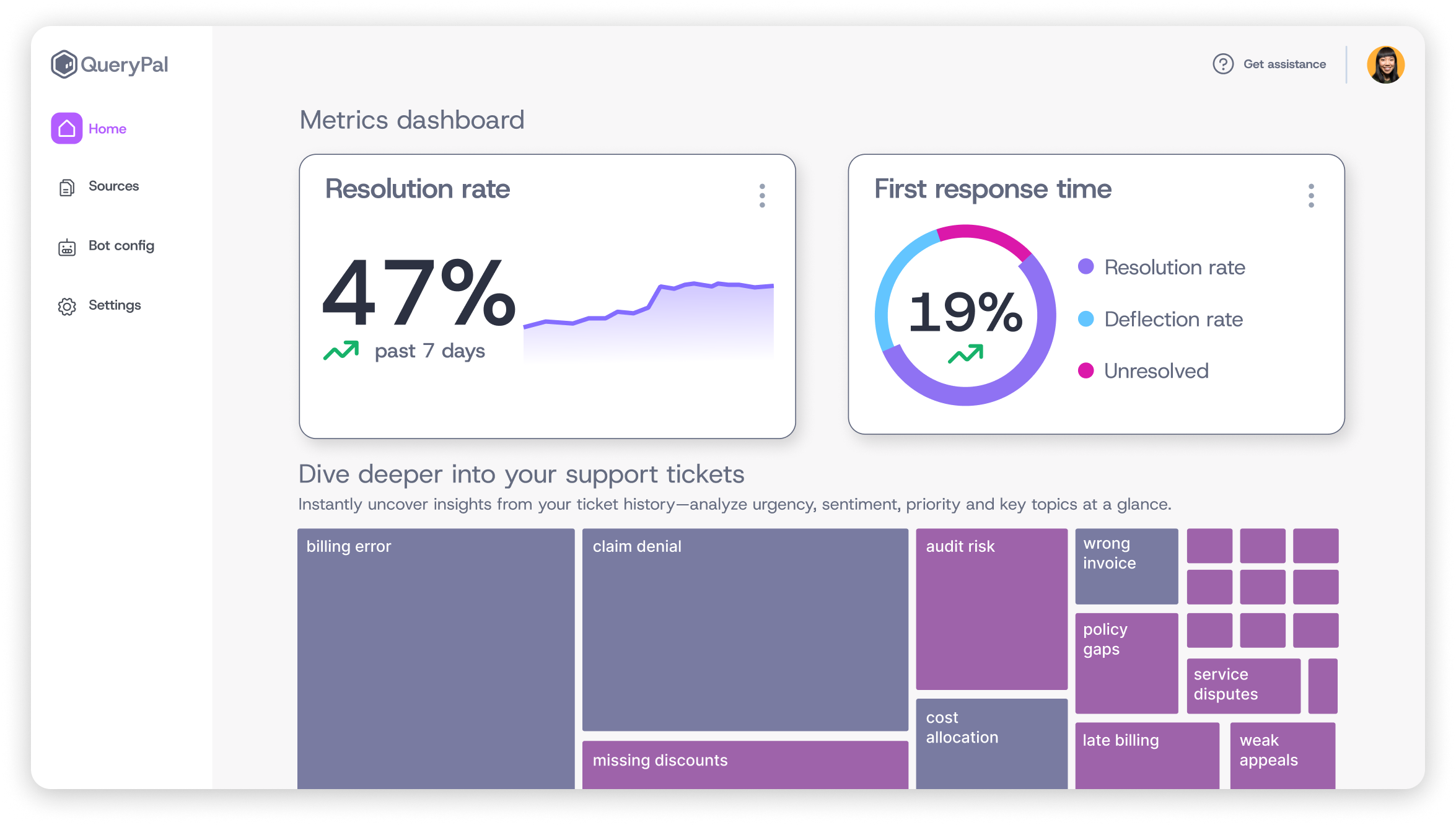
QueryPal focuses on deep AI support automation so human agents can handle fewer tickets. It cuts support costs by about 60 percent and shortens resolution times by taking actions on its own, like changing account settings, pulling records, or updating orders.
It bundles Intercept for ticket automation, Prism for analytics, and Concierge as the AI chatbot, and supports SOC 2, GDPR, and even self-hosted AWS deployment.
It connects with Zendesk, Freshdesk, Intercom, Salesforce, ServiceNow, Slack, Teams, Notion, Google Drive, and Confluence.
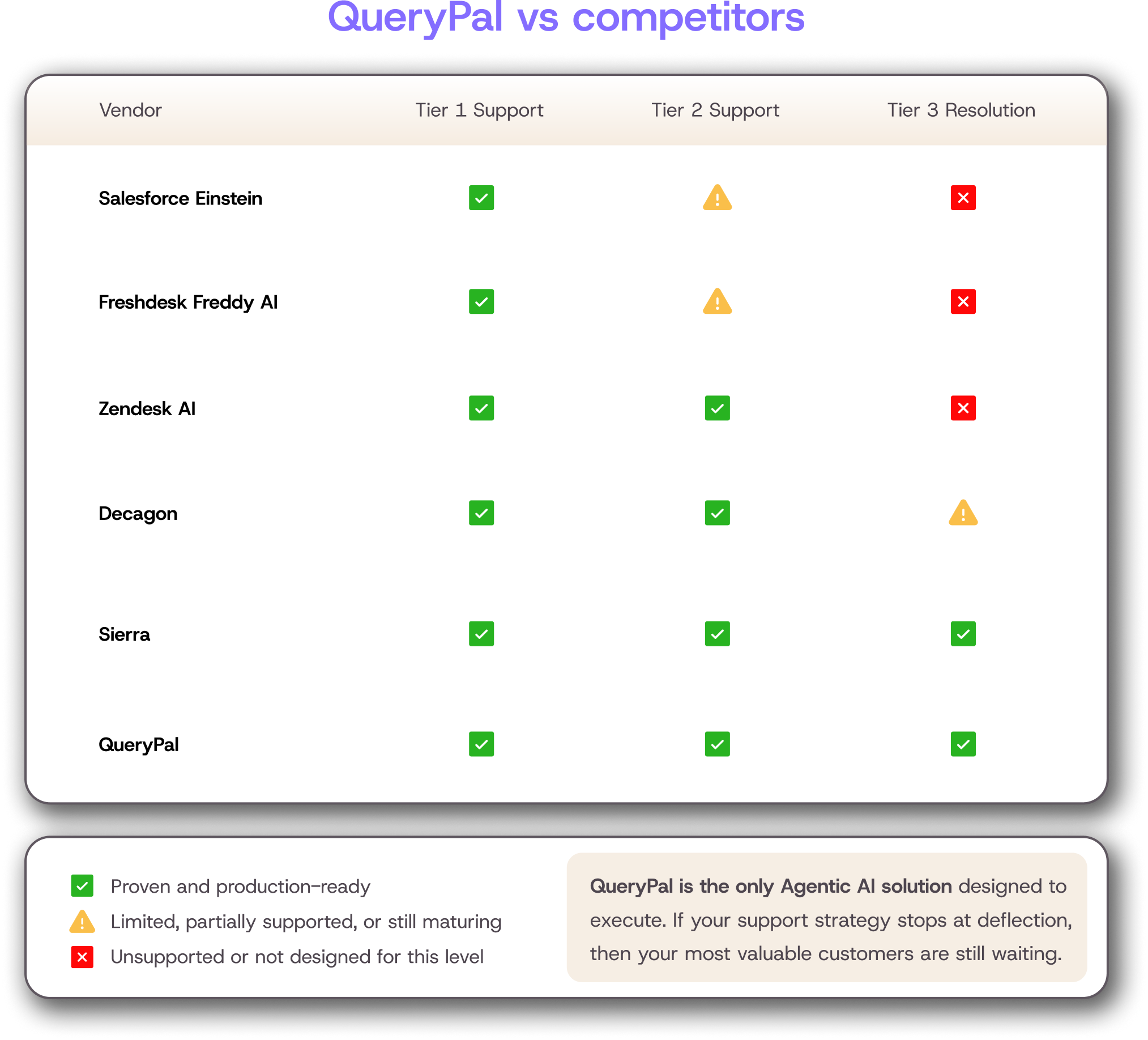
Teams like that QueryPal earns about a 90 percent agent upvote rate, reduces response times by around 40 percent, and works without a huge workflow rebuild while handling Tier 1 through Tier 3 work.
The tradeoff is that it needs a good history of tickets to perform at its best and it is really built for mid size and larger teams.
It fits support orgs that see large or seasonal ticket spikes and is usually not ideal for very small teams without clear processes.
2. Zendesk AI
Zendesk AI adds triage, Answer Bot, and routing on top of Zendesk's core CX platform, so it feels like a natural upgrade for teams already inside Zendesk.
It offers automated ticket categorization, AI routing, Answer Bot for quick answers, reporting, and a built in knowledge base. It also has mobile apps and a large integration marketplace, which helps global teams keep everything in one place.
The strong points are reliability, mature features, and a wide ecosystem of integrations. The weak side is lock in, since you are tied to Zendesk, along with higher per agent pricing and some AI features only available on expensive plans.
It is best for teams already committed to Zendesk that want to level up with AI capabilities, and less suited for organizations that keep knowledge spread across many platforms.
3. Intercom (Fin AI)
Intercom with Fin AI leans into real time messaging for support and outreach. It shines when customers prefer chat, using AI to automate live conversations, send proactive messages, and craft responses based on context from the Intercom knowledge base and connected CRM tools. It feels fast and personal when used in a product or app.
Its strengths are great real time support, a smooth conversational interface, and strong fit for modern SaaS teams. The limits show up if you run a lot of email based support or want to avoid another ecosystem, since Intercom tends to pull you into its own stack and can get expensive.
It works best for SaaS and product teams that care about chat first engagement and in app experiences.
4. Freshdesk (Freddy AI)
Freshdesk with Freddy AI gives you ticketing, AI assisted routing, and agent help inside the Freshworks world. It supports multichannel work, including email, chat, and phone, and offers collaboration tools so teams can handle tickets together without chaos.
The idea is simple automation that does not scare admins.
On the plus side, Freshdesk tends to be more affordable and easy to roll out, especially if you already use other Freshworks products. On the minus side, its AI and knowledge features are strongest when you stay inside that ecosystem, and results can be uneven when pulling from outside knowledge bases.
It fits teams that want a cost effective, unified multichannel support suite more than heavy custom builds.
5. Ada
Ada focuses on conversational AI with strong language understanding and a no code flow builder. Teams can design chat experiences with drag and drop tools, support many languages, and customize flows to match brand voice and support rules.
It is built to push a high share of traffic through automation.
Its big advantages are high automation potential, strong NLP, and flexible, multilingual bots that can keep evolving. The catch is that it still needs ongoing care, testing, and tuning, and it is mainly centered on chatbot use cases instead of full ticketing.
It works best for enterprises that face huge volumes of repetitive questions and want to deflect as many as possible.
6. Kustomer
Kustomer treats support like a CRM problem and gives agents a unified timeline for each customer. It pulls channels and events into one view and lets teams design relationship focused workflows that feel more like account management than simple ticket queues.
The omnichannel inbox and custom flows help agents see context at a glance.
Pros include very rich customer context, deep CRM style integration, and strong tools for high touch support. The downsides are heavier migrations and pricing that targets enterprise or fast growing brands.
It is best for relationship driven companies that want every interaction to sit inside a long term customer story, not a single ticket.
7. Gladly
Gladly is a CX platform that treats customers as ongoing conversations instead of separate tickets. It keeps a lifelong history of interactions across channels and shows a clear profile so agents can pick up right where the last person left off.
That focus gives it a more human feel for both agents and customers.
Its strengths are brand friendly experiences, strong tools for personal service, and an agent workspace that feels premium. Weaknesses include less focus on heavy automation and generally higher costs, which can be hard for lean teams.
It is best for premium brands that want white glove, human centered support and are willing to invest in it.
8. Salesforce Service Cloud
Salesforce Service Cloud brings service into the same CRM universe as sales and marketing. It uses the Service Console, Einstein powered case routing, and CRM workflows to tie customer issues to accounts, deals, and data already in Salesforce.
For many enterprises, that central source of truth is the main draw.
The pros are end to end visibility across the customer lifecycle and a high level of customization for complex processes. The cons are complexity, higher cost, and the fact that it really shines only when the company is already all in on Salesforce.
It suits large enterprises that want deep CRM driven service and have the resources to manage it.
9. Crescendo.ai
Crescendo offers hybrid AI support that keeps humans in the loop. Its AI handles common issues while clear escalation paths send tricky cases to people, with controls that support compliance needs.
It behaves like a managed service rather than a pure software tool.
You get high accuracy and a strong focus on compliant outcomes, often with outcome based pricing that ties cost to results. It is not ideal for teams that want to own and run all AI logic in house or control every small detail of configuration.
It works best for regulated industries and support teams that value oversight and shared responsibility.
10. Eesel AI
Eesel AI acts as a smart layer on top of your existing help desk instead of replacing it. It adds tools like AI Copilot and AI Agent, plus a simulation mode that lets you test AI behavior before turning it loose on real users.
It connects to more than 100 data sources so it can learn from tools you already use.
The main benefits are keeping your current platform, avoiding a big migration, and using simulation to build trust in the AI. The drawbacks are that it is a newer player and some advanced features sit in higher priced tiers.
It is best for teams that want to add AI to their current help desk setup without switching core systems.
11. ServiceNow Customer Service Management
ServiceNow Customer Service Management supports service across the whole enterprise, not just the support team. It brings predictive intelligence, SLA tracking, and workflows that cross departments like IT, ops, and finance.
It tries to connect every part of the organization that touches the customer.
Its power lies in how well it links different teams, systems, and services into one structured platform. The tradeoffs are high cost and longer implementation projects that need strong internal ownership.
It is best for large enterprises with deep IT and customer service workflows that need tight control and cross department coordination.
Why Support Teams Switch From Forethought
Support teams usually start looking for alternatives when the tool feels more expensive and harder to manage than it looked in the demo. The forethought pricing model can be unclear, with extra add-ons that make the true monthly cost hard to predict.
On top of that, implementations can drag on, pulling in engineers, ops, and support leads for months instead of weeks. The product suite often feels split across pieces that you have to buy and connect, instead of one clear system.
Later, the cracks show up in day to day work. The shiny AI promises do not always match real outcomes, especially when flows get complex or edge cases pop up. Teams struggle to keep knowledge sources in sync across help centers, internal docs, and ticket history, so answers drift or clash.
At some point, leaders ask a simple question: are we managing customers or babysitting a tool, and is it time to switch. Many teams also evaluate other platforms like kayako alternatives to find better solutions that match their workflow needs.
How to Choose the Right Forethought Alternative
Start by mapping your world. List your help desk, internal knowledge tools, and customer channels, then check which alternatives plug into them cleanly. If a platform cannot connect to your ticketing system or main docs without hacks, it probably is not worth more research.
Next, look at team size and ticket volume. Smaller teams may want simple AI add ons. Larger orgs might need deep CRM workflows or even a managed service model.
Use a simple decision path and stick to it: define goals, match tools to use cases, shortlist 3 to 5 options, run a pilot with real tickets, then scale what works. Track a few hard numbers during the pilot, like resolution time, deflection rate, and CSAT, not just how the demo felt.
Tools like querypal vs forethought comparisons can help you understand performance differences. The right alternative should prove itself in your data, not just in slides.
When evaluating forethought.ai competitors, consider how AI can transform knowledge management and whether the platform supports agentic AI capabilities. Look at the forethought ai pricing structure compared to alternatives, and check if vendors display their forethought logo and brand transparently.
The best platforms will offer clear pricing models and demonstrate ROI calculations upfront.
Finding Your Ideal Forethought Alternative in 2026
Before, your team was stuck weighing Forethought's rising complexity and costs against the real needs of your support org. Now, you've seen how different alternatives stack up—where they shine, where they fall short, and which models fit different levels of scale and workflow complexity.
The "best" tool is the one that matches your support model and maturity, not someone else's. Shortlist a few platforms, spin up trials or request demos, and see how they perform with your real tickets and teams.
Explore additional resources to help guide your decision, and consider how each platform addresses strategies to reduce customer costs while maintaining service quality.
References
"Forethought Alternatives." Slashdot, Slashdot Media, 2026, slashdot.org/software/p/Forethought/alternatives.
"Navigating the World of Business Software." Iowa Association of Business and Industry, Iowa ABI, 2025, iowaabi.org/news/business-monthly/story/navigating-the-world-of-business-software.

Activate your free
6 week trial
& white-glove integration support.
Cut support costs by 60%, slash response & resolution times, improve your customer experiences, & reduce agent burnout. Find some time with us to show you how.