Chat vs. Voice Customer Service: Pros, Cons, Costs, and Which Is Better?
Chat vs. Voice Customer Service: The Short Answer
Neither channel is universally better. Voice wins on complex, emotional, or high-stakes conversations, where tone and real-time back-and-forth matter most.
Chat wins on speed, scale, and cost, especially for quick or documentation-answerable questions. The right choice depends on your ticket complexity, volume, and budget, and most teams end up needing both.
Voice (Phone)
Best for: Complex, emotional, high-stakes issues
Speed: Real-time, but may involve queues and hold times
Cost per Contact: Highest
Concurrency: One call at a time
Personalization: High (tone and empathy)
Chat (Live or AI)
Best for: Fast, high-volume, document-answerable questions
Speed: Instant, with no hold time
Cost per Contact: Low to moderate
Concurrency: Many conversations at once
Personalization: Moderate, with higher personalization when powered by strong AI
Here is the real difference in plain terms. Voice is real-time spoken support delivered over the phone, one conversation at a time.
Chat is text-based support delivered by live agents or AI, where a single agent, or a single AI, can handle several conversations at once. That one distinction, concurrency, drives almost everything else. Speed, cost, and the way each channel copes with complexity all trace back to it.
Voice Customer Service: Pros and Cons
Voice is the high-touch, high-trust channel. It is still what customers reach for when something feels urgent, confusing, or emotionally charged, like a billing dispute or an outage that is costing them money.
That strength is also its constraint. A phone call ties up one agent for the length of the conversation, which shapes both its value and its cost.
Where Voice Support Wins
Voice carries tone. A calm, human voice can reassure a frustrated customer in a way that text cannot, which makes it the right call for complaints, sensitive account issues, and high-value relationships. It handles complexity well, too.
When a problem has many moving parts, talking it through in real time is faster than typing paragraphs back and forth, so voice suits multi-step technical or account problems where clarification happens on the fly.
Trust is another factor. For urgent or high-stakes moments, many customers still default to the phone, and older or less digital-first segments lean on it more than younger ones. A skilled agent can de-escalate an upset caller, something a chat thread often struggles to match.
Where Voice Support Falls Short
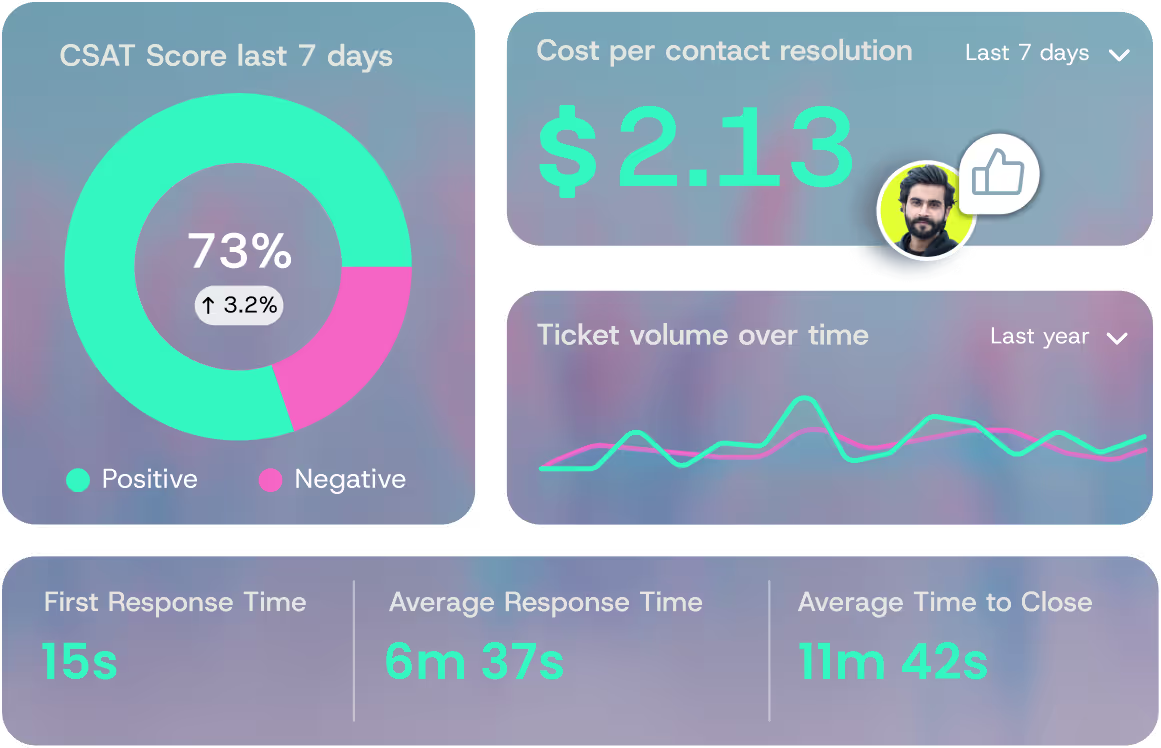
The catch is cost and capacity. An agent handles exactly one call at a time, which makes voice the most expensive channel per contact and the hardest to scale. When volume spikes, you cannot add capacity without adding headcount.
That is where wait times creep in. Phone queues, hold music, and clunky IVR menus frustrate customers during busy periods and drag down CSAT. Calls are hard to reference later, too. Without transcription, there is no easy paper trail to search, and customers have to stop what they are doing and stay on the line to get help.
Chat Customer Service: Pros and Cons
Chat is the speed-and-scale channel. It spans live chat with human agents, asynchronous messaging, and AI chat agents, and it has quietly become the channel many customers prefer for quick questions.
The important thing for a support leader is to separate human live chat from AI chat, because their cost and capability differ. This is where the biggest efficiency gains live, as long as quality holds up.
Where Chat Support Wins
Concurrency is the headline. One human agent can typically run roughly two to three moderately complex chats at once, and AI chat can handle far more simultaneous conversations, which pushes cost per contact well below voice.
Speed is the other draw. Answers are instant, there is no hold time, and customers can multitask while they wait for a reply.
Chat creates a record, too. Every conversation is logged and searchable, which makes coaching and quality review easier and gives customers something to refer back to.
Done well, AI chat delivers consistent, on-brand answers pulled straight from your documentation, tickets, and workflows. It is also the channel where rising expectations are easiest to meet, a shift you can see across the AI customer service statistics.
A quieter benefit rounds it out. Since chat is written, it compounds into a knowledge asset. Every resolved conversation can feed the help center, sharpen the next answer, and surface the questions that keep coming back, so the channel gets smarter over time instead of starting from zero on every call.
Where Chat Support Falls Short
Text has an empathy gap. It is easy to misread tone in a tense exchange, so emotionally charged or ambiguous issues can stall in chat and feel impersonal.
The bigger risk is the bad bot. Generic chatbots that only deflect, bouncing customers to a help article instead of solving the problem, frustrate people and damage CSAT.
The difference between deflecting and resolving is the one that matters most, and it comes back into play below.
Chat has practical limits too. Highly technical, back-and-forth troubleshooting can be slower to type than to say, and poorly staffed live chat creates its own queues. Chat only wins on cost when the quality is there to back it up.
How to Tell a Resolving AI Chat From a Deflecting Bot
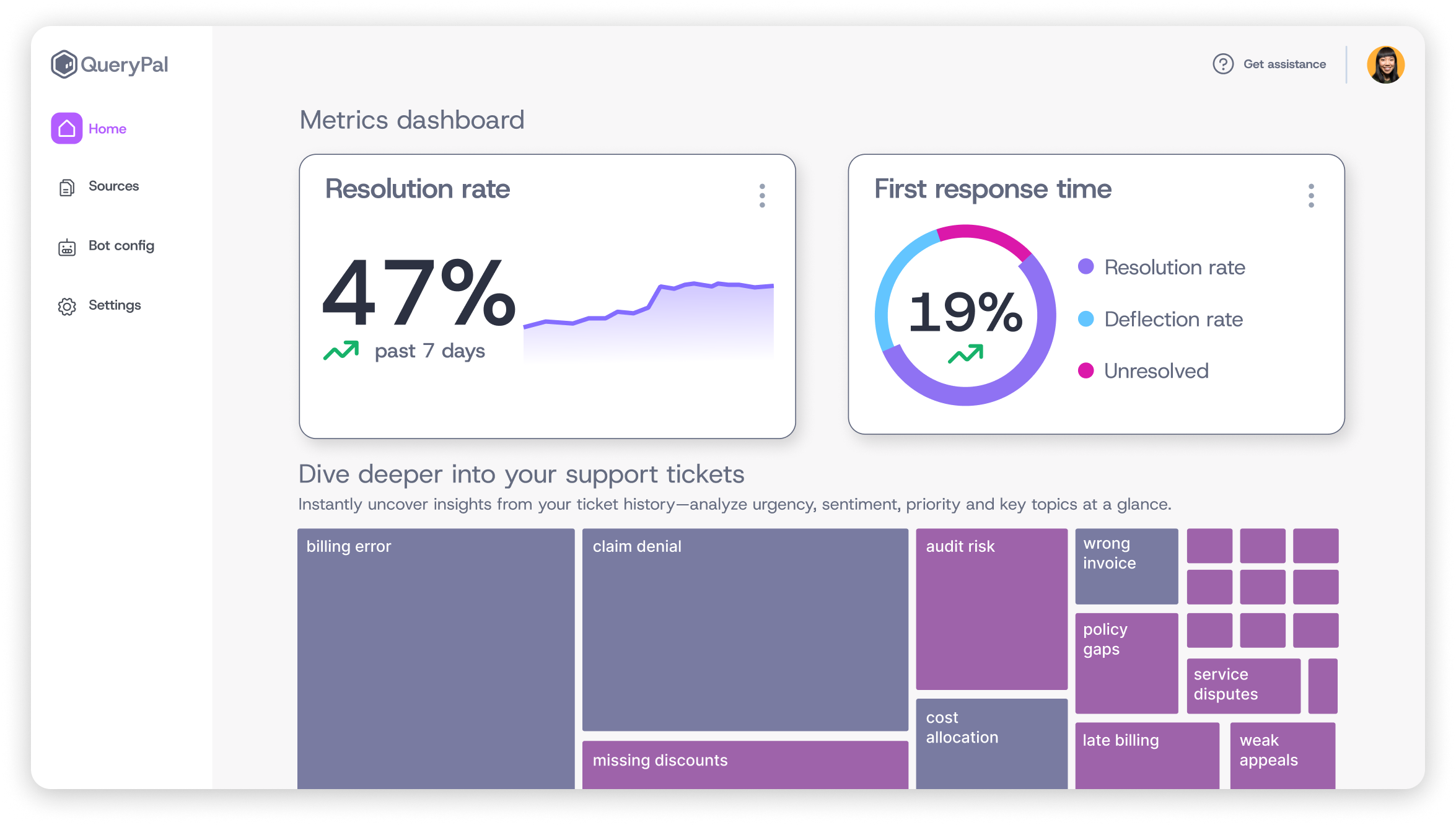
The difference between an AI chat that resolves and one that only deflects comes down to a single test. Does it produce the answer, or does it hand the customer a link and hope it sticks?
A resolving assistant reads your documentation, past tickets, and workflows, then works the problem all the way to a close. A deflecting bot matches a keyword and bounces the customer to an article. Before you trust any AI chat with your complex tickets, pressure-test it on four things.
- Resolution rate, not just deflection rate. Ask what share of tickets it closes without a human, and track resolution and deflection as separate numbers.
- Grounded answers. It should pull from your own docs, tickets, and workflows rather than generic web text, so replies match how your product behaves.
- A clean escalation path. When it cannot solve something, it should hand the conversation to an agent with full context, so the customer never has to start over.
- Honest limits. Be wary of any tool that promises to solve every ticket. The realistic goal is shrinking the pool of tickets that ever need a call, not pretending that pool is zero.
Get those four right and chat stops being the channel you apologize for. It becomes the one that carries your hardest tickets.
The Real Cost Difference: Chat vs. Voice
This is the part most comparisons skip, and it is the part that decides your budget. The gap between chat and voice comes down to concurrency.
According to TELUS International's chat versus voice cost analysis, a voice agent handles one session at a time, while a chat agent can handle anywhere from one to six sessions at once, with roughly two to three being a safe average for moderately complex issues.
Same volume, far fewer agents. That is why chat sits at the low end of cost per contact and voice sits at the high end.
Complexity changes the math. Technical and regulated tickets take longer to resolve because they often require troubleshooting, verification, or careful data handling. For the technology, financial services, and healthcare teams QueryPal works with, the real cost pressure comes from the time and expertise each complex ticket demands.
Put simple numbers on it. Picture a SaaS team fielding 6,000 tickets a month, with a third of them complex enough to need Tier 2 help.
If those 2,000 harder tickets each cost $30 to resolve on a call, that is $60,000 a month tied up in your most expensive channel. Move even half of them into a chat workflow that genuinely resolves them, and the savings stack up quickly, without a single new hire. That is the lever most cost comparisons never show you.
So the savings compound in one specific place, resolving a complex ticket in chat instead of escalating it to a call. Voice carries hidden costs as well, such as more agents, more training, and overtime during spikes. Chat needs solid tooling and, for AI, real quality guardrails.
Cost per resolution is the number that matters most here. A cheap chat that fails to solve the problem and forces a callback is not cheap at all, which is why teams increasingly focus on ticket deflection and resolution rather than raw contact volume.
Which Is Better for Your Business?
The better question is not which channel, but which channel for which ticket. Once you frame it that way, the decision gets much simpler. Sort your tickets by complexity, volume, customer base, and budget, then route them accordingly. Most teams find they need both, which is exactly the point.
Two questions usually make the call for you. First, how complex is the ticket, really? If a clear help doc or a capable AI can resolve it, chat is the efficient home for it. Second, how much is at stake for the customer and the relationship?
The higher the emotion or the dollar value, the more a voice conversation earns its cost. Run each queue through those two filters and your channel mix stops being a debate and starts being a routing decision.
When Voice Support Makes Sense
Pick up the phone when the stakes or the emotions are high:
- High-value or high-emotion interactions, complex sales, and regulated industries
- Lower-volume queues where personalization pays off more than raw efficiency
- Moments that call for real de-escalation or human judgment
When Chat Support Makes Sense
Default to chat when volume and repeatability are high:
- High ticket volume and repetitive, documentation-answerable questions
- Global or around-the-clock coverage you need to staff without adding headcount
- Digital-first customers and quick, transactional queries
Why You Might Not Have to Choose
The good news is that this was never an either-or decision. The strongest support operations run both, routing simple and mid-complexity issues to chat and reserving voice for the moments that genuinely need it, while letting customers move between channels without repeating themselves.
Routing is where this gets real. A simple rule of thumb works well. Send anything repetitive or documentation-answerable to chat first, and escalate to voice only when emotion, ambiguity, or a real judgment call enters the picture.
Make the handoff smooth, so the customer never has to restate their problem when they switch channels. The goal is to make sure each conversation lands where it will get resolved, not to shove everyone toward the cheapest option.
What changes the calculus is AI. For years, complex tickets were voice-only territory because early chatbots could only deflect, handing customers a link and hoping it stuck. Modern agentic AI is different.
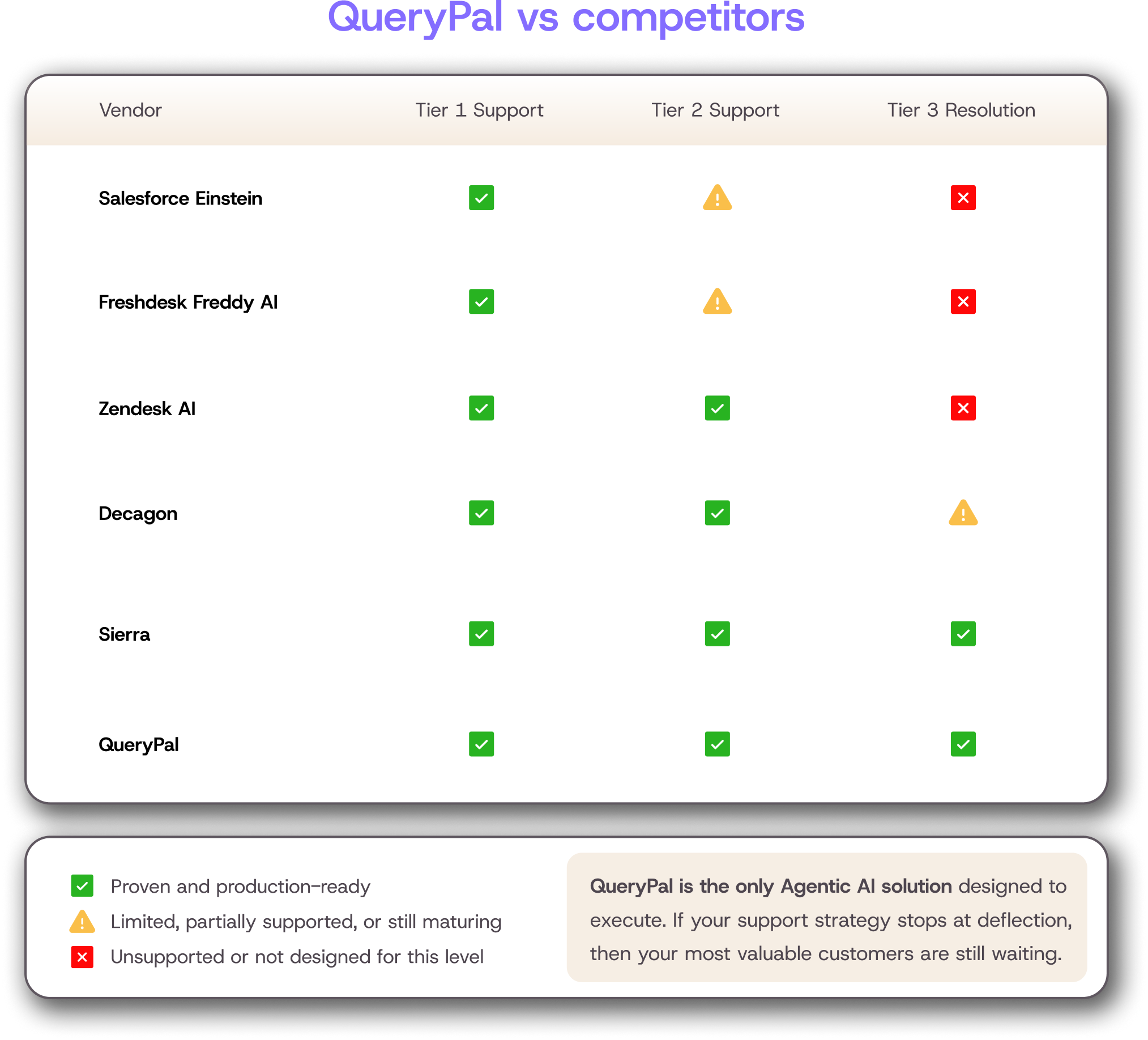
Platforms like QueryPal are built to resolve complex Tier 1 through Tier 3 questions in chat, not just deflect them, by scanning a company's documentation, past tickets, and workflows to produce accurate, context-aware answers. That moves work which used to require a phone call into a cheaper, faster channel without sacrificing quality.
The credibility caveat matters. No AI resolves every ticket, and pretending otherwise erodes trust. The realistic goal is to shrink the pool of tickets that ever need a human, while keeping a clean escalation path for the ones that do.
For security-conscious teams, it helps that this kind of AI can run self-hosted and SOC 2 Type II compliant, so sensitive data never leaves your environment.
Frequently Asked Questions
Here are quick answers to the questions support leaders ask most when weighing chat against voice.
What is the difference between voice support and chat support?
Voice support is real-time help delivered over the phone, one conversation at a time. Chat support is text-based help delivered by live agents or AI, where a single agent or bot can handle several conversations at once. That concurrency is why chat usually costs less per contact, but voice tends to feel more personal.
Is chat or voice better for complex issues?
Historically, voice was the better choice for complex issues, because talking through many steps in real time is easier than typing them. That is changing. Capable AI chat can now resolve many complex, documentation-based problems in text. Voice still has the edge for emotional, ambiguous, or highly sensitive situations where tone and judgment matter most.
What are the disadvantages of chat support?
The main drawbacks are the empathy gap, since text is easy to misread in tense moments, weak generic bots that deflect instead of resolving, and typing friction on very technical problems. Most of these are solvable with capable AI and a clear path to a human when the conversation needs one.
Making the Right Call for Your Support Team
The winning move is to match each channel to the tickets it handles best, then use AI to shrink the number that ever need a call. Route the simple and mid-complexity volume to chat, keep voice for the high-stakes moments, and measure resolution, not just deflection.
If you want to see how that plays out in practice, take a look at how QueryPal resolves complex Tier 1 through Tier 3 tickets in chat, so your support team can scale without scaling headcount.

Activate your free
6 week trial
& white-glove integration support.
Cut support costs by 60%, slash response & resolution times, improve your customer experiences, & reduce agent burnout. Find some time with us to show you how.