Decagon vs. Sierra vs. QueryPal: Which 2026 AI Customer Service Tool To Use?
Support leaders in 2026 want AI agents that can actually close tickets without a human in the loop. The gap between marketing claims and production results is wider than most vendor decks suggest.
Peer-reviewed research from the National Bureau of Economic Research found that generative AI raised customer support agent productivity by an average of 14% in a real-world deployment, with the largest gains for the least experienced agents.
That is real money, and it is the reason "AI customer service" is now the single most contested category in CX software.
Decagon, Sierra, and QueryPal are three of the names that come up most in evaluations. Decagon is the enterprise-design-partner play, used by Notion, Eventbrite, and Substack.
Sierra is the Bret Taylor and Clay Bavor company, valued at $15.8 billion in May 2026 and known for voice-first agents at consumer brands like WeightWatchers, Sonos, and ADT.
QueryPal is the help desk-native option, built for B2B SaaS support teams that want to be live in days, not quarters.
This guide compares all three on features, pricing, real customer reviews, deployment timelines, security posture, integrations, and a final decision framework.
No default winner gets named. The right pick depends on the channels you support, the stack you run, and the timeline you have.
What is the State of AI Customer Service in 2026?
The market has moved past the deflection chatbot. According to McKinsey's State of AI research, customer service is one of the functions where companies most often report meaningful financial impact from generative AI, ahead of marketing, sales, and software engineering.
That signal is showing up in the procurement cycle. Buyers are asking vendors for resolution rates, not deflection rates. They are asking for live conversation logs, not curated highlight reels.
Two definitions matter before you sit through another vendor demo.
Resolution rate measures the percentage of tickets the AI fully closes without a human ever touching them. Deflection rate measures the percentage of contacts the AI keeps off the queue entirely, often through self-service or pre-ticket interception.
The two numbers are not interchangeable, and most vendors mix them in marketing.
A platform with a 70% deflection rate might still produce a backlog of escalated, partially-resolved tickets that consume more agent time than they save.
A platform with a 50% resolution rate, where every closed ticket is genuinely closed, can be the better investment. When you compare Decagon, Sierra, and QueryPal, hold them to the same definition.
The sections below use six evaluation criteria. Resolution quality, integration depth, deployment speed, pricing transparency, security posture, and real customer evidence. Every section maps back to those six.
Decagon at a Glance
Decagon is an enterprise AI customer service platform backed by Accel, Andreessen Horowitz, Bain Capital Ventures, and a long list of operator angels.
Public customer references include Notion, Eventbrite, Substack, and Duolingo. The product is built around two layers. AI Agents handle conversations across chat, email, voice, and in-app channels.
AgentOS sits above them as the supervisory layer for knowledge management, human handoff, analytics, and quality assurance.
The Decagon model is design-partner first. The vendor team works hand in hand with the customer's CX leadership during onboarding, tuning the agent against historical tickets and writing custom logic for edge cases.
That model produces strong outcomes for teams that can invest the time. It also explains why Decagon shows up most often in evaluations for enterprises with dedicated CX engineering resources, not for lean support teams who need to ship something next month.
Decagon fits enterprise CX organizations with complex support operations, internal AI or CX engineering capacity, and budget for a high-touch deployment.
What Decagon Does Well
The enterprise partnership model is the consistent strength. Reviewers on G2 describe Decagon's team as responsive, knowledgeable, and willing to absorb work rather than push it back to the customer.
One pattern shows up repeatedly. When the support team flags an issue, Decagon proposes options before asking the customer to build a workaround inside Zendesk.
Channel coverage is mature. Decagon handles chat, email, voice, and in-app at the same level of polish, with escalation logic that survives real production volume.
Reporting and QA tooling are built for support leaders who need granular visibility into how the agent is performing per intent, per channel, and per agent reviewer.
For enterprises that are buying the team as much as the software, Decagon is a credible choice.
Where Decagon Falls Short
Pricing is not published anywhere on Decagon's site. Independent reviews and analyst commentary describe enterprise-tier custom quotes that can climb into six figures annually, with implementation services charged on top.
That model works for buyers with procurement infrastructure, but it adds friction for anyone who needs a budget number before opening a vendor evaluation.
Deployment runs longer than the marketing implies. G2 reviewers note a steep learning curve and a multi-week to multi-month tuning phase where the bot is improving with usage and the team is monitoring it closely.
Reddit discussions of Decagon in production raise a related concern about transparency. One reviewer noted "limited transparency, you can't always see why it decided something," which matters for support leaders who own escalation policies.
Customization can be a friction point. Reviewers describe missing features, filtering gaps, and limited room to tune behavior as granularly as some teams want.
Decagon's team is iterating quickly, but the product is still maturing in places. For teams without that engineering capacity, surveying the broader Decagon alternatives landscape can surface options with shorter time-to-value.
What Real Customers Say About Decagon
At the time of writing, Decagon holds a 4.9 out of 5 rating on G2 across roughly 18 reviews. The volume is thin compared to legacy CX platforms with hundreds of reviews, so the average should be read as directional rather than statistically rigorous.
Common themes in the positive reviews include ease of implementation relative to expectations, fast and skilled vendor support, and a collaborative approach to problem-solving.
Common themes in the critical reviews include missing features, limited customization, and a steep early-stage learning curve as the agent learns the support corpus.
Verify both the rating and any specific review quote against the live G2 listing before publishing or sharing internally. G2 refreshes frequently.
Sierra AI at a Glance
Sierra was founded by Bret Taylor, former co-CEO of Salesforce and current chair of the OpenAI board, alongside Clay Bavor, who previously ran Google Labs for nearly two decades.
The company raised $950 million in May 2026 at a reported $15.8 billion valuation, less than a year after a prior round at $10 billion. Sierra reports working with roughly 40% of the Fortune 50, including WeightWatchers, Sonos, SiriusXM, ADT, and Casper.
The product is built around conversational AI agents that handle voice and chat at scale, with custom personas tuned to match each brand. Sierra has positioned voice as the leading wedge.
The Voice product launched in late 2024 and is the feature that gets the most analyst attention. Sierra's pricing model is outcome-based. Customers pay when the agent successfully resolves a customer issue, not per message or per minute.
Sierra is built for large consumer brands with significant voice and chat volume, where brand-aligned conversation quality on phone is a core requirement.
What Sierra Does Well
Voice is the strongest part of the product. Reviewers and analysts consistently flag the realism of Sierra's phone agents, the brand-aligned tone customization, and the depth of integration with CRM and Zendesk-style backends.
WeightWatchers, a public reference customer, has described Sierra interactions as "genuine and empathetic." That is a credible voice signal coming from a brand whose customers expect warmth on the phone.
Founder credibility matters in enterprise procurement, and Sierra has the strongest founder story in the category. That alone gets the company into rooms competitors struggle to reach.
Integration capability is well rated by G2 reviewers, who call out the ability to plug Sierra into CRM and Zendesk and have it maintain brand voice across both surfaces without re-tuning.
Where Sierra Falls Short
Pricing is opaque and reported to be among the highest in the category. Reported pricing for entry-level Sierra contracts often lands well into six figures annually, with implementation and professional services adding meaningfully to first-year cost.
G2 reviewers raise the same complaint. One verified review describes the "limited transparency on technical details and pricing, which makes it harder to fully assess long-term costs and integration, and the fact that scalability and consistency at enterprise scale are still largely unproven."
Conversation depth is a recurring concern in reviews. A G2 reviewer put it this way. "Sierra AI may struggle to maintain context in longer conversations, leading to repetitive or irrelevant responses.
At times, the AI's responses can feel generic and lack the depth or nuance of a human conversation." That is the trade-off you accept when an agent is tuned heavily for tone.
The conversation feels right, but the resolution can drift on complex threads.
Performance is generally strong but not flawless. Reviewers note the platform "can be slow at times, and there are occasional bugs that need fixing," plus a learning curve for new users on the configuration surface. None of these are dealbreakers at the price point, but they are real.
The product is heavily B2C oriented. B2B SaaS support teams evaluating Sierra alongside more helpdesk-native options often find the fit awkward.
Buyers in that bucket frequently shortlist Sierra AI alternatives that integrate with Zendesk, Intercom, or Salesforce out of the box.
What Real Customers Say About Sierra
Sierra's G2 review volume is smaller than its market profile would suggest, which is typical for a fast-growing enterprise vendor whose customers are still in their first or second year of deployment.
Verify the current rating and review count on the live G2 listing before publishing.
The consistent positive themes across reviews include setup smoothness, brand-aligned conversation tone, throughput at high traffic levels, and integration depth with CRM and Zendesk.
The consistent critical themes include high cost, pricing opacity, occasional context loss on long conversations, and a learning curve on configuration.
WeightWatchers' public quote on the empathy of Sierra interactions remains the strongest external endorsement.
QueryPal at a Glance
QueryPal is an agentic AI customer support platform built by a team with deep AI and ML backgrounds.
The company was founded by Dev Nag, whose prior company Wavefront was acquired by VMware, alongside engineers from Meta and Google focused on enterprise-grade support automation.
The product runs on a self-hosted, SOC 2 Type II and GDPR compliant architecture, integrates natively with Zendesk, Intercom, Salesforce, Front, Gorgias, Help Scout, and Freshdesk, and ships with QueryPal Prism, an analytics layer that surfaces ticket trends, agent performance, and content gaps.
QueryPal's positioning is different from Decagon and Sierra. It is built for support teams that want autonomous ticket resolution without a long enterprise sales cycle, with transparent pricing published on the website and standard deployments measured in days rather than quarters.
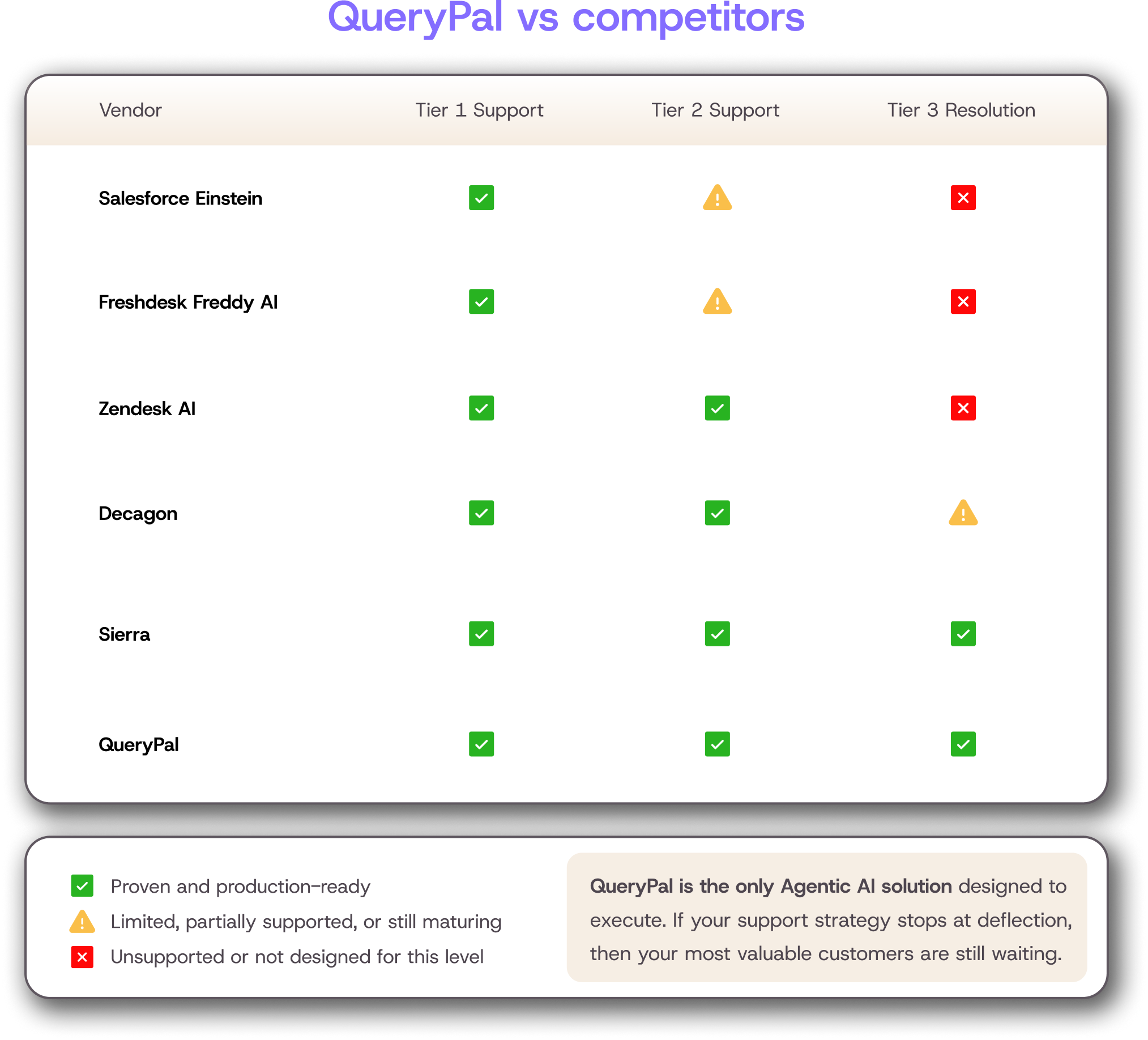
The platform scans existing documentation, past tickets, and workflows to generate accurate, context-aware responses on Tier 1 through Tier 3 questions, rather than chasing pure deflection.
QueryPal sits with B2B SaaS and services companies that want fast deployment, transparent pricing, and tight integration with a mainstream helpdesk.
What QueryPal Does Well
Deployment speed is the strength customers call out most. JetBrains' customer success department head put it directly.
"With QueryPal we can now manage the 1000's of tickets we get every day, in or out of peak season." That kind of throughput on a no-code setup is the headline benefit.
Helpdesk integration is native. QueryPal plugs into the support stacks teams already run rather than forcing a rip-and-replace. The Prism analytics layer surfaces ticket trends and content gaps so support leaders can close documentation issues at the same time the agent is closing tickets.
Pricing is published on QueryPal's site, which makes evaluation easier without a sales conversation. SOC 2 Type II and GDPR compliance, plus self-hosted options, address the security questions enterprise procurement asks first.
Where QueryPal Falls Short
QueryPal is a newer brand. As a result, current market presence is smaller than Decagon's or Sierra's, and G2 review volume is correspondingly lower.
Buyers who weigh category leadership heavily, or who require dozens of public reference customers before signing, may treat that as a factor.
The honest read is that QueryPal is earlier in its public profile curve, but the underlying team and technology are mature.
Voice is not the primary surface. Teams whose dominant channel is phone, especially consumer brands with high call volume, should evaluate Sierra alongside QueryPal. QueryPal is strongest on text channels where helpdesk integration matters most.
The company is younger than both Decagon and Sierra. That is rarely a problem in product capability, but it can be one in enterprise procurement when buyers want category-defining brand recognition on the contract.
What Real Customers Say About QueryPal
The public customer evidence for QueryPal centers on two named case studies.
JetBrains, the maker of IntelliJ IDEA and other developer tools used by more than 11 million developers, deployed QueryPal to handle fluctuating ticket volume across seasonal spikes and new product releases.
The customer success department head added, "Achieving a 90% upvote rate from our own agents, normally averse to AI, is the ultimate seal of approval." Over 92% of QueryPal-drafted answers have been upvoted by JetBrains agents in production.
Simply Benefits, an employee benefits administration platform, removed Freddy AI in the first week of implementing QueryPal.
Their customer success lead said, "QueryPal allowed us to meet our SLAs despite a 62% increase in ticket volume year-over-year," and added, "If we took QueryPal away now, things would be on fire."
The same team noted, "Our agents rely on QueryPal daily, and we've never handled peak season this smoothly."
Verify QueryPal's current G2 rating and review count on the live G2 listing before publishing.
Be transparent about the smaller review volume.
Side-by-Side Comparison
Decagon
- Best for: Enterprise CX teams with engineering capacity
- Primary channels: Chat, email, voice, in-app
- Deployment time: Multi-week to multi-month rollouts
- Pricing transparency: Custom quote, not published
- Key integrations: Major helpdesks and enterprise systems
- Security and compliance: Verify on Decagon trust page
- Standout strength: Design-partner model and AgentOS depth
- Primary tradeoff: Longer sales cycle and higher cost
Sierra
- Best for: Consumer brands with high voice and chat volume
- Primary channels: Voice and chat with strong voice focus
- Deployment time: Multi-month implementations
- Pricing transparency: Custom quote, not published
- Key integrations: Helpdesks plus voice infrastructure
- Security and compliance: Verify on Sierra trust page
- Standout strength: Voice quality and brand-aligned tone
- Primary tradeoff: Pricing opacity and higher cost
QueryPal
- Best for: B2B SaaS and mid-market support teams
- Primary channels: Chat, email, ticket-based helpdesk channels
- Deployment time: Days to a couple of weeks
- Pricing transparency: Published on website
- Key integrations: Zendesk, Intercom, Salesforce, Front, Gorgias, Help Scout, Freshdesk
- Security and compliance: SOC 2 Type II and GDPR, self-hosted option
- Standout strength: Fast deployment and helpdesk-native fit
- Primary tradeoff: Smaller market presence and review volume
The table does not name a winner because there is no single winner. The three platforms occupy distinct corners of the market.
Decagon is a fit when the buyer has CX engineering capacity, an enterprise procurement process, and an appetite for a design-partner relationship.
The strength of the vendor team and the maturity of the AgentOS layer pay off for organizations that can absorb the deployment timeline.
Sierra is a fit when voice is a primary surface, the brand is consumer-facing, and conversation tone matters as much as the resolution number.
The price point is real, and so is the founder credibility. Brands with significant phone volume often find the value math works.
QueryPal is a fit when the buyer wants to be live quickly, when the stack already runs on Zendesk, Intercom, Salesforce, Front, Gorgias, Help Scout, or Freshdesk, and when transparent published pricing is a procurement requirement.
The case study evidence with JetBrains and Simply Benefits speaks to throughput and ROI on text channels.
The right pick depends on the buyer's channel mix, company size, integration footprint, and deployment timeline. Hold each platform to the same six criteria, and the right answer usually becomes obvious.
Pricing Compared
Decagon does not publish pricing. Independent reviews describe enterprise-tier custom quotes, often in the six-figure annual range, with services charged separately.
Buyers should expect a discovery call and a custom proposal before seeing a number. The Decagon pricing page directs everyone to a sales conversation.
Sierra also does not publish pricing. Outcome-based contracts are the standard model, where the customer pays when the AI agent resolves an issue.
Reported entry-level annual contracts for Sierra tend to land in the six-figure range, with implementation and professional services adding to first-year totals.
QueryPal publishes pricing directly on the QueryPal pricing page. That alone removes a step from procurement. Plans align with ticket volume rather than seat count, and the no-code setup keeps implementation services charges low.
Total cost of ownership is more than list price. For any AI customer service vendor, ask for a year-one estimate that includes implementation services, custom integration work, ongoing prompt and content maintenance, and the internal time required to manage the agent.
The lowest list price can produce the highest total cost if the implementation drags.
Deployment and Implementation
Decagon implementations run multi-week to multi-month under the design partnership model. The vendor team leads tuning against historical tickets, builds custom logic for edge cases, and runs the QA cycles before go-live.
Teams with internal CX engineering capacity get the most out of that model.
Sierra implementations are services-heavy. The Sierra team leads design and tuning, especially on voice deployments where persona, intent coverage, and brand voice need to be tuned together. Plan for a multi-month rollout. The trade-off is conversation quality on day one.
QueryPal deployments run days to a couple of weeks for standard configurations. No-code setup, native helpdesk integration, and a pre-built ingestion pipeline against existing documentation and past tickets are what shorten the timeline.
Industry analyst coverage of autonomous agent deployments has consistently flagged time-to-value as one of the largest variables in AI customer service ROI, and the QueryPal model is built around shrinking it.
Here is the reality on the ground. Vendor demos often show idealized timelines that do not survive production. Ask every vendor for a reference customer of similar size and stack who can confirm the timeline they actually hit.
Security and Compliance
Decagon publishes SOC 2 and enterprise security certifications on its trust page.
Verify the current certifications and any incremental compliance posture, such as HIPAA or FedRAMP if your industry requires them, directly with the Decagon team.
Sierra publishes SOC 2 and enterprise security certifications. Confirm specifics on Sierra's trust page before procurement, especially for regulated industries where data residency and training data isolation are contractual requirements.
QueryPal is SOC 2 Type II and GDPR compliant, with self-hosted deployment options for buyers who need to keep customer data inside their own infrastructure. Details are documented on the QueryPal security page.
Five questions are worth asking any AI customer service vendor, beyond the certification logos.
- Where does customer data sit at rest?
- Are model providers ever trained on your data?
- What is the retention policy on conversation logs?
- How is PII handled inside the prompt?
- What happens to your data if you terminate the contract? The certification badges are table stakes. The contract language is what matters.
Integrations and Ecosystem Fit
Decagon integrates with major helpdesks and a range of enterprise systems, with deep coverage for teams already running a mature CX stack.
The integration approach assumes the customer has internal capacity to maintain the connections.
Sierra integrates with major helpdesks and voice infrastructure, with particular strength on the telephony side. Best fit for stacks where voice is a primary channel and CRM data is centralized.
QueryPal offers native integrations with Zendesk, Intercom, Salesforce, Front, Gorgias, Help Scout, and Freshdesk, with the Zendesk integration built to plug into existing workflows without re-platforming.
The integration model assumes the customer wants the AI to live inside the helpdesk the agents already use, not on top of it.
One rule applies to any AI agent procurement. Do not pick a tool that forces you to rebuild your helpdesk. Pick the tool that fits the stack you already run.
Resolution vs. Deflection: How to Evaluate Vendor Claims
Most AI customer service vendor decks lead with a single big number, like 70% deflection, 80% resolution, or 90% containment.
Those numbers are not directly comparable across vendors, and the difference matters.
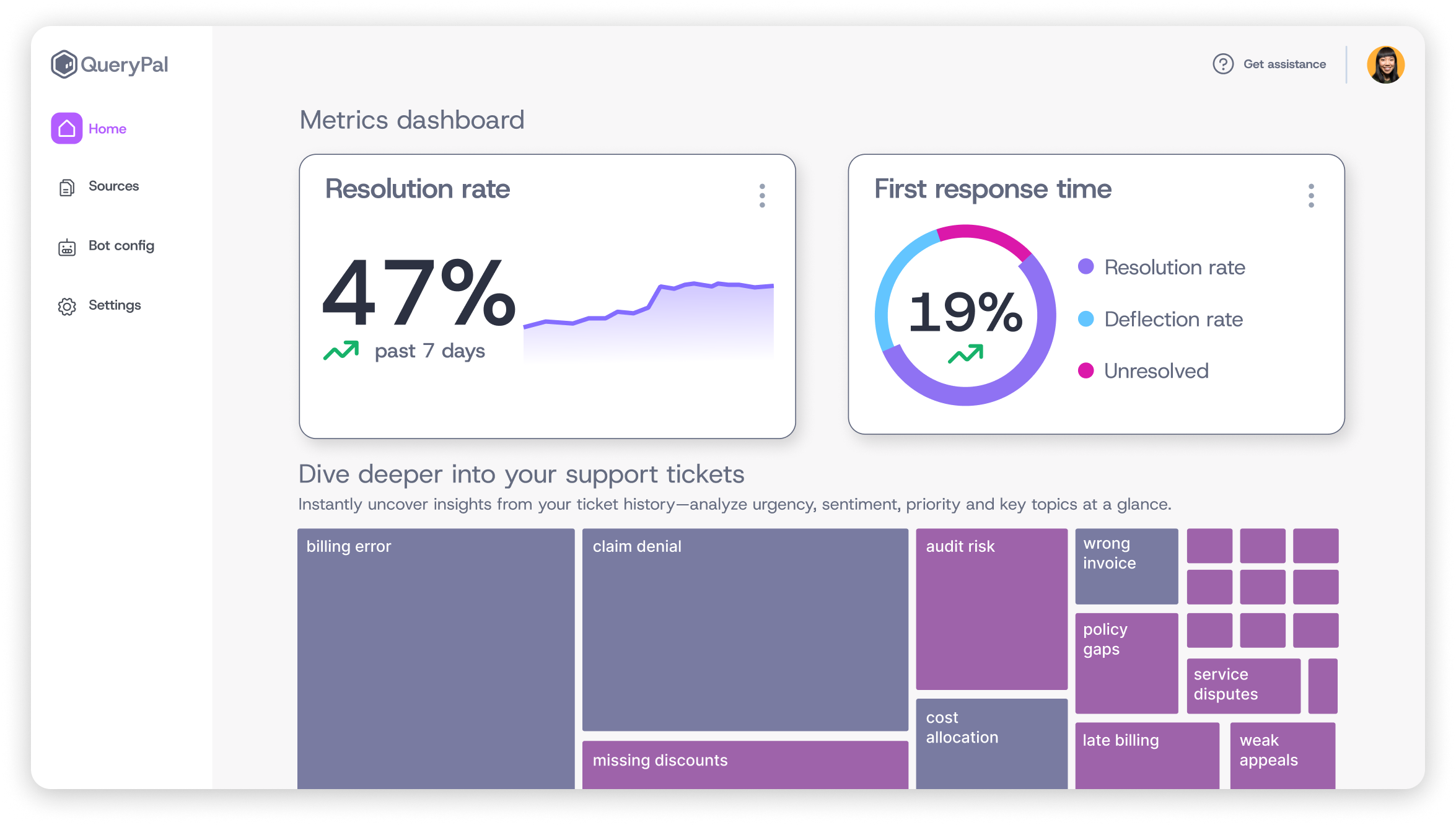
Resolution rate is the percentage of tickets the AI fully closes without a human ever touching them. A resolved ticket is one the customer accepts as answered, where the conversation ends inside the AI surface.
Deflection rate is the percentage of contacts the AI keeps off the queue entirely. A deflected ticket may never have been a ticket.
It might be a self-service article click, a pre-ticket FAQ interception, or a chatbot turn that did not escalate.
A high deflection rate without a high resolution rate can create a hidden backlog of partially-answered conversations that come back as escalations.
A high resolution rate with a lower deflection rate means the AI is doing the harder work of closing complex tickets that would have hit the queue anyway. Both numbers matter, and vendors often emphasize whichever number is higher.
Five questions are worth asking in every vendor demo.
- What counts as a resolved ticket in your reporting?
- Show me the math behind the resolution number.
- Can I see a randomly sampled set of conversation logs, not curated highlights?
- How do you handle ambiguous resolutions, where the customer disengaged without confirmation?
- What percentage of your published case study customers can you connect me with as references?
How to Choose Between Decagon, Sierra, and QueryPal
Choose Decagon if you are an enterprise with a dedicated CX engineering team, you have budget for a custom deployment, and you want a high-touch design partner who will absorb the implementation work.
The AgentOS layer is mature, and the vendor team is a real asset.
Choose Sierra if voice is your primary channel, you are a consumer brand, and brand-aligned conversation quality on phone is a core requirement. Accept the price point and the multi-month rollout in exchange for tone quality that is hard to get elsewhere.
Choose QueryPal if you are a B2B SaaS or services company, you want fast deployment and transparent pricing, and you need tight integration with a mainstream helpdesk without a long sales cycle.
The JetBrains and Simply Benefits case studies speak to throughput and ROI on text channels.
The decision framework comes down to four criteria.
- What channels do you support, and which one matters most?
- What helpdesk and CRM stack do you already run?
- What is the procurement timeline you have to hit?
- What is the budget posture, published pricing or open enterprise contract?
Hold the three platforms to those four questions, and the right answer usually emerges.
Find the Right AI Customer Service Tool for 2026
The best AI customer service agent in 2026 is the one your team actually ships. Pick the platform that fits your channel mix, your existing helpdesk and CRM stack, your budget posture, and your timeline.
Hold every vendor to the same six criteria. Resolution quality, integration depth, deployment speed, pricing transparency, security posture, and real customer evidence.
JetBrains and Simply Benefits, both cited above, show what fast deployment and helpdesk-native integration look like in production rather than a demo.
If transparent pricing, fast deployment, and native integration with Zendesk, Intercom, Salesforce, Front, Gorgias, Help Scout, or Freshdesk match the requirements on your evaluation list, see live QueryPal pricing on the pricing page or book a demo to see the agent against your own tickets.

Activate your free
6 week trial
& white-glove integration support.
Cut support costs by 60%, slash response & resolution times, improve your customer experiences, & reduce agent burnout. Find some time with us to show you how.