Decagon vs. Fin vs. QueryPal: Pick the Right AI Customer Support Agent in 2026
The short answer first. If your team already lives inside Intercom and you want a low-friction AI agent paid by the resolution, Fin is the safest first trial.
If you have engineering bandwidth, a six-figure budget, and a 4 to 8 week timeline for a custom rollout, Decagon delivers some of the deepest agentic workflows in the category.
If you already run Zendesk, Intercom, Salesforce, Front, Gorgias, Help Scout, or Freshdesk and you want SOC 2 Type II security, knowledge-base-grounded accuracy, and a 2-week launch, QueryPal is the closest fit.
This guide walks through pricing, resolution data, implementation timelines, and the math behind each vendor's published numbers so you can make a call your CFO will sign off on.
The State of AI Customer Service in 2026
AI customer support is past the experiment stage. Most enterprise CX teams now run a structured AI support vendor evaluation playbook before signing a contract, with Decagon, Fin, and QueryPal on every shortlist.
A peer-reviewed NBER working paper by Brynjolfsson, Li, and Raymond, Generative AI at Work, studied 5,179 customer support agents and found that giving them a generative AI assistant raised issues resolved per hour by 14% on average. Newer agents saw a 34% bump.
The same study reported higher customer sentiment scores and lower attrition among teams using the assistant.
Buyer behavior has caught up to the research. Most CX leaders are no longer trialing AI agents alongside human teams as a side experiment.
They are running them as core support infrastructure, with budget lines, SLAs, and dedicated ops owners. AI agents have moved from pilot programs to permanent line items in the CX budget.
That changes the question on the table. Most CX leaders are no longer debating whether to deploy an AI agent.
They are deciding which one to bet a year of strategy on. Three AI customer service platforms dominate almost every shortlist this year: Decagon, Fin, and QueryPal.
Each takes a different approach, and the right pick depends on your stack, your ticket volume, your timeline, and how much engineering time you can spare.
Decagon at a Glance
Decagon AI is an enterprise AI agent platform founded in 2023 and backed by Accel and Andreessen Horowitz.
The company raised a Series D in January 2026, tripling its valuation to roughly $4.5 billion in about six months according to Bloomberg's reporting. That kind of capital tells you two things.
The product is being built for the high end of the market, and procurement teams will be asked to sign contracts that reflect it.
Decagon's customer list reads like a venture capital portfolio: Hertz, Eventbrite, Bilt, Notion, Duolingo. These are mid-market and enterprise brands with high-volume tickets and the engineering bandwidth to support a custom rollout.
The pitch is "AI agents, not chatbots." Decagon emphasizes agentic workflows, custom tool calls, and deep ticket understanding, with sales engineers helping map workflows in detail. That depth is the strength. It is also the friction.
Where Decagon Wins
Complex, multi-step workflows are where Decagon stands out. Reported deployments handle order changes, returns, and account modifications end-to-end without a human in the loop. That is harder than it sounds, and most chatbot tools cannot do it without breaking.
Brand voice control is another differentiator. Decagon's enterprise customers consistently cite the ability to match brand tone closely. That matters more for premium consumer brands than for utility-focused B2B SaaS, but if your CMO cares about voice, it is real.
Then there is the analytics layer. Conversation-level reporting gives ops leaders the kind of visibility older chatbot dashboards never offered. You can see why a conversation failed, not just that it did.
Where Decagon Falls Short
Start with implementation time. Real deployments run 4 to 8 weeks, sometimes longer, because each customer gets a hand-mapped workflow buildout. That depth pays off in production, but it makes Decagon a tight squeeze for any team that needs to launch before a quarterly review.
Pricing opacity is the next issue. Decagon publishes no public rates, and industry reports place enterprise contracts in the six-figure annual range. Procurement teams should expect a multi-month negotiation, not a checkout flow.
Helpdesk dependency rounds out the trade-offs. Decagon integrates with Zendesk, Intercom, and Salesforce, which covers most of the market. But switching helpdesks mid-deployment introduces retraining cost. Worth weighing during the buy decision.
Who Should Pick Decagon
Mid-market and enterprise teams running 250+ agents with the engineering bandwidth to support a 4 to 8 week deployment. Brands prioritizing complex multi-turn conversations over speed-to-launch.
Companies with budget room for opaque enterprise pricing and the patience to negotiate it. If those describe your situation, Decagon is built for you.
Fin (Intercom) at a Glance
Fin AI is Intercom's AI agent, launched in 2023 and now in its third generation according to Intercom's product page. It is built natively on top of the Intercom Inbox, which is both its biggest strength and its biggest limitation depending on your stack.
The customer list is impressive: Vanta, Anthropic, Function Health, Synthesia, and what Intercom reports as more than 7,000 Fin customers. That number is vendor-reported, not verified by an outside auditor, but it is consistent with what Intercom has published since mid-2025.
The pitch is outcome-based pricing. Fin charges $0.99 per resolution, no seat fees. The argument is that you pay only when Fin closes a ticket. That alignment of vendor incentives with buyer outcomes is genuinely uncommon in the AI category, and it is the reason many CX teams trial Fin first.
Where Fin Wins
Outcome pricing is what most CX leaders trial Fin for. Many AI vendors charge per seat or per conversation regardless of whether the conversation went anywhere useful. Fin's model means a failed deployment costs less than a successful one. Fair deal for the buyer.
Native Intercom integration matters almost as much. If your team already runs Intercom, Fin is a one-click install. No separate platform to manage, no second login, no data syncing to debug. The conversation just gets an AI first responder.
Then there is published resolution data. Intercom reports a 67% average resolution rate across the Fin customer base, with top deployments reaching 80% or more.
The company also published a comparison study run with Vanta showing Fin resolving 73% of conversations versus an unnamed competitor's 49%. That comparison page is hosted on Fin's own site, which matters.
The number was commissioned by Fin, not produced by an independent third party. Use it as a vendor benchmark, not as an audited result.
Where Fin Falls Short
Intercom dependency is the trade-off for the integration win. Fin runs best on the Intercom Inbox. Teams using Zendesk, Salesforce, or Front can technically integrate Fin, but you lose much of the native value. If you are not on Intercom and not planning to migrate, Fin is not the right starting point.
Then there is the resolution definition itself, which most readers miss. Fin counts a conversation as "resolved" if it closes without human handoff within 24 hours. Useful operational metric. But it differs from CSAT-validated resolution, which measures whether the customer's actual problem was solved.
The 67% number can include conversations the customer abandoned out of frustration. Ask Fin's sales team in your demo what percentage of "resolved" tickets reopen within seven days, and you will get a clearer picture.
Per-resolution math is the last catch. At $0.99 per resolution and a 67% resolution rate, a 10,000-ticket month runs roughly $6,633.
Reasonable for stable mid-volume teams. For high-ticket-volume operations, flat-rate platforms become cheaper above a certain threshold. Run the numbers against your monthly ticket count before signing.
Who Should Pick Fin
Teams already on Intercom who want the lowest-friction AI agent path. Brands with predictable, mid-volume ticket flow where outcome pricing pencils out cleanly.
CX leaders who want a vendor accountable to outcomes rather than seats. If you fit that profile, Fin is the easiest first trial in the category.
QueryPal at a Glance
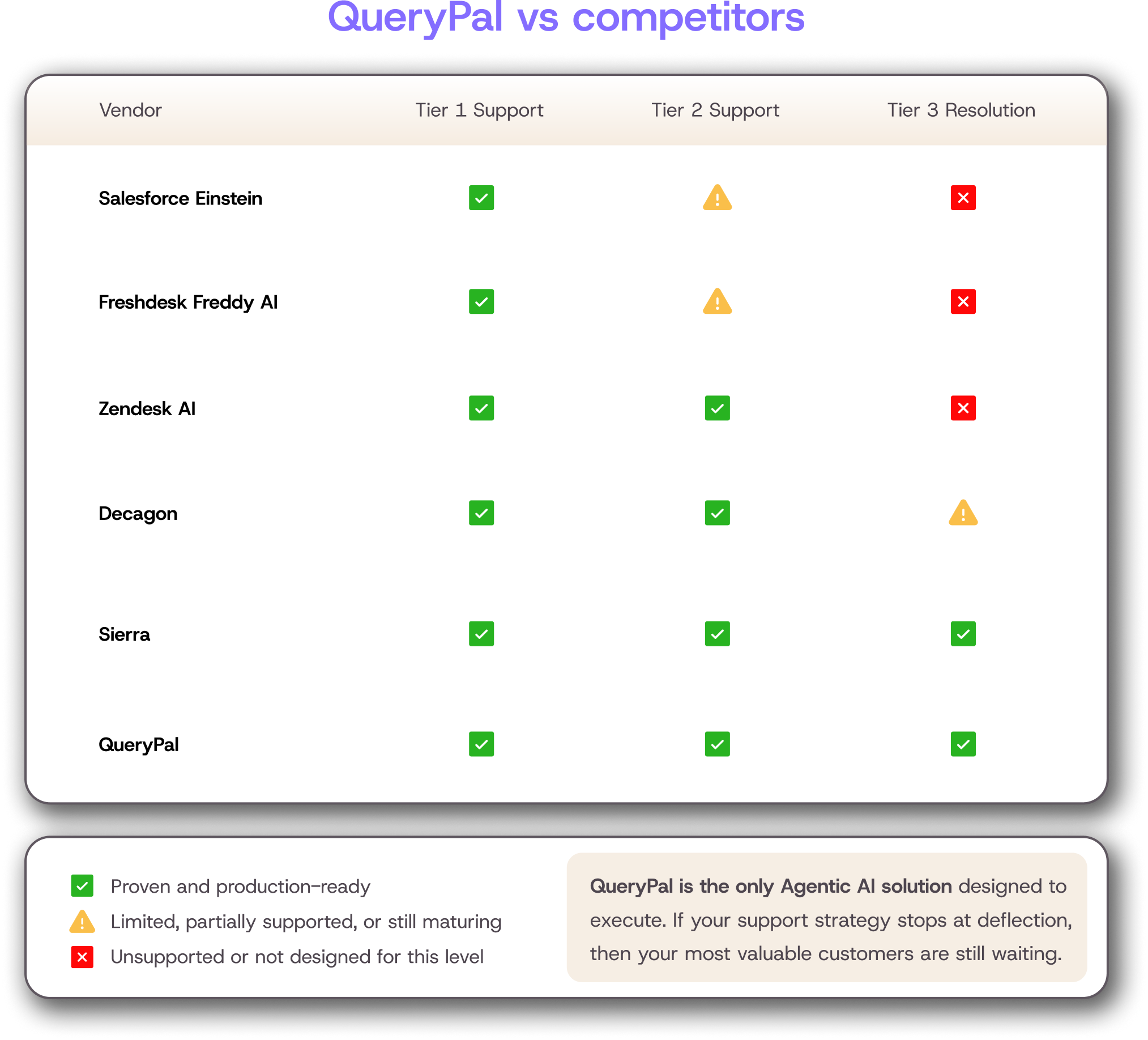
QueryPal is an agentic AI customer support platform founded by Dev Nag, whose prior work includes leading engineering at Wavefront (acquired by VMware) before launching QueryPal. The platform is built for Tier 1 through Tier 3 support automation across SaaS, financial services, and healthcare teams.
QueryPal does not try to replace your help desk. It plugs into the one you already run: Zendesk, Intercom, Salesforce, Front, Gorgias, Help Scout, or Freshdesk.
The platform reads your existing knowledge base and ticket history as the source of truth, then resolves complex tickets inside the helpdesk where your agents already work.
Customers include JetBrains and Simply Benefits, the latter being a healthcare-adjacent SaaS deployment that put QueryPal's compliance posture to a real test.
Where QueryPal Wins
Helpdesk-native architecture is what most buyers notice first. Most AI agent platforms ask you to rebuild your support flow around them. QueryPal runs inside the Zendesk, Intercom, Salesforce, Front, Gorgias, Help Scout, or Freshdesk environment your team already lives in.
No new login, no parallel UI, no migration project.
Accuracy comes from grounding answers in real customer data. QueryPal pulls from the actual knowledge base and historical ticket history, not generic LLM training data, which is the foundation of accurate AI ticket deflection across email and helpdesk channels.
For the JetBrains deployment, that approach produced measurably higher accuracy on technical support tickets than general-purpose chatbots, with the exact metric published in QueryPal's case study materials.
Time to value is fast. Because the platform reads existing data instead of rebuilt workflows, most deployments come online in days rather than weeks.
For teams that need an AI agent live this quarter, that timeline matters more than any feature comparison.
Where QueryPal Falls Short
Brand recognition is the honest answer. Decagon and Fin both have larger marketing budgets and more SERP presence in 2026.
For Fortune 500 procurement teams that filter shortlists by vendor name recognition, QueryPal will sometimes need to be advocated internally before it gets a seat at the table.
Last point. QueryPal is best-fit, not all-fit. It is built for support-heavy SaaS, ecommerce, and regulated-industry teams. Brands running heavily customized in-house helpdesks will need more configuration.
The platform is honest about that. If your stack is exotic, ask in the demo.
Who Should Pick QueryPal
Teams already running Zendesk, Intercom, Salesforce, Front, Gorgias, Help Scout, or Freshdesk who want AI layered on top of the stack rather than instead of it.
SaaS, ecommerce, and regulated-industry CX teams that need accuracy from a real knowledge base, not generic LLM responses.
Companies that want SOC 2 Type II compliance from day one without committing to a six-figure enterprise contract.
Decagon vs. Fin vs. QueryPal: Side-by-Side Comparison
The Decagon AI vs Fin vs QueryPal side-by-side below shows how the three platforms compare on the rows that matter most during vendor evaluation.
Use this AI customer support agent comparison to shortlist quickly, then read the sections below for the math behind each cell. Skim it for fit, then read the sections below for the math behind each cell.
Best for
- Decagon: Enterprise teams with complex multi-step workflows
- Fin (Intercom): Intercom-native teams wanting outcome-based pricing
- QueryPal: Multi-helpdesk SaaS, ecommerce, and regulated CX teams
Pricing model
- Decagon: Custom enterprise, no public rates
- Fin (Intercom): $0.99 per resolution, no seat fees
- QueryPal: Tiered subscription by ticket volume, public pricing
Helpdesks supported
- Decagon: Zendesk, Intercom, Salesforce, custom via API
- Fin (Intercom): Intercom-native; Zendesk, Salesforce, Front secondary
- QueryPal: Zendesk, Intercom, Salesforce, Front, Gorgias, Help Scout, Freshdesk
Implementation time
- Decagon: 4 to 8 weeks, solutions-engineer-led
- Fin (Intercom): 1 to 2 weeks on Intercom
- QueryPal: Days, not weeks
Published resolution data
- Decagon: Customer-specific case studies, no public average
- Fin (Intercom): 67% average (vendor-reported)
- QueryPal: Case-study based (vendor-published)
Compliance
- Decagon: SOC 2 Type II, private instance at enterprise tier
- Fin (Intercom): SOC 2 Type II via Intercom infrastructure
- QueryPal: SOC 2 Type II, tenant-isolated, self-host option
Knowledge base source
- Decagon: Custom-mapped workflows plus customer KB
- Fin (Intercom): Intercom Articles and connected sources
- QueryPal: Existing knowledge base plus ticket history
Customizable workflows
- Decagon: Deep agentic workflows, custom tool calls
- Fin (Intercom): Inbox-scoped flows with limited custom logic
- QueryPal: Helpdesk-native workflows with no parallel UI
Notable customers
- Decagon: Hertz, Eventbrite, Notion, Duolingo, Bilt
- Fin (Intercom): Vanta, Anthropic, Function Health, Synthesia
- QueryPal: JetBrains, Simply Benefits
If you are a mid-market team without dedicated engineering for a custom rollout, the implementation time and pricing model rows are the most decision-relevant.
If you are already on Intercom, the helpdesks supported row resolves the question quickly. If you are a regulated-industry team, the compliance row is where the real comparison lives.
Pricing Compared
Fin vs Decagon pricing is where most CX teams hit their first real fork in the road. Decagon publishes no public pricing, and industry sources put enterprise contracts in the six-figure annual range.
Procurement involves a sales cycle measured in months and contract terms negotiated line by line. That is the scale of dollars being moved in this category, and Decagon sits firmly at the high end of it.
Fin charges $0.99 per resolution with no seat fees. Predictability sells the model. The downside is linear scaling. A team handling 5,000 tickets per month at a 67% resolution rate pays roughly $3,300.
A team handling 50,000 tickets at the same rate pays $33,000. Once your ticket volume crosses a certain threshold, flat-rate competitors get cheaper fast.
QueryPal uses a tiered subscription priced by ticket volume. The QueryPal pricing page publishes the tiers, so you can budget without a sales call. There are no per-resolution surprise costs.
For high-volume operations, the predictable monthly fee is often the deciding factor over per-resolution models.
Deployment and Implementation
Decagon deployments run 4 to 8 weeks on average. A solutions engineer scopes the workflows, your team provides documentation and access, and the rollout happens in stages.
That timeline reflects the depth of the platform. If you want a custom multi-step agent that handles edge cases, the time is well spent.
Fin deployments take 1 to 2 weeks for teams already on Intercom. The Inbox is already in place, the Articles are already indexed, and Fin just turns on. For teams integrating from outside Intercom, the timeline stretches based on how much of the Intercom stack you adopt alongside Fin.
QueryPal deployments are typically measured in days. The platform connects to the existing helpdesk and reads the existing knowledge base.
No rebuilt workflows, no parallel UI, no migration. If your team needs an AI agent live before next month's CX review, this is the only option of the three that hits that timeline reliably.
Security and Compliance
All three vendors hold SOC 2 Type II compliance. Verify each vendor's compliance page during procurement, because attestation dates and scopes change.
Decagon offers private-instance deployments at the enterprise tier. That is the most isolated option but also the most expensive.
Fin runs on Intercom's shared infrastructure, which has a strong public security track record but means your data sits in a multi-tenant environment.
QueryPal isolates customer data by tenant and offers self-hosted deployment for teams that need full data residency control.
For regulated industries, GDPR and HIPAA stance matter. QueryPal has documented healthcare and financial-services deployments and has built its security posture for procurement teams who need both.
Verify Decagon and Fin's published HIPAA stance directly with each vendor before contract.
Integrations and Ecosystem Fit
Decagon integrates with Zendesk, Intercom, and Salesforce natively, plus custom systems via API. The strongest fit is mid-market and enterprise stacks with engineering teams that can support deeper custom integrations.
Fin integrates natively with Intercom. Integrations with Zendesk, Salesforce, and Front exist, but they are not the primary path Intercom invests in. Teams not on Intercom should weigh the cost of either migrating to Intercom or accepting a less-native Fin experience.
QueryPal integrates natively with Zendesk, Intercom, Salesforce, Front, Gorgias, Help Scout, and Freshdesk, operating as a Zendesk AI agent, Intercom AI agent, or Salesforce AI agent depending on the team's stack.
That is the widest helpdesk coverage of the three, which matters for SaaS and ecommerce teams who have already made their helpdesk choice and are not planning to change it.
Resolution Rate vs. Deflection Rate: How to Read Vendor Claims
AI agent resolution rate is the most-cited metric in this category, and resolution and deflection sound similar. They mean different things, and AI vendors mix them on purpose because higher numbers sell better.
Resolution is a ticket closed without human handoff where the customer's issue was solved. Deflection is a ticket prevented from reaching the support queue at all, often through self-service content.
A ticket where the customer gave up and walked away counts as deflection. It does not count as resolution. Vendors that safely deflect complex support tickets distinguish between true case closure and walked-away conversations.
Fin publishes a 67% average resolution rate. The definition Intercom uses is "closed within 24 hours without escalation." That is an operational metric, useful for benchmarking workload reduction.
It is not a CSAT-validated outcome. Some percentage of those resolved tickets will reopen, and some percentage of customers will be unsatisfied even if the ticket technically closed.
Industry research from Zendesk's CX Trends 2026 report and Salesforce's State of Service consistently flags the gap between vendor-reported resolution and customer-validated outcomes as a major source of misaligned AI expectations.
That misalignment is the wedge QueryPal built its product around. The platform is designed to resolve tickets against the team's existing knowledge base and ticket history rather than count any conversation closed within 24 hours, so the resolution number a buyer sees in pilot reporting lines up more closely with the CSAT score behind it.
Three questions to ask in every demo:
- What is your resolution definition?
- What CSAT do "resolved" tickets actually hold?
- What percentage of "resolved" tickets reopen within seven days?
Those three cut through the marketing math faster than any feature checklist.
How to Choose Between Decagon, Fin, and QueryPal
Picking the best AI agent for customer service comes down to three questions.
- What helpdesk are we already on? If the answer is Intercom and you are not migrating, Fin is the natural first trial. If the answer is anything else, the conversation gets more open, and QueryPal's native coverage of seven helpdesks moves it to the top of the list. Decagon is a fit for any of the three platforms Decagon supports, but only if you also clear the other two questions.
- How predictable is our ticket volume? Stable mid-volume teams (1,000 to 10,000 tickets per month) can run the math on per-resolution pricing and often find Fin cheapest. High-volume teams (50,000+) usually find flat-rate models like QueryPal's tiered subscription cheaper at scale. Variable-volume teams should price both models against six months of historical ticket data before committing.
- Do we have engineering bandwidth and a 4 to 8 week runway? If yes, Decagon's depth pays off. If no, the choice narrows to Fin and QueryPal, and from there the helpdesk question above resolves it.
If you are still uncertain after running those three filters, the 15 Decagon alternatives roundup walks through edge-case scenarios like multilingual support, voice channels, and bespoke compliance requirements that some teams need to factor in.
Find the Right AI Customer Support Agent for 2026
The Decagon vs. Fin vs. QueryPal decision comes down to stack, volume, timeline, and compliance posture. No single tool wins for every team. That is the honest answer, and any comparison piece that gives you a different one is selling something.
Decagon is built for enterprise teams who can commit to a 4 to 8 week implementation and a six-figure budget for deep agentic workflows. Fin is built for Intercom-native teams who want outcome-based pricing and a one-click rollout. QueryPal is built for teams already running any of the major helpdesks who want SOC 2 Type II security, knowledge-base-grounded answers, and a launch measured in days.
If your stack lands in QueryPal's coverage zone, the next step is a 30-minute demo run against your real helpdesk and your real knowledge base.
You see how the platform handles your actual ticket history, not a sales script, and you walk out with the resolution math you need to brief your VP of CX and your CFO. SOC 2 Type II compliance from day one.
Deployment measured in days. No per-resolution surprise bills at month-end. Book a QueryPal demo before you sign a 4 to 8 week Decagon rollout or a usage-based Fin contract that scales linearly with every ticket your team handles.
References
Brynjolfsson, Erik, Danielle Li, and Lindsey R. Raymond. "Generative AI at Work." National Bureau of Economic Research Working Paper 31161, April 2023, www.nber.org/papers/w31161.

Activate your free
6 week trial
& white-glove integration support.
Cut support costs by 60%, slash response & resolution times, improve your customer experiences, & reduce agent burnout. Find some time with us to show you how.