The Top 9 Customer Service Trends to Stay Ahead of in 2026
Customer expectations aren't slowing down. They've accelerated every year since 2020, and 2026 is no different.
A recent Gartner survey found that 91% of customer service leaders feel pressure to implement AI this year alone. But AI adoption is just one piece of a much bigger shift.
The trends reshaping customer service go beyond new technology. They touch how teams are structured, how agents are supported, how data gets used, and how companies treat service as a business function rather than a cost line.
Here are the nine trends that matter most right now, along with what your team can actually do about each one.
1. Agentic AI Moves Past the Hype
Two years ago, every vendor slapped "AI-powered" onto their product page and called it innovation. Most of those tools were glorified search bars with a chatbot skin. That era is ending.
The conversation has shifted toward agentic AI, systems that don't just suggest answers but actually resolve issues autonomously. These platforms process multi-step workflows and pull context from past tickets to handle the kind of complexity that simple chatbots can't touch.
Gartner predicts agentic AI will resolve 80% of common customer service issues without human intervention by 2029.
What does that look like in practice? A customer emails about a billing discrepancy that involves two subscription tiers, a promo code, and a mid-cycle upgrade.
An agentic system can trace the full history, calculate the correct amount, draft a resolution, and apply the credit.
A traditional chatbot would route that ticket to a human queue and add 24 hours to the resolution time.
The gap between "AI-assisted" and "AI-resolved" is where most companies are stuck right now.
If your AI strategy is still built around deflection metrics, you're measuring the wrong thing.
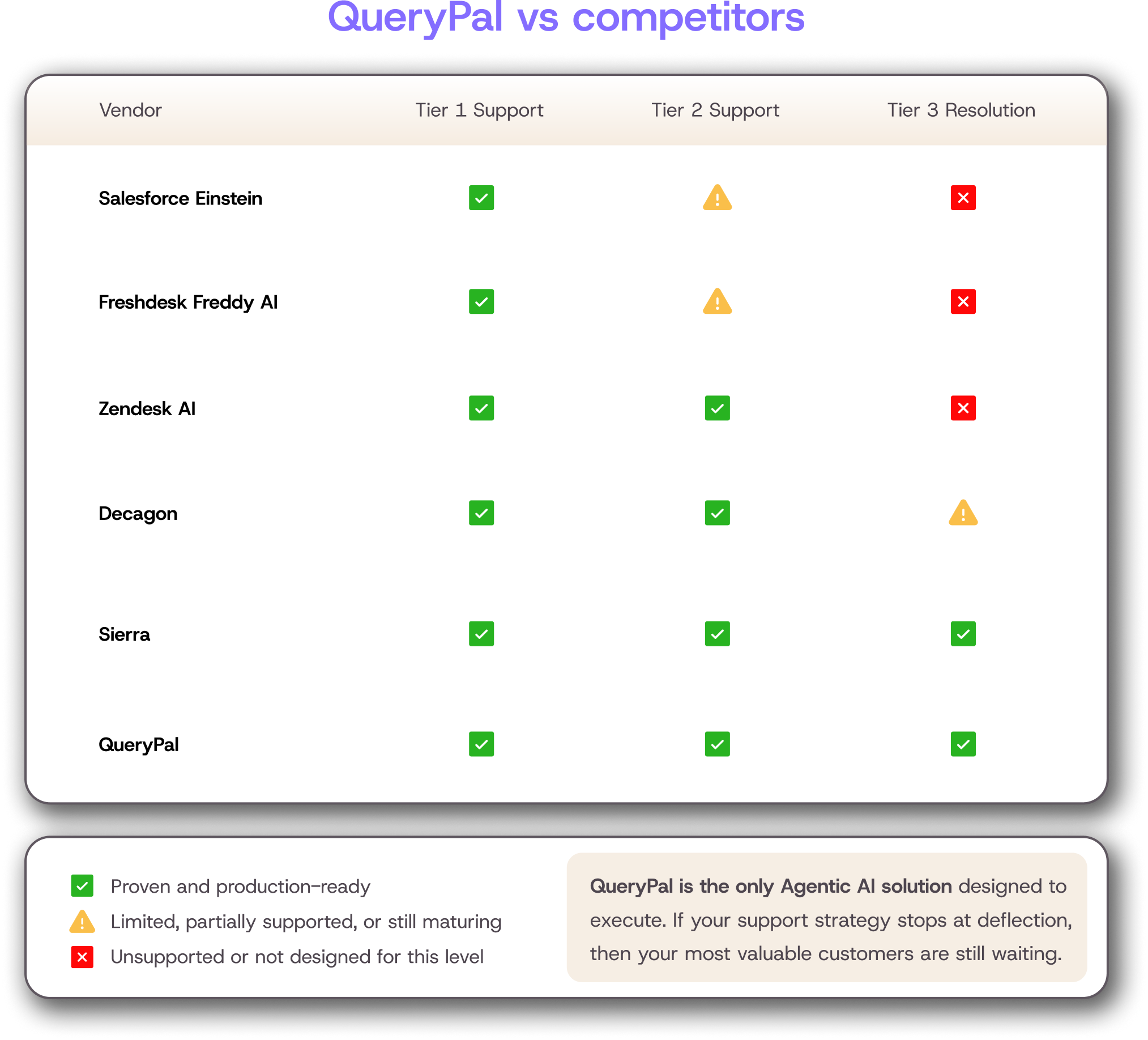
The teams pulling ahead this year are focused on resolution, and they're investing in AI that can actually deliver it. QueryPal is one example of this resolution-first approach.
The platform pulls context from a company's past tickets, internal documentation, and existing workflows to close out multi-step issues on the first touch, rather than routing them to a human queue.
2. Human-AI Collaboration Replaces the Replacement Debate
The argument about whether AI will take support jobs is settled. AI won't replace agents. But it will reshape what agents spend their time doing, and that shift is already underway.
Research out of Harvard Business School shows that AI tools helped agents respond to customer inquiries roughly 20% faster, with the biggest gains among less experienced team members.
The pattern is clear. AI handles repetitive, information-heavy work. Agents focus on conversations that require judgment and empathy.
The agent role itself is evolving. A growing number of service leaders now plan to upskill agents into knowledge management specialists rather than cutting headcount.
The agents who thrive won't be the ones memorizing product specs. They'll be the ones who know how to work alongside AI and step in when a situation demands a human touch.
The move for support leaders is straightforward. Invest in training that helps your team work with AI instead of competing against it.
The productivity gains compound over time as agents learn which tasks to hand off and which to handle personally.
3. Self-Service Finally Starts Working
Self-service has been a promise for years. The reality has been disappointing.
A Gartner survey found that only 14% of customer service issues get fully resolved through self-service. Even for issues customers described as "very simple," just 36% were handled without contacting an agent.
That failure rate is changing because the underlying technology has gotten dramatically better. AI-powered knowledge bases now understand context, not just keywords.
They walk customers through multi-step troubleshooting and surface relevant documentation without requiring the customer to guess the exact right search terms.
Self-service and live chat are gaining ground and may surpass traditional channels as the go-to service technologies within the next few years. The companies getting ahead of that timeline aren't building FAQ pages.
They're building intelligent systems that learn from every interaction and improve with each one.
Teams that invest in knowledge infrastructure will see the biggest gains.
When your self-service tools pull from the same knowledge base your agents use, and when AI can reason across that knowledge rather than pattern-match against it, resolution rates climb fast.
4. Proactive Support Replaces Reactive Firefighting
The default mode for most support teams is still reactive. A customer hits a problem, submits a ticket, and waits. That model worked when expectations were lower.
Proactive support flips that sequence. It means identifying and addressing issues before customers realize something is wrong.
System monitoring can trigger outreach before an outage generates tickets. Usage analytics can flag accounts showing early signs of churn risk before a customer ever contacts you.
A SaaS company tracking product usage, for example, can spot when a key user hasn't logged in for two weeks and trigger a check-in from customer success.
That one touchpoint often catches problems that would have otherwise surfaced as a cancellation request 30 days later.The data supports the investment.
Proactive outreach can significantly reduce churn among customers who experienced a problem. Companies investing in proactive approaches tend to see meaningful improvements in retention compared to teams that only respond after complaints arrive.
The barrier for most organizations isn't willingness. It's infrastructure. Proactive support requires unified data and workflows that can act on signals automatically. Without those pieces, "proactive" stays a line item on a roadmap slide.
Building this capability takes time, but the starting point is simple. Pick your highest-volume, most predictable issue category and build one proactive workflow around it.
One automated alert, one early-warning trigger. Then expand from there.
5. Omnichannel Consistency Becomes Table Stakes
Customers expect a consistent experience across chat, email, phone, and social media. That expectation isn't new. What's changed is that companies are finally investing in the backend systems to deliver on it.
The numbers tell the story. Most consumers demand consistency across channels, but few say they actually get it.
That gap is closing, slowly, as more teams invest in unified customer profiles and shared conversation histories. Routing systems that transfer context along with the customer, so nobody has to repeat themselves, are becoming standard rather than aspirational.
The technical challenge is real. Most support stacks have been bolted together over years, with different tools for different channels and no shared data layer connecting them. Fixing that requires deliberate investment in integration, but the payoff is immediate.
Agents stop wasting time reconstructing context. Customers stop repeating themselves. Satisfaction scores go up.
One common mistake is trying to cover every channel at once. Being on six channels with inconsistent quality is worse than being on two channels with excellent quality.
The goal this year isn't channel count. It's quality and continuity across whichever channels you support.
6. Personalization Scales Beyond "Hi [First Name]"
Real personalization goes far beyond dropping a customer's name into a greeting template. It means using ticket history and product usage data to tailor every touchpoint in a meaningful way.
McKinsey's research found that effective personalization drives a 10 to 15% revenue lift, with top performers seeing gains as high as 25%. And most customers now expect personalized support. Frustration climbs fast when they don't get it.
In customer service, this looks like:
- An agent who already knows the customer's issue history before the conversation starts
- Recommended solutions based on the customer's specific product configuration
- Follow-up communications that reference the actual problem instead of a generic satisfaction survey
Personalization requires careful balance. Using someone's past tickets to give them faster service feels great, but referencing their browsing behavior in a support chat feels uncomfortable.
Personalize based on information the customer knowingly shared with your support team, not data scraped from other touchpoints.
The companies doing this well have unified data across their support stack. When systems talk to each other, personalization happens naturally.
When they don't, agents spend the first two minutes of every interaction asking customers to repeat information they've already provided four times.
7. Agent Experience Becomes a C-Suite Priority
Contact centers face annual turnover rates between 30% and 45%, according to industry estimates. Replacing a single agent can cost between $10,000 and $20,000 in hiring and training alone, before counting the productivity ramp-up. And burnout risk across the industry remains high.
Run those numbers across a 100-agent team losing 35 people per year. That's up to $700,000 in replacement costs, before counting the quality dip that comes with a constant stream of new hires still learning the product.
Those figures are getting executive attention because the math is brutal. Better tools solve this faster than any team-building workshop.
When agents spend less time hunting for answers across disconnected systems and more time actually helping customers, satisfaction rises and turnover drops.
This is the problem QueryPal was built to solve. It surfaces accurate answers for agents in seconds, pulled from existing documentation and past tickets. Less time hunting for information, more time on the conversations that genuinely need a human.
Career development matters too. The best support organizations are creating progression tracks that move experienced agents into knowledge management or AI training roles. That gives people a reason to stay beyond the next burnout cycle.
Companies that treat agent experience as a strategic priority will have a real advantage in 2026. The ones who keep treating their frontline teams as interchangeable will keep paying the turnover tax.
8. Support Data Becomes a Strategic Asset
Most support teams track CSAT and average handle time. Some track first-contact resolution. Very few are using their support data to its full potential.
Customer support generates more unfiltered customer feedback than any other function in most organizations. Every ticket, every chat log, every escalation, every phone call contains signals about product issues, feature gaps, competitive pressure, and user behavior.
The teams turning this data into strategic insight gain an advantage that extends far beyond support itself.
Consider a simple example.
If your team sees a 40% spike in tickets related to a specific integration over two weeks, that's a product quality signal, not just a support workload issue.
Surfacing that pattern to the product team can prevent hundreds of future tickets and the customer frustration that comes with them.
The shift this year is from backward-looking reporting to forward-looking analytics.
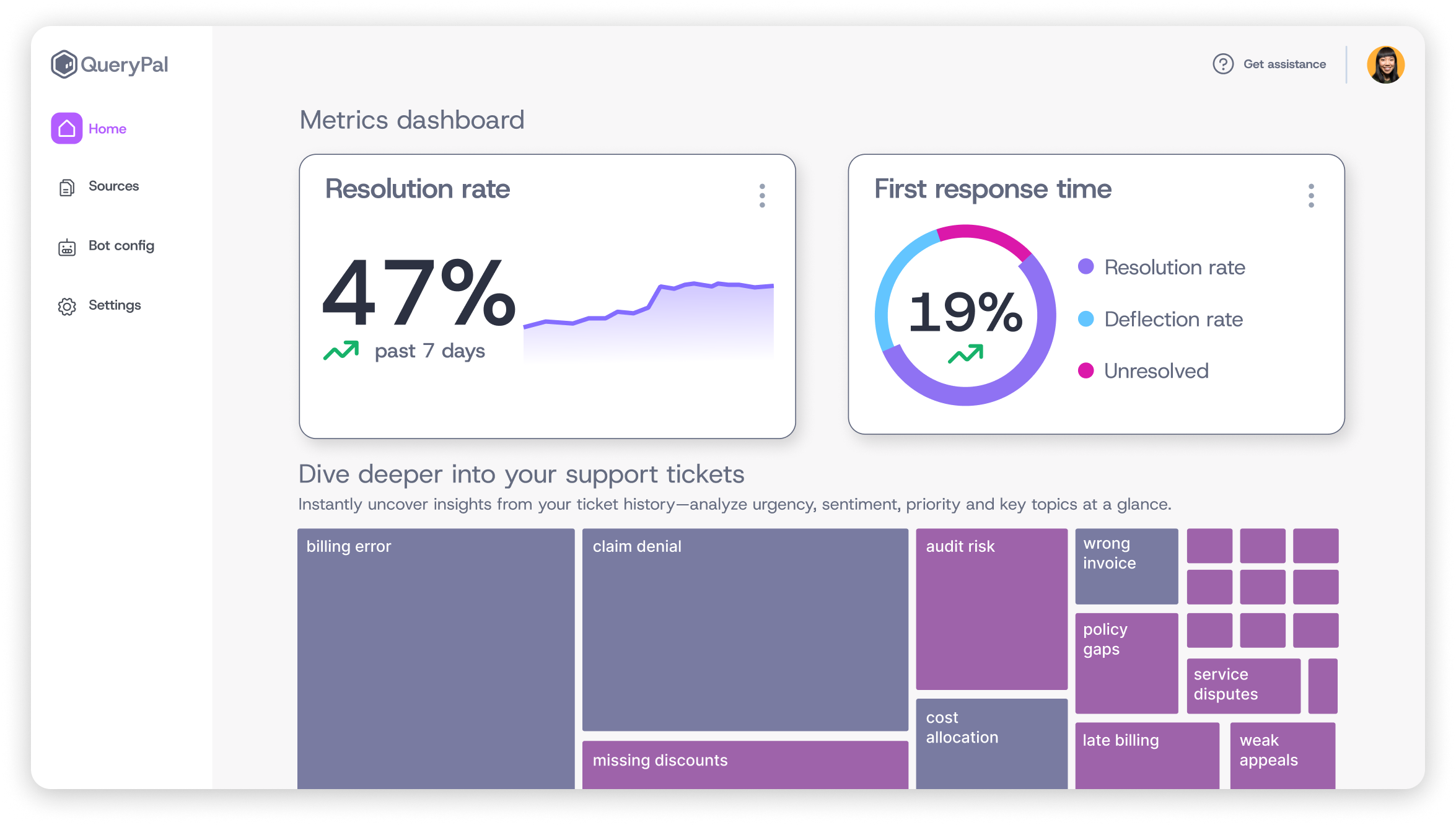
Sentiment analysis catches rising frustration with a specific feature before it triggers cancellations.
Trend identification spots recurring integration failures across hundreds of tickets, giving product teams a clear, prioritized list of what to fix next.
Support leaders who position their teams as a strategic data source are the ones securing bigger budgets and earning seats at leadership meetings.
The ones still reporting only on handle times are leaving real value on the table.
9. Real-Time Resolution Speed Becomes the Baseline
Speed expectations keep compressing. Customer service statistics and help desk statistics confirm that customers who once tolerated 24-hour email responses now expect answers in minutes through live chat. And the bar keeps moving.
But raw speed alone won't cut it. A fast response that's wrong does more damage than a slightly slower one that's right.
The metric that matters in 2026 is resolution speed, meaning how quickly the customer's actual problem gets solved, not just how quickly someone acknowledges the ticket.
The technology enabling faster resolution combines AI-assisted response suggestions with unified agent workspaces.
When the right information gets surfaced automatically during a conversation, agents can resolve issues in a single interaction instead of bouncing between disconnected systems and putting the customer on hold.
The biggest gains here come from knowledge management. When an agent can type a few words about the customer's issue and instantly see the most relevant solution from your knowledge base, pulled from past tickets and documentation, resolution time drops significantly.
It's the difference between an agent who needs five minutes to find an answer and one who has it in five seconds.
That's better for the customer and better for the bottom-line metrics leadership watches.
Building Your Customer Service Strategy for 2026
These nine trends share a common thread. They all point toward support teams that are smarter and more connected to the rest of the business.
AI is amplifying what good agents already do. And agent experience has gone from a back-office concern to a boardroom priority.
The companies winning at customer service this year aren't chasing every shiny tool. They're investing in the right infrastructure and giving their teams what they need to do great work.
Start by auditing where your team stands on each of these trends. Identify the two where the gap between your current state and where you need to be is widest.
Build a focused plan to close those gaps, starting with the ones that directly impact customer satisfaction and agent productivity.
If your support stack is still built around ticket deflection and manual workflows, it's time for an upgrade. QueryPal helps support teams resolve complex, multi-step issues instead of just routing them to a human queue.
It works with the helpdesks most teams already run on (Zendesk, Intercom, Freshdesk, Salesforce, ServiceNow) and uses your existing documentation and past tickets so customers get accurate answers without the wait.
See how it works at querypal.com.

Activate your free
6 week trial
& white-glove integration support.
Cut support costs by 60%, slash response & resolution times, improve your customer experiences, & reduce agent burnout. Find some time with us to show you how.